

If your business is behind on payroll taxes, the first few weeks matter a great deal. Penalties and interest start building soon after a deposit is missed, and IRS notices can arrive sooner than many owners expect. Waiting for cash flow to recover often turns a manageable balance into a case that a revenue officer has to handle.
If you are asking what to do if you are behind on payroll taxes, this guide walks through the steps in the order they usually matter. You will learn how payroll taxes differ from other business debt, how to catch up on late 941 deposits, how penalties are calculated, and what the trust fund recovery penalty means for owners.
|
Key Takeaways
|
Why Falling Behind on Payroll Taxes Is Different From Other Tax Debt
Most tax debt comes from income you report and then pay on your own schedule. Payroll taxes work differently. Your business withholds part of each paycheck and passes it to the government on a fixed schedule. A business that is behind on payroll taxes is holding money that does not belong to it, which is why the IRS responds faster than it does to an individual balance.
What Counts as Payroll Taxes and Trust Fund Taxes?
Payroll taxes combine amounts withheld from employees with the employer’s own share. The IRS calls the withheld portion trust fund taxes. The main pieces include:
- Federal income tax withheld from each employee’s wages
- The employee’s share of Social Security and Medicare taxes
- The employer’s matching share of Social Security and Medicare taxes
- Federal unemployment tax (FUTA), which follows its own deposit rules
Separating the trust fund portion from the employer share in your records shows you where your real risk sits. It also helps you decide which bills to address first.
Why Late Deposits Create Penalties and Interest Quickly
Late payroll tax deposits begin to cost money the day after the due date. The failure-to-deposit penalty rises the longer a deposit stays late, and interest keeps building on the unpaid amount until it is paid. A deposit that is only a few days late is far easier to fix than one that has been outstanding for months, so speed matters.
What Happens If a Business Doesn’t Pay Payroll Taxes?
When a business misses a deposit, the IRS usually starts with notices rather than seizing assets. That gap gives you time to respond. If the balance is still open, support for unpaid payroll tax liabilities from a tax professional can help you choose a response before collection begins.
IRS Notices and Requests for Payment
Early notices ask for the balance and explain any penalties added to it. Notice codes such as CP220 and CP504J show how far along your case is. The notices generally become more urgent in this order:
- Balance due notices that request payment and list penalties
- Notices for immediate payment, which signal that collection may move faster
- Final notices before levy, which give a short window to respond
Respond by each deadline, even if you cannot pay the full amount. A written response that explains your plan keeps the case moving in a workable direction.
When a Revenue Officer May Be Assigned
A revenue officer is an IRS field collection employee who handles unresolved accounts. A case may be routed to one when a business does not qualify for a simple payment arrangement.
- IRS guidance tells businesses that do not qualify to prepare Form 433-B and contact the IRS right away.
- An assigned revenue officer often requests detailed financial records and sets their own timeline.
How Liens, Levies, and Collection Actions May Follow
If the balance stays unpaid, collection actions can follow.
- The IRS may file a federal tax lien.
- The IRS may levy a bank account, which can disrupt daily operations quickly.
- Before a levy, the IRS generally sends a final notice, such as Letter 1058, which gives 30 days to respond.
- A hearing request on Form 12153 must be filed within that 30-day window.
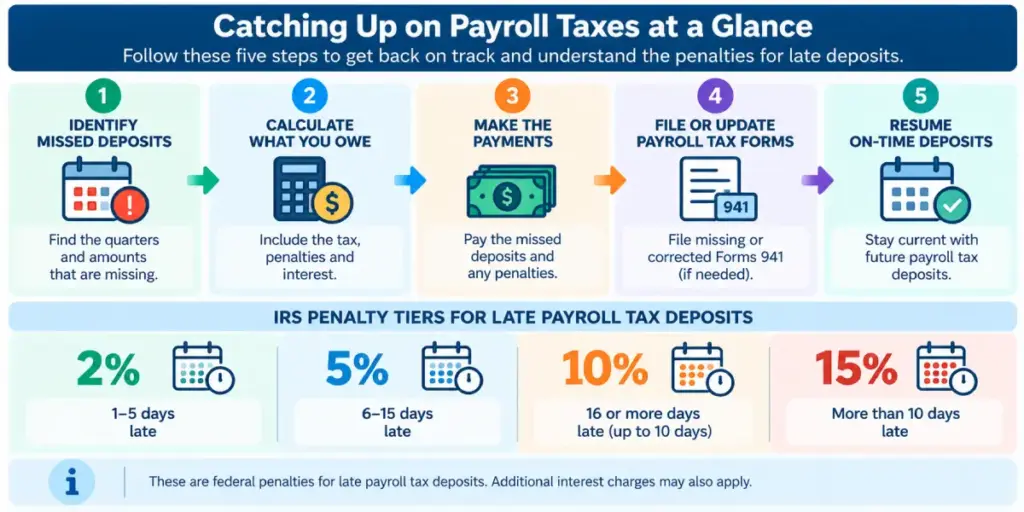
How to Catch Up on Late Form 941 Deposits
Form 941, Employer’s Quarterly Federal Tax Return, reports wages, tips, and payroll taxes withheld each quarter. Learning how to catch up on late 941 deposits means fixing deposits and returns together. Many owners start with missing filings because the return tells the IRS what you reported and owed. If several quarters are missing, assistance with missing Form 941 returns can help you put them in the right order.
Steps 1 and 2: Find Missed Deposits and Missing Returns
Start by listing every quarter since the problem began. Late payroll tax deposits often hide in bank records, so compare your payroll software reports with your bank statements. For each quarter, note:
- The deposit date and amount for each payroll cycle
- The date each Form 941 was filed, if it was filed at all
- Any IRS notice received for that quarter
File missing returns early. Filing stops the larger failure-to-file penalty from building, so a late return usually costs less the sooner it is submitted.
Steps 3 to 5: Reconcile, Calculate, and Resume Deposits
Next, compare your records with your IRS account transcripts, which show the balances the IRS has posted. Then calculate what is owed for each quarter and restart current deposits. Most employers deposit monthly or semiweekly, and the schedule depends on the tax liability reported during the lookback period. The table below shows a sample tracking sheet.
| Quarter | Deposit Status | Form 941 Status |
| Quarter 1 | Paid 6 days late | Filed on time |
| Quarter 2 | Not paid | Not filed |
| Quarter 3 | Paid on time | Filed two months late |
How to Calculate and Understand Payroll Tax Penalties
Penalties are where a manageable balance starts to grow. Several types can apply at once. Knowing how each one is calculated helps you decide whether help with late payroll tax deposits is worth pursuing before the rates climb.
Failure-to-Deposit Penalties
The failure-to-deposit penalty uses calendar days late, counted from the due date. The tiers do not stack. If a deposit is more than 15 days late, the penalty is 10% of the unpaid deposit, not 10% added on top of the earlier 2% and 5% amounts.
| Days Late | Penalty Rate |
| 1 to 5 calendar days | 2% of the unpaid deposit |
| 6 to 15 calendar days | 5% of the unpaid deposit |
| More than 15 calendar days | 10% of the unpaid deposit |
| More than 10 days after a first notice or a notice for immediate payment | 15% of the unpaid deposit |
The 15% tier is the one most owners want to avoid. Once a notice demands payment, the clock matters, so pay what you can while you work on the rest.
Failure-to-File, Failure-to-Pay, and Interest
The failure-to-file penalty is generally 5% of the unpaid tax for each month or part of a month a required return is late, up to 25%. A separate failure-to-pay penalty can apply to unpaid tax, and interest continues on the balance until it is paid. Filing quickly limits the first penalty, and paying what you can limits the rest.
Read More: Payroll Tax Penalties: How a Tax Resolution Firm Gets Them Reduced or Removed
What Is the Trust Fund Recovery Penalty?
The Trust Fund Recovery Penalty, often called the TFRP, can be assessed personally against people who had authority over payroll decisions. It equals 100% of the unpaid trust fund taxes. Owners of a business behind on payroll taxes should understand that a corporation or LLC does not automatically shield them from it.
Which Owners, Officers, or Employees May Be Responsible
The IRS looks for a responsible person, meaning someone with the duty and authority to collect, account for, and pay over the taxes. Actual control matters more than job title. People often considered responsible include:
- Owners and officers who make payment decisions
- Check signers who decide which bills get paid
- Managers or bookkeepers with authority over payroll funds
How the IRS Evaluates Willfulness
The IRS must show that the person acted willfully. In this context, willfulness generally means an intentional and voluntary decision not to send trust fund taxes to the government.
Using business money to pay rent or vendors while withheld taxes stay unpaid can be treated as evidence of that decision. During an investigation, the IRS may use Form 4180 to learn who had authority over the funds.
What to Know About Letter 1153 and Your Deadline
Before assessing the penalty, the IRS sends Letter 1153, which proposes the penalty and explains your appeal rights. The letter generally gives 60 days from its date to file a written protest, or 75 days if it is addressed outside the United States. Note the date the moment the letter arrives, and ask a tax professional whether a protest should be filed.
What Should You Do Before an IRS Revenue Officer Is Assigned?
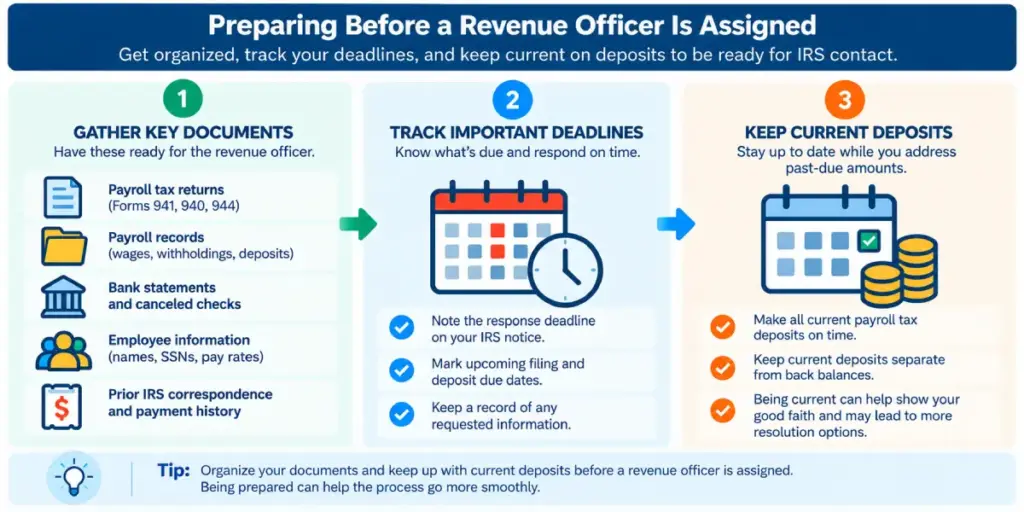
The best window to act is before a revenue officer gets involved. Once a case is assigned, the officer sets the pace and may request records on short notice.
|
A common issue we see is business owners waiting for a letter before pulling their records together. Gathering documents early often shortens the time it takes to answer the IRS. |
Gather Payroll Reports, Filed Returns, and Deposit Records
Put the documents the IRS is most likely to request into one folder, either physical or digital. A complete starting file usually includes:
- Payroll reports for each pay period in the unpaid quarters
- Copies of filed Forms 941 and payroll data for any unfiled quarters
- Deposit confirmations and business bank statements for the same period
- Current IRS account transcripts for each period
Respond to Notices and Track Deadlines
Every IRS notice has a response date, and missing it can make a manageable problem harder to resolve. Keep a simple list with the notice type, the date received, and the deadline. The notice that threatens levy is the one to answer first.
Build a Cash Flow Plan and Avoid Overpromising
Current deposits come first. Setting aside withheld amounts each pay period keeps new balances from building while you work on old ones. Also avoid promising a payment date your cash flow cannot support, since a missed promise can damage trust with the revenue officer.
What Are Your Options for Resolving Back Payroll Taxes?
Owners who are behind on payroll taxes often ask how to resolve back payroll taxes without closing the business. The right path depends on the amount owed, your compliance record, and the cash you can reliably set aside each month.
In-Business Trust Fund Express Installment Agreements
An In-Business Trust Fund Express Agreement is an IRS payment plan for active businesses with trust fund tax debt. IRS guidance says the business generally must owe $25,000 or less when the agreement is set up, and the balance must be paid within 24 months or before the collection statute expires, whichever is earlier. Key requirements include:
- A balance of $25,000 or less, which can be reached by paying down the debt first
- A direct debit installment agreement when the balance is between $10,000 and $25,000
- Full compliance with all filing and payment requirements
This program generally does not require a detailed financial statement. IRS terms can change, so confirm current thresholds before you apply.
Penalty Relief When the Facts Support It
Penalties are not always final. The IRS may remove or reduce a penalty when the failure was caused by circumstances outside the business’s control. Relief depends on documentation, so a dated record of events is the first step.
When an Offer in Compromise May Be Worth Exploring
An offer in compromise lets certain taxpayers settle tax debt for less than the full amount owed. It is generally considered when the IRS is unlikely to collect the full balance, or when full payment would create serious hardship. Applications require complete financial statements and current compliance, so a careful review comes first.
Read More: Payroll Tax vs. Income Tax Debt: Why Business Owners Need a Different Resolution Strategy
Common Mistakes When You Are Behind on Payroll Taxes
Most delays come from a few predictable errors. Avoiding them keeps your catch-up plan moving:
- Ignoring notices or leaving returns unfiled: Unanswered notices and missing returns add penalties and make the file harder to resolve.
- Using withheld taxes for other bills: Money withheld from employees is trust fund money, and spending it raises personal risk.
- Catching up on old debt while current deposits are missed: New penalties can outpace progress on the old balance.
- Assuming an LLC or corporation prevents personal liability: The trust fund recovery penalty can still reach responsible people.
How Salinger Tax Consultants Can Help With Payroll Tax Issues
If you are behind on payroll taxes, professional help with IRS payroll tax issues can give your situation structure. Our team at Salinger Tax Consultants typically helps with the following:
- Eligibility review: We review balances, deposit history, and filing status to identify which resolution paths may fit.
- Filing and records: We help organize payroll records and prepare missing Forms 941 when needed.
- Catch-up planning: We map out how to bring deposits and returns current, then keep them on schedule.
- Penalty review: We look for grounds for penalty relief and prepare requests when the facts support them.
- Revenue officer preparation: We help you respond to notices, prepare financial statements, and get ready for IRS questions.
- Negotiation and appeals: We communicate with the IRS, prepare Letter 1153 protests when appropriate, and pursue payment arrangements.
Regain Control of Payroll Tax Debt
If your business is behind on payroll taxes, start by gathering the facts. List missed deposits and unfiled returns, read every IRS notice, and bring current deposits back on schedule. Acting early usually leaves more room to choose a workable plan than waiting for a revenue officer to get involved.
Salinger Tax Consultants can help you understand your balance, the penalties involved, and the options that may fit your situation, including payroll tax help tailored to your business.
Schedule a consultation to review your payroll tax situation and plan your next steps.
FAQs
Start by listing missed deposits, missing Form 941 returns, and every IRS notice you have received. Then bring current deposits back on schedule. A tax professional can review the balance and explain your options before the IRS takes further action.
File the missing returns first, reconcile your records with IRS transcripts, and then calculate the balance for each quarter. Learning how to catch up on late 941 deposits in that order helps you avoid new errors while you address old ones.
The IRS usually starts with notices, then moves toward liens or levies if the balance stays unpaid. Penalties and interest keep building during that time. Responsible people may also face the trust fund recovery penalty, so responding early gives you more options.
Yes. A revenue officer may be assigned when a payroll tax balance remains unresolved, and no payment arrangement is in place. Officers often request detailed financial statements, so preparing records before assignment helps the process move more smoothly.
The failure-to-deposit penalty is 2% for deposits 1 to 5 days late, 5% for 6 to 15 days late, and 10% for more than 15 days late. A 15% rate can apply after a notice demanding payment. Late payroll tax deposits also accrue interest, and late returns can add a separate failure-to-file penalty.
Yes, in some cases. The trust fund recovery penalty can be assessed against a responsible person who willfully fails to pay withheld taxes. An LLC or corporation does not automatically prevent that exposure, and each case depends on its facts.
In many cases, yes. Active businesses may qualify for an in-business trust fund express agreement when the balance is $25,000 or less. Other arrangements may be available depending on the amount owed, and any approved plan requires that new deposits and returns stay current.

