

You opened an IRS notice and found a balance for your business. Before you choose a response, understand which kind of tax you owe. A balance tied to employee paychecks follows different rules than one tied to business profit, and that difference shapes your options.
The payroll tax vs. income tax confusion affects how quickly the IRS acts, who is responsible, and which relief programs apply. Payroll taxes involve money withheld from employees. Income taxes depend on what the business or its owners earned.
This guide compares the two debts and explains how each one builds and how the IRS collects it.
|
Key Takeaways
|
Payroll Tax vs. Income Tax: What Is the Difference?
Both taxes come out of a paycheck, so they tend to blur together. They serve different purposes and reach different people when they go unpaid.
Sorting out the payroll tax vs. income tax difference first keeps you from applying an income tax fix to a payroll problem. Here is how each one works, starting with payroll tax.
What Is Payroll Tax?
Payroll tax covers the taxes tied to paying employees. In a payroll vs. income tax comparison, the Social Security and Medicare piece sets payroll tax apart, since it funds those two programs. For 2026, according to IRS Publication 15, payroll tax includes:
- Social Security tax: 6.2% each for the employer and the employee on wages up to $184,500
- Medicare tax: 1.45% each, with no wage cap
- Federal income tax withholding: taken by the employer from employee wages
- Unemployment taxes: which the employer may also owe
What Is Income Tax?
Income tax is based on taxable income after deductions and credits, and it funds general government operations. How it is reported depends on the business structure:
- Sole proprietor: reports business profit on a personal Form 1040
- Partnership and S corporation owners: report their share of profit on their own returns
- C corporation: files its own return
In the payroll versus income tax comparison, income tax follows how the business performed, while payroll tax follows the wages it paid, whether or not it made a profit.
Who Is Responsible for Each Tax?
Under the employer payroll tax rules, the business owes its own share of Social Security and Medicare. It must also collect and pay over what it withholds, in most cases reporting on Form 941 each quarter.
Income tax falls on whoever earned the income, whether the pass-through business owner or the corporation. Payroll tax filing services can take deposits and returns off an owner’s plate.
The table below summarizes the differences between payroll tax and income tax.
| Feature | Payroll Tax | Income Tax |
| Based on | Wages paid | Taxable income |
| Who pays | Employer and employees | The taxpayer whose income is taxed |
| Typical return | Form 941 (quarterly for most) | Form 1040 or a business return |
| Personal liability | Possible for responsible people | Generally the taxpayer who owes |
The last row deserves attention, since personal liability changes how the IRS collects and how you should respond.
Payroll Tax vs. Income Tax Debt: How Each One Develops
Neither debt appears overnight. In the payroll tax vs. income tax debt picture, each grows out of specific missed filing or payment steps. Knowing what you missed points to the right fix. Payroll tax debt usually begins with a late or skipped deposit or return. Income tax debt begins when a business or owner can’t pay the balance in full.
How Payroll Tax Debt Develops
Payroll tax debt develops when deposits are late, short, or skipped, or when Form 941 returns are filed late or not at all. Cash flow strain is a common trigger, and the IRS says using available funds to pay other creditors instead of withheld taxes indicates willfulness.
The IRS schedule below shows the penalty tiers.
| Days late | Penalty |
| 1 to 5 calendar days | 2% of the unpaid deposit |
| 6 to 15 calendar days | 5% of the unpaid deposit |
| More than 15 calendar days | 10% of the unpaid deposit |
| More than 10 days after first notice, or on a demand for immediate payment | 15% of the unpaid deposit |
The IRS does not add the tiers together, so a deposit 20 days late carries 10% in total.
How Business Income Tax Debt Develops
Income tax debt develops when a return shows tax due, and the balance is not paid by the deadline, or when estimated payments fall short. A strong year followed by a slow one is a familiar setup, because the bill reflects earlier profit while the cash is gone.
Unfiled returns add a failure-to-file penalty, and interest and penalties keep accruing until you pay the balance.
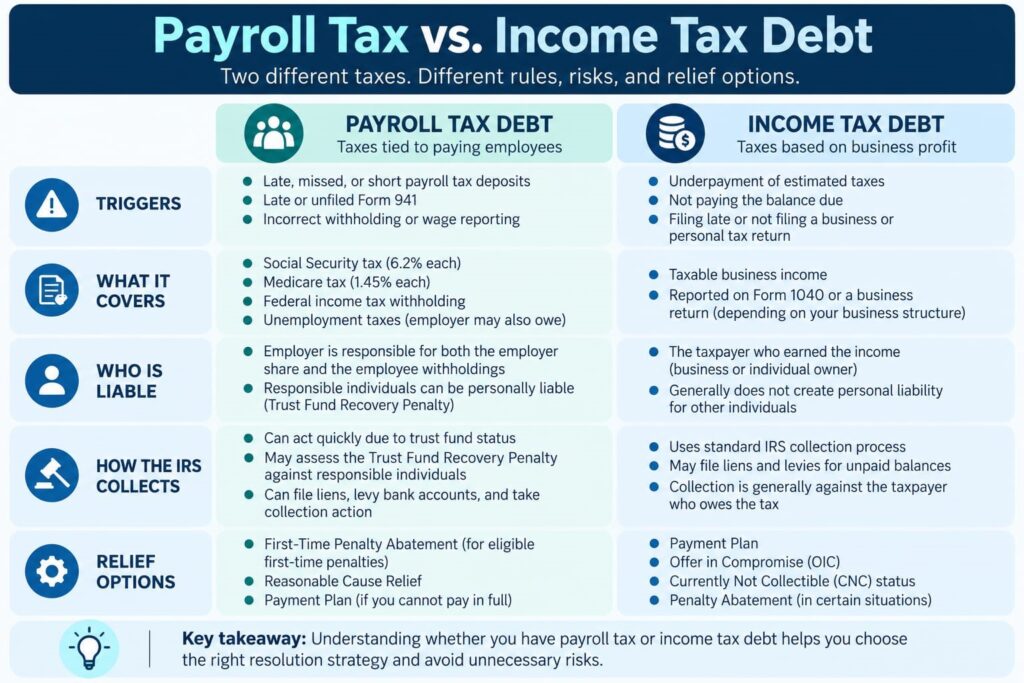
With both paths in view, the next question is which debt the IRS treats as more urgent.
Why Payroll Tax Debt Is More Urgent
Payroll tax debt is more urgent because part of it is money withheld from employees that the business held in trust. That trust fund portion is where personal liability comes from, and it can bring a payroll balance to an owner’s personal assets. Payroll tax vs income tax debt cases often turn on this distinction for employers.
Trust Fund Taxes and Withheld Employee Taxes
Trust fund taxes are the income tax, Social Security tax, and Medicare tax an employer withholds from employee wages. The IRS uses that name because the employer holds the money in trust until it is deposited with the Treasury.
The employer’s matching share is also owed but is not part of the trust fund portion. The IRS may collect the trust fund amount from the business, from responsible individuals, or from both, but only once. Knowing which employer payroll taxes are trust fund taxes helps you judge your exposure.
Trust Fund Recovery Penalty (TFRP) and Owner Liability
The Trust Fund Recovery Penalty equals the unpaid trust fund tax. The IRS can assess it against a responsible person who willfully fails to collect or pay it. This includes owners, officers, and others who control funds.
| A common issue we see is owners assuming an LLC or corporation shields them from trust fund taxes. The TFRP is assessed against individuals, so the business structure does not settle the question. |
Willfulness means knowing about the unpaid taxes and disregarding the law, and no evil intent is required.
|
IRS Reminder The IRS sends a letter proposing the TFRP, and you have 60 days from its date (75 if addressed outside the United States) to appeal. Without a response, the IRS assesses the penalty and sends a Notice and Demand for Payment. |
Get help with payroll tax debt before the appeal window closes. After assessment, the IRS can file a federal tax lien or levy personal assets.
How the IRS Handles Payroll Tax Debt and Income Tax Debt
After a missed deposit or an unpaid return, the IRS follows a collection process that can include notices, liens, and levies. The relief programs look similar for both debts, yet the payroll tax vs. income tax difference shows up in the requirements, especially for employers. This section covers what to expect, starting with payroll debt and moving to income tax debt.
Payroll Tax Notices, Payment Plans, and Penalty Relief
For unpaid employer payroll taxes, the IRS typically begins with notices. It offers Simple Payment Plans for businesses, which you can request by phone.
Penalty relief is a second path, and it recently changed. In July 2026, the IRS announced an Automatic Exemption from Penalty. Here is how it works:
- Who qualifies: taxpayers with a timely filing and payment history over the prior three years (12 quarters for quarterly returns)
- What it covers: failure to file, failure to pay, and failure to deposit penalties, so payroll tax relief may apply without a request
- If you do not qualify: you can still ask for reasonable cause relief
|
Important Penalty relief covers penalties only. You still owe the tax and interest. |
Get help with IRS payroll tax issues if you are unsure whether relief applies, since the IRS is phasing out First Time Abate during this transition.
Income Tax Debt: Installment Agreements, Offers in Compromise, and CNC
Income tax debt follows the same collection process, and the IRS offers three main routes for taxpayers who cannot pay in full right away. The table below compares them.
| Option | What it does | Key requirement or limit |
| Installment agreement | Spreads payments over time | Interest and penalties continue |
| Offer in Compromise | Settles for less than owed | Returns filed and employer deposits current |
| Currently Not Collectible (CNC) | Temporarily delays collection | Debt remains; penalties and interest continue |
A tax resolution specialist can weigh these options against your income, expenses, and assets. An Offer in Compromise generally must at least match your reasonable collection potential, which is the IRS estimate of what it could collect from you. Taxpayers who can pay in full generally will not qualify.
What Happens When a Business Cannot Pay Payroll or Income Taxes?
Falling behind can feel like one problem, yet the first steps depend on which tax is unpaid. Payroll deposits keep coming due while you work on the old balance, so staying current matters as much as fixing the past.
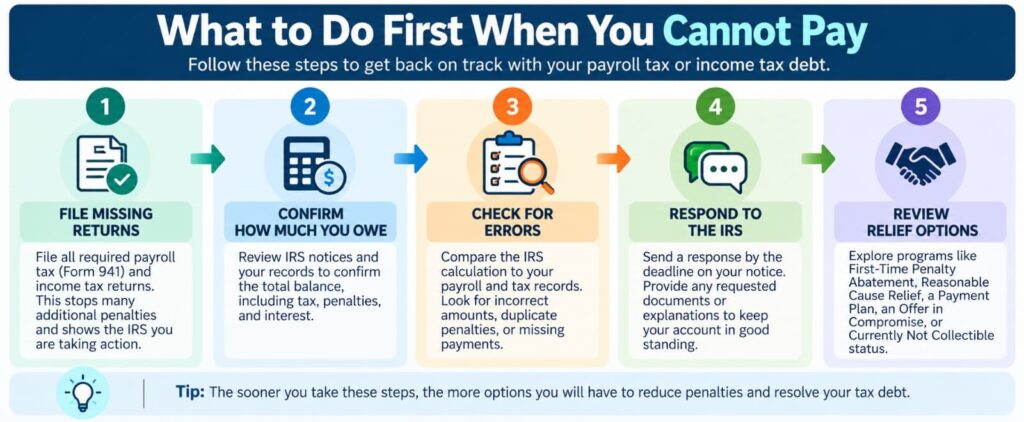
The steps below start with payroll and then cover income tax, so the payroll-versus-income-tax difference stays in view.
If You Cannot Pay Payroll Taxes
Start by filing any missing payroll tax returns, because the IRS expects required returns on file before it will consider most resolution options. Then:
- Pay what you can, since penalties and interest continue on unpaid balances
- Request a payment arrangement through the number on your notice or the business line at 800-829-4933
- Keep making current deposits so the arrangement does not default
Tax resolution services can help match the arrangement to your cash flow.
If You Cannot Pay Income Taxes
Begin by adding up the total liability across all tax years and related entities. Then match the IRS options to your finances:
- Payment plan: fits if you can pay over time
- Offer in Compromise: fits if the balance exceeds your reasonable collection potential
- CNC status: fits if paying would keep you from meeting basic living expenses
Finally, review penalties and interest. Penalties may qualify for relief, while interest generally continues until you pay the balance.
Read More: How to File Overdue Payroll Taxes Without Triggering an IRS Audit (2026)
When a Tax Resolution Specialist Makes the Difference
Because these debts follow different rules, a plan built for one can fail for the other. A payroll balance with trust fund exposure calls for a plan that accounts for the individuals involved.
An income tax balance calls for a plan built around income and assets. A tax resolution specialist determines your situation before recommending a path.
What a Tax Resolution Specialist Does Differently
A tax resolution specialist starts by identifying the type of debt, because that choice steers the rest of the work. The specialist then:
- Reviews IRS account transcripts and notices to confirm balances, tax periods, and penalties
- Assesses personal liability exposure on payroll balances, since the TFRP can reach individuals as well as the business
- Builds a resolution strategy
- Communicates with the IRS on your behalf under a signed power of attorney, such as Form 2848
When to Hire a Tax Resolution Specialist
Speak with a tax resolution specialist if any of these describe your business:
- You have several unpaid tax periods and cannot see the total balance clearly.
- You received an IRS collection notice or a letter proposing the TFRP.
- You may face personal liability for unpaid trust fund taxes.
- You cannot afford the full balance and need to compare your options.
Early review protects your options. The 60-day appeal window on a proposed TFRP runs from the date on the IRS letter, so time can pass before you notice. A specialist can also confirm your returns and deposits are current, which the Offer in Compromise program requires.
How Salinger Tax Consultants Can Help
At Salinger Tax Consultants, our team helps business owners nationwide resolve IRS problems, and we treat payroll tax debts and income tax debts with their respective solutions.
Payroll Tax Filing and Compliance Support
We help you stay current on employer payroll taxes and bring unfiled returns up to date so you can explore resolution options.
Our support includes:
- Preparing payroll tax returns
- Reviewing deposit schedules
- Catching missing filings before they become notices
- Reviewing prior quarters so gaps do not surprise you later
Payroll Tax Debt Resolution
For payroll tax debt, we review your IRS transcripts and notices, then build a plan around your balance and deadlines. Our support includes:
- Evaluating your exposure under the Trust Fund Recovery Penalty
- Pursuing payment arrangements or penalty relief where they fit
- Responding within IRS deadlines, including the appeal window on a proposed TFRP
IRS Tax Resolution and Representation
For income tax debt and other balances, we compare your options against your income, expenses, and assets. As your tax resolution specialist, we handle the IRS so you can focus on running the business.
Conclusion
Payroll tax and income tax debt can both begin with a single unpaid balance, yet they follow different rules. The payroll tax vs. income tax difference affects who owes, how the IRS collects, and whether owners face personal liability. Your next step is to confirm which debt you have and which deadlines apply.
At Salinger Tax Consultants, we review your transcripts and notices, identify the debt type, and build a plan around it. A plan matched to the debt gives your case clearer direction than a general approach. That review often clarifies which options are available and in what order.
Schedule a consultation today with our team to review your options for payroll and income tax debt.
FAQs
Payroll taxes are tied to wages and include Social Security and Medicare. Income tax is based on taxable income. The payroll tax vs. income tax split matters in collection because withheld payroll amounts are trust fund taxes that can create personal liability.
They are separate taxes. In the payroll versus income tax comparison, payroll tax funds Social Security and Medicare and is shared by employer and employee. They overlap in one place: employers withhold federal income tax from wages and deposit it through payroll.
Payroll tax debt is unpaid employment tax, including amounts withheld from employees and the employer's share. The IRS treats it differently because the withheld portion is held in trust, and it can assess the Trust Fund Recovery Penalty to responsible individuals.
They may be. The IRS announced an Automatic Exemption from Penalty for taxpayers with a timely compliance history, and reasonable cause relief remains available for others. Tax and interest stay due, so payroll tax relief depends on your compliance history and case.
Yes. With a signed power of attorney, a qualified professional can communicate with the IRS about either debt. Tax resolution services often begin by separating the two balances, because payroll vs. income tax debt carries different collection rules and liability risks.
Consider hiring one when you have several unpaid periods, an IRS collection notice, a letter proposing the TFRP, or a balance you cannot pay in full. Acting early keeps options open, including the 60-day window to appeal a proposed TFRP.

