
A notice about payroll tax penalties can turn a routine week into a stressful one. Maybe a payroll deposit went out a few days late, or you filed Form 941 after the deadline during a busy quarter. Either way, the balance keeps growing while the notice sits on your desk.
The good news is that payroll tax penalties are not always permanent. The IRS calculates these charges under specific rules and runs programs that can reduce or remove them once a business qualifies.
This guide explains why the IRS assesses payroll tax penalties, how much they typically cost in 2026, and the relief options available to employers.
|
Key Takeaways
|
What Are Payroll Tax Penalties?
Payroll tax penalties are charges the IRS adds when a business fails to file, deposit, or pay employment taxes correctly and on time. They sit on top of the tax already owed.
What Counts as an Employment Tax Penalty?
Employment tax penalties can result from a late Form 941, a missed deposit, an incorrect withheld amount, or inaccurate wage reporting. The IRS treats each return and each deposit as a separate requirement, so a business can face several employment tax penalties in one quarter.
Why the IRS Assesses Payroll Tax Penalties
Payroll taxes fund Social Security, Medicare, and income tax withholding, and employees never see the withheld money directly. Because it is held in trust, the IRS treats late deposits seriously, and these penalties exist to keep employers depositing and filing on schedule.
What Causes Payroll Tax Penalties?
Most payroll tax penalties stem from a handful of common triggers. Knowing what causes them helps you catch a problem before the IRS does.
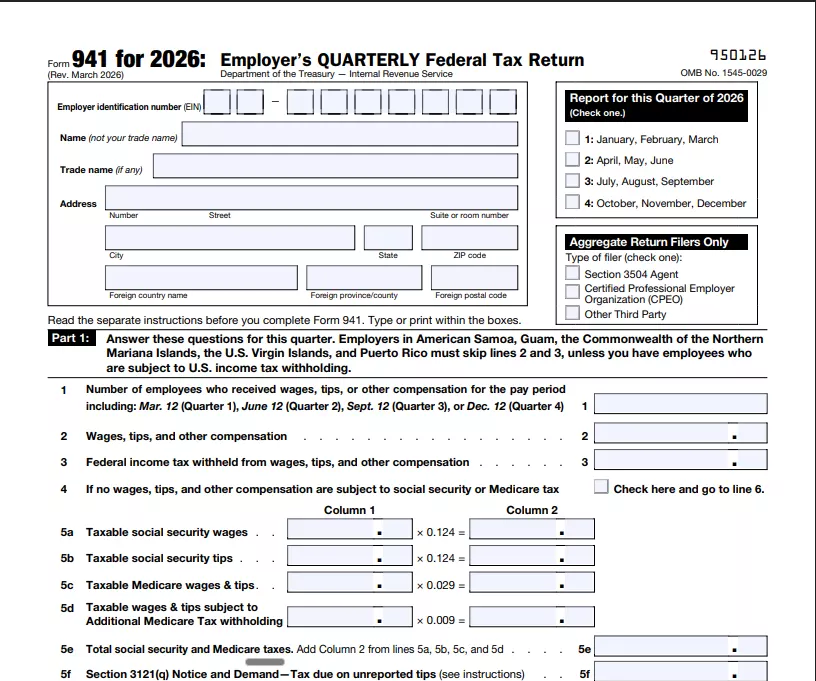
Late Filing of Form 941
Form 941 is due the last day of the month following each quarter. Filing even one day late can trigger a Form 941 late-filing penalty, and the IRS does not need to warn you first.
Late or Incorrect Tax Deposits
Deposits made after the due date, in the wrong amount, or through the wrong method can trigger employment tax penalties, even when the return is filed on time. Your deposit schedule is based on a prior lookback period.
Failure to Pay Payroll Taxes
When you file a return but don’t pay the tax in full, failure-to-pay penalties begin accruing separately from any filing penalty and continue until you resolve the balance.
Incorrect Payroll Tax Reporting
Misclassifying workers, underreporting tips, or miscalculating withholding can all lead to employment tax penalties once the IRS catches the error, sometimes years later through an audit.
How Much Do Payroll Tax Penalties Cost?
The dollar impact of payroll tax penalties depends on which penalty applies and how long the issue goes unresolved. Interest accrues on both the tax and the penalty.
Failure-to-File Penalties
A 941 late filing penalty is calculated as follows:
- 5% of the unpaid tax for each month or partial month the return is late
- Capped at 25% of the unpaid tax
- Separate from any deposit penalty on the same balance
Failure-to-Pay Penalties and Interest
Failure-to-pay penalties and interest work like this:
- 0.5% of the unpaid amount per month, capped at 25%
- Rises to 1% per month after certain IRS notices
- Interest compounds daily on top of both the tax and the penalty, at a rate the IRS resets quarterly
- For the quarter beginning October 1, 2026, that rate is 7% for individuals and 9% for large corporate underpayments
Failure-to-Deposit Penalties
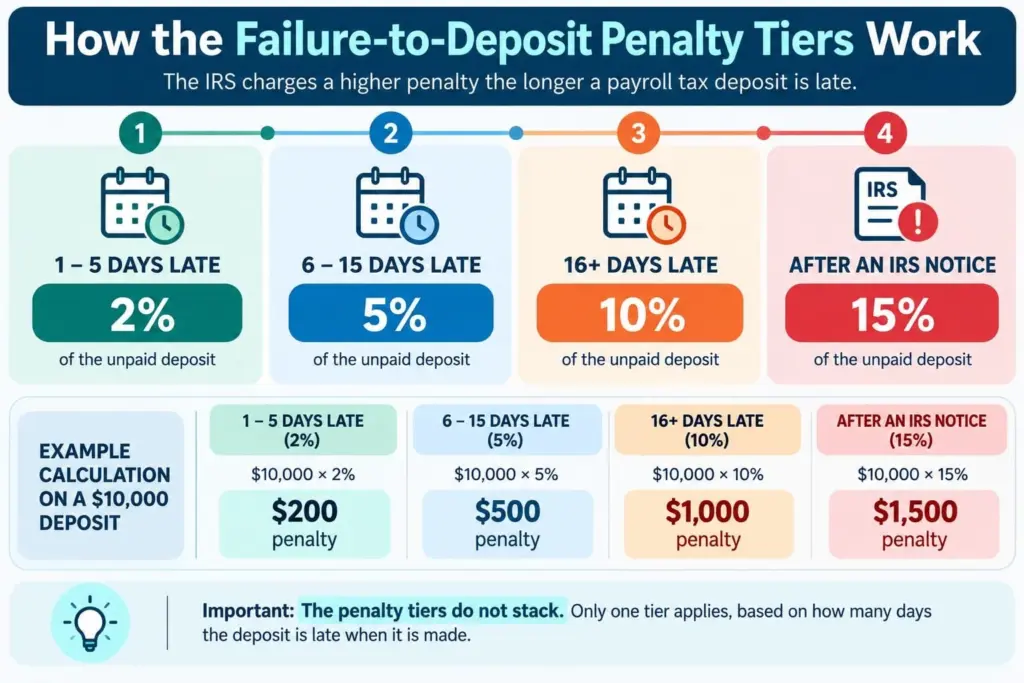
Late-deposit penalties are tiered by how many days the deposit is late:
- 1 to 5 days late: 2%
- 6 to 15 days late: 5%
- More than 15 days late: 10%
- After an IRS notice demanding payment: 15%
- These tiers do not stack; only the highest tier reached applies
The table below summarizes how each penalty is calculated and capped.
|
Penalty |
Rate | Maximum |
| Failure to file (Form 941) | 5% per month or partial month |
25% of unpaid tax |
|
Failure to pay |
0.5% per month (1% after notice) | 25% of unpaid tax |
| Failure to deposit | 2% to 15% by lateness tier |
Set by highest tier reached |
What Is the 941 Late Filing Penalty?
The 941 late filing penalty is one of the most common payroll tax penalties, since Form 941 is due every quarter, four chances a year to miss the deadline.
When Form 941 Penalties Apply
The 941 late filing penalty applies once the quarterly due date passes without a filed and accepted return, even with no tax owed. A zero-liability quarter still generally needs to be filed.
How the IRS Calculates Late Filing Penalties
The IRS calculates the 941 late filing penalty the same way as other failure-to-file penalties: 5% of the unpaid tax for each month or partial month late, up to 25%.
Quick Fact

The IRS does not need to send a warning before assessing a 941 late filing penalty. The clock starts the day after the quarterly due date passes.
Can a Form 941 Penalty Be Removed?
Often, yes. A business with a clean filing history for the prior three years may qualify for penalty relief through First Time Abate, or the newer automatic relief rolling out in 2026.
Can Payroll Tax Penalties Be Reduced or Removed?
Payroll tax penalties are not always the final word. The IRS offers several paths to Resolve payroll tax penalties, and the right one depends on your compliance history.
First Time Penalty Abatement
First-time penalty abatement can remove failure-to-file, failure-to-pay, and failure-to-deposit penalties for a business with three years of clean compliance history.
Reasonable Cause Penalty Relief
When first-time penalty abatement is not available, tax penalty relief may still come through reasonable cause, such as a disaster, serious illness, or the death of someone solely responsible for filing.
Other IRS Penalty Relief Options
A tax relief and resolution agency can also flag options beyond these two paths, including correcting an IRS error or disaster-area relief for specific regions.
Read More: Understanding and Waiving IRS Penalties: A Complete Guide
How First-Time Penalty Abatement Can Help
First-time penalty abatement is often the fastest way to resolve a payroll tax penalty, since it does not require proving hardship. It is worth exploring payroll tax penalty relief every time a notice arrives.
Who May Qualify for First-Time Relief
To qualify for first-time penalty abatement, a business generally needs three years of on-time filing and payment for the same return type, with all required returns filed.
What the IRS Considers Before Granting Relief
Before granting penalty abatement, the IRS checks prior penalties and whether it has already waived the failure-to-deposit penalty several times in the past three years. Starting in 2026, the IRS is also rolling out Automatic Exemption from Penalty, which applies this same clean-history check automatically.
|
Feature |
First Time Abate | Automatic Exemption (2026) |
| How relief is granted | Not automatic; must contact the IRS |
Automatic, no action required |
|
Penalty assessment |
Assessed first, then removed | Never assessed |
| Failure-to-pay accrual | May continue until tax is paid |
Does not accrue |
What to Do If First-Time Relief Does Not Apply
If your business does not qualify, tax resolution services can pursue reasonable cause relief or negotiate the balance through a payment plan.
Read More: First-Time Penalty Abatement IRS Guide
What Happens After You Receive a Payroll Tax Penalty Notice?
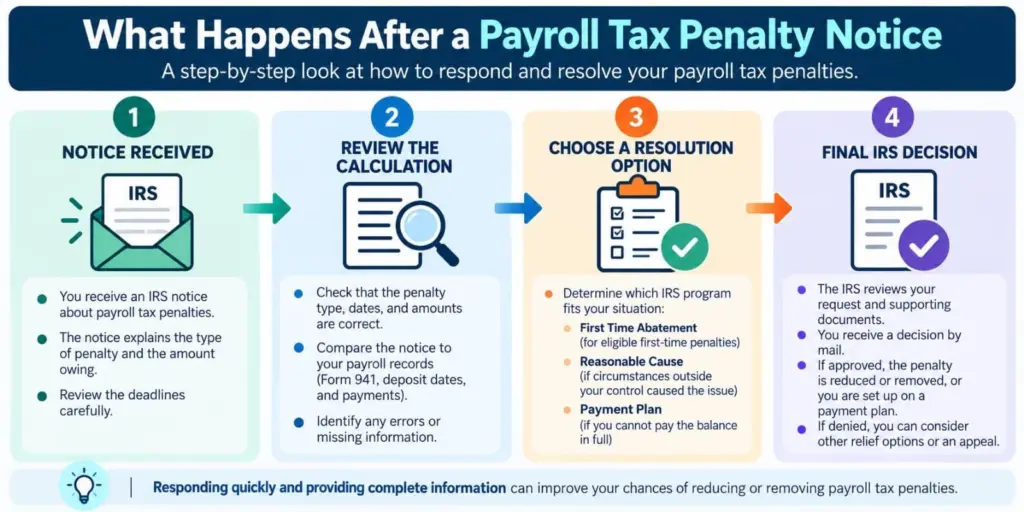
Receiving a payroll tax penalty notice is stressful, but the notice tells you exactly what the IRS expects next. Knowing when to get help with an IRS payroll tax notice matters as much as reading it.
Review the Notice and Tax Period
Every payroll tax notice identifies the tax period, return type, and specific penalty codes applied. Confirming these details catches IRS errors early.
Check the Penalty Calculation
It is worth independently checking how the penalties were calculated, since the four-tier deposit system is easy to apply incorrectly by hand.
A common issue we see is business owners setting a penalty notice aside because the deadline feels far off. By the time they call, the response window has narrowed, and fewer options remain on the table.
Understand Your Response Deadline
Most notices give 30 to 60 days to respond before collection escalates. Missing this window does not eliminate your options, but it narrows them.
What If Your Business Cannot Pay Its Payroll Taxes?
Payroll tax debt creates more urgency than most IRS balances, since the trust fund portion can become a personal liability.
Separate Taxes Owed From Penalties
It helps to separate the underlying tax from penalties and interest, since some relief programs only affect the penalty portion.
IRS Payment Plans and Installment Agreements
Many businesses qualify for an installment agreement that spreads the balance over monthly payments, and tax resolution services can help structure a plan the business can sustain.
Other Tax Resolution Options
A tax relief and resolution agency may also evaluate Currently Not Collectible status or an offer in compromise, though offers involving payroll tax debt are reviewed more strictly.
Can Payroll Tax Problems Become Personal Liability?
One reason payroll tax debt gets serious attention is the trust fund recovery penalty, which can reach past the business entity to an individual.
What Is the Trust Fund Recovery Penalty?
The trust fund recovery penalty applies under IRC 6672 when a responsible person willfully fails to collect, account for, or pay over withheld income, Social Security, and Medicare taxes.
Who Can Be Personally Responsible?
A responsible person can be an owner, officer, partner, or an employee with authority over which bills get paid. Paying other expenses instead of withheld employment tax penalties can be considered willful.
Important

The trust fund recovery penalty equals the full amount of unpaid withheld tax, plus interest, and the IRS can assess it even while the business is still operating.
DIY Penalty Relief vs. Hiring a Tax Resolution Firm
Some payroll tax penalty situations are simple enough to handle directly with the IRS, while others benefit from tax resolution services. It generally comes down to a few factors:
- Handle it yourself: A single, clearly late deposit with an otherwise clean compliance history is often a good candidate to handle yourself.
- Bring in professional help: Once a case involves multiple quarters or a trust fund recovery penalty investigation, tax resolution services become more valuable.
- Especially with multiple issues: When penalties stack across several quarters, a tax relief and resolution agency can review the full picture at once, not one notice at a time.
|
Situation |
Best Fit |
| One late deposit, clean history |
Handle directly with First Time Abate |
|
Multiple quarters or a disputed amount |
Tax resolution services |
| Trust fund recovery penalty involved |
Tax relief and resolution agency |
How to Prevent Future Payroll Tax Penalties
Resolving a current penalty is only half the job. A few habits afterward, including reliable Payroll tax filing services, help avoid new employment tax penalties in future quarters.
File Form 941 on Time
Calendar reminders set well before the deadline reduce the risk of a future Form 941 late-filing penalty. Confirm e-file acceptance, not just submission.
Follow the Correct Deposit Schedule
Since the deposit schedule can change year to year, checking it every January helps avoid penalties tied to using last year’s schedule.
Maintain Accurate Payroll Records
Accurate, up-to-date payroll records make it easier to catch a withholding error before it becomes one of many employment tax penalties.
How Salinger Tax Consultants Can Help
Resolving a payroll tax penalty is easier with a team that has sat on the other side of the table. Salinger Tax Consultants works with businesses at every stage, from staying compliant before a problem starts to negotiating relief once a notice has already arrived.
Payroll Tax Filing and Compliance Support
Our team helps businesses stay current on federal payroll tax deposits and quarterly filings, reducing the risk of future payroll tax penalties. We review your deposit schedule and flag discrepancies between payroll records and what has been reported to the IRS.
Payroll Penalty Resolution and Relief
When payroll tax penalties have already been assessed, we review your IRS account transcript, determine whether first-time penalty abatement or reasonable cause applies, and prepare the request on your behalf.
IRS Notice and Tax Problem Assistance
If you have received a payroll tax notice or a proposed trust fund recovery penalty, Speak with a tax resolution professional before responding on your own. We communicate directly with the IRS on your behalf and work to keep a payroll tax problem from becoming a personal one.
Conclusion
Payroll tax penalties can feel overwhelming, but they are rarely the end of the story. Understanding why a penalty was assessed, whether it is a late Form 941, a missed deposit, or a payment issue, is the first step toward fixing it instead of just paying it.
Salinger Tax Consultants has helped businesses across the country reduce or eliminate payroll tax penalties, negotiate manageable payment plans, and keep the trust fund recovery penalty from becoming a personal problem. Our team knows how the agency evaluates these cases from the inside.
Contact our tax resolution team today to review your payroll tax notice and find out which relief options may apply to your situation.
FAQs
Payroll tax penalties are charges the IRS adds when an employer fails to file, deposit, or pay employment taxes correctly and on time. They can include failure-to-file, failure-to-pay, and failure-to-deposit penalties.
Employment tax penalties most often result from a late Form 941, a missed or incorrect deposit, or inaccurate wage reporting.
A 941 late filing penalty is 5% of the unpaid tax for each month or partial month the return is late, up to a maximum of 25%.
Yes. Many payroll tax penalties qualify for First Time Abate if the business has a clean three-year compliance history, and others may qualify for reasonable cause relief.
First-time penalty abatement is an IRS administrative waiver that removes a qualifying failure-to-file, failure-to-pay, or failure-to-deposit penalty for a business with a clean compliance history.
Yes, first-time penalty abatement applies to Form 941 and other employment tax returns. Starting in 2026, similar relief is also being automated through the IRS's new Automatic Exemption from Penalty program.
Reasonable cause can support tax penalty relief when a documented event, such as a disaster or serious illness, prevented timely compliance, even if First Time Abate does not apply.
If you cannot pay payroll tax debt in full, options include an installment agreement, Currently Not Collectible status, or in limited cases, an offer in compromise.
The IRS can waive employment tax penalties through First Time Abate, reasonable cause, or other administrative relief announced for specific situations.
Yes. Tax resolution services can review your IRS account, identify the right relief program, and communicate with the IRS on your behalf.
It generally makes sense to work with a tax relief and resolution agency once penalties span multiple quarters or a trust fund recovery penalty is involved.
Yes. Unpaid trust fund taxes can result in the trust fund recovery penalty, which makes a responsible person personally liable for the full unpaid amount.

