

If you owe the IRS more than $50,000, the rules that govern your options start to change. A balance at this level can draw closer attention from IRS collection staff, and the paperwork for a payment plan usually grows. Many people in this position want to know whether a payment plan is still possible, whether a lien is on the way, and what happens if they fall behind.
This guide explains how the $50,000 line affects your choices. You will see when a payment plan is simple, when a full financial review is required, and when a revenue officer may get involved.
|
Key Takeaways
|
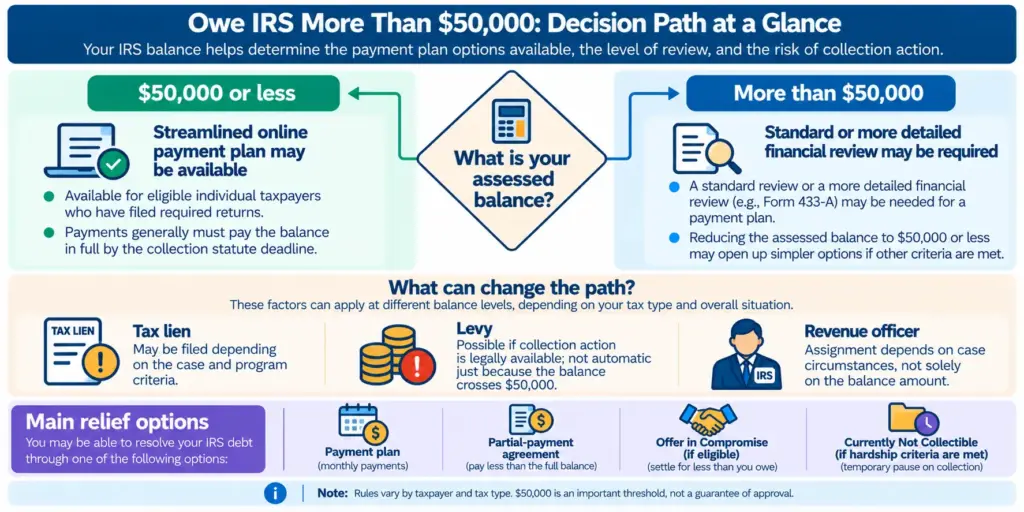
Can You Get a Payment Plan If You Owe More Than $50,000?
The answer depends on how the IRS views your total. The $50,000 mark decides how much information the IRS needs before it approves a monthly amount. If you need assistance with IRS installment agreement options, start by finding out where your balance sits against that line. Balances at or below the limit usually move through a simpler review, while larger balances often require more paperwork before approval.
What Is a Streamlined Installment Agreement?
A streamlined installment agreement is a payment plan the IRS can approve without a detailed review of your finances, as long as your balance is within the limit. An IRS collection memo describes that limit as $50,000 in aggregate unpaid assessments. Balances of $10,000 or less may qualify for a guaranteed agreement, which has even fewer conditions.
Streamlined agreements generally work like this:
- Your assessed balance is $50,000 or less.
- Your monthly payment is set so the balance is paid within the allowed term, generally up to 72 months. [VERIFY]
- Balances between $25,001 and $50,000 must be set up as a direct debit installment agreement.
What Happens When Your Balance Exceeds the Standard Limit?
When the total is above $50,000, the IRS usually reviews the case more closely. The same memo notes that a balance above $50,000 can still be considered for a streamlined agreement if it is paid down to $50,000 or less before the agreement is granted.
Your main choices above the line include:
- Paying the balance down to $50,000 or less, then applying for a streamlined agreement.
- Applying for a non-streamlined agreement, which requires full financial disclosure, usually on Form 433-A.
- Requesting a partial payment plan if you cannot pay the full balance within the collection period.
What Happens If You Owe the IRS Over $50,000?
A large balance does not stay the same. Interest accrues on the unpaid amount, penalties may be added, and the IRS can move through a series of collection steps when a debt goes unpaid for a long time.
Knowing the sequence helps you respond at the right moment. If notices are already arriving, you can get support with IRS collection concerns from a representative who works through these notices every week.
How Penalties and Interest Can Increase Your Balance
If you owe the IRS more than $50,000, the cost of waiting is easy to underestimate. Interest runs from the original due date until the balance is paid, and the failure-to-pay penalty keeps growing each month until it reaches its maximum.
Three factors usually drive the growth:
- Interest, which continues on the unpaid balance over time.
- The failure-to-pay penalty, which applies while the tax stays unpaid.
- Filing penalties, if one or more required returns are still missing.
Tax Liens and Levies: What Changes Your Finances
Liens and levies are separate tools, and each affects your finances in a different way. Knowing the difference helps you judge how urgent a notice is.
- Federal tax lien: a public claim against your property that can make it harder to sell a home or refinance a loan.
- Levy: a legal seizure of property, such as bank funds or part of your wages, generally issued after the IRS has sent a notice and given you a chance to respond.
A pending Offer in Compromise or an approved installment agreement can pause many collection actions, though interest and penalties still continue to accrue.
If you want a second opinion on your balance, our team provides back tax relief and IRS tax resolution services that can review your file before you choose a path.
Does Owing Over $50,000 Trigger a Revenue Officer?
Owing more than $50,000 does not automatically trigger an IRS revenue officer, and many people with a large balance never receive one. Most cases begin with automated notices. A case may move to the field when those steps do not resolve the debt and the case meets IRS collection priorities, which usually take the amount due into account.
What an IRS Revenue Officer Does
An IRS revenue officer is a civil collection employee who handles tax debts the automated system could not resolve. Officers have more tools than notices do, and a Treasury Inspector General report found that the IRS prioritizes high-balance cases for collection. A revenue officer may:
- Request a Collection Information Statement and supporting bank, income, and expense records.
- Set deadlines for documents and for a proposed payment plan or settlement.
- Recommend a lien, a levy, or other enforcement steps when the case calls for them.
- Work toward a resolution when you respond with accurate information.
What to Do If a Revenue Officer Contacts You
Your first conversation with an IRS revenue officer sets the tone for the case, so prepare before you respond. These habits keep you organized and protect your position.
- Confirm the officer’s name, badge number, and phone number, and ask which tax periods are involved.
- Request a written list of the documents needed, and note the due date.
- Keep copies of everything you send, along with a short log of each call.
- Respond by the deadline, and ask for more time in writing if you need it.
- Sign a Form 2848 if a representative will speak with the officer for you.
A short pause to check your figures can prevent a payment plan you cannot sustain.
Read More: Penalties and Interest Doubled Your Bill? Tax Debt Relief Programs That Cut the Total
What Are Your Options for Resolving Large IRS Tax Debt?
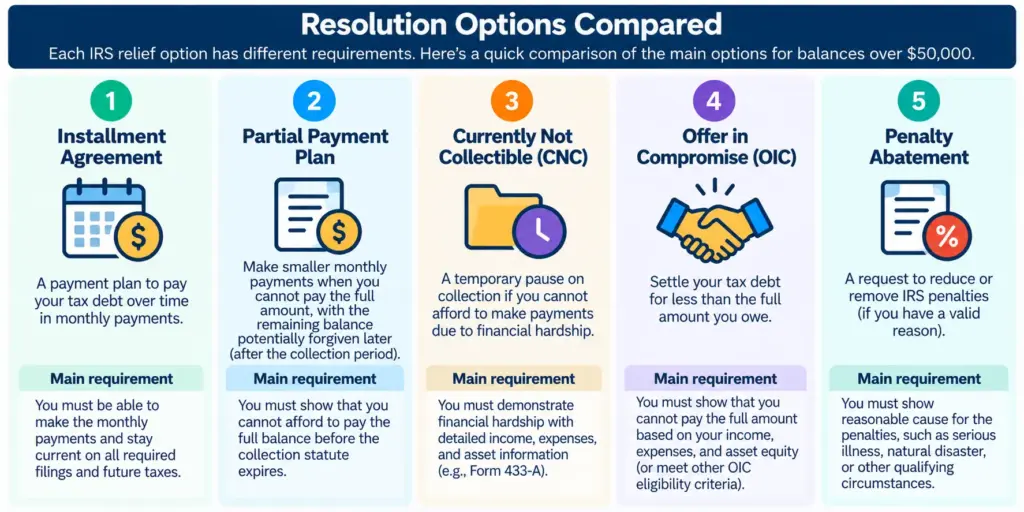
Large balances usually have more than one path. The right one depends on your income, your assets, your monthly expenses, and whether you can pay the balance over a reasonable period. Help resolving large IRS tax debt often starts with comparing the choices side by side, as the table below does.
| Option | Best For | Full Payment Required? |
| Installment agreement | Taxpayers who can make monthly payments | Yes, paid over time |
| Partial payment plan | Taxpayers who cannot pay the full balance in the collection period | No, payments reflect ability to pay |
| Currently Not Collectible | Taxpayers facing severe financial hardship | No immediate payment |
| Offer in Compromise | Taxpayers who cannot reasonably pay the full balance | No, but an offer must be submitted and reviewed |
Installment Agreements and Partial Payment Plans
A standard installment agreement lets you pay the full balance over time, with monthly payments based on what you can afford. A partial payment installment agreement is for taxpayers who cannot pay the full amount before the collection period ends. Both options keep interest running.
Currently Not Collectible Status
Currently Not Collectible status, often called CNC, pauses active collection when payment would leave you unable to cover basic living expenses. CNC does not erase the debt, and interest and penalties keep growing.
CNC is usually considered when:
- Your income covers only basic needs.
- You have little equity in property, vehicles, or accounts.
- Your hardship can be documented with current records.
Can You Settle IRS Debt Over $50,000 for Less Than You Owe?
An Offer in Compromise lets eligible taxpayers settle a tax debt for less than the full amount, but only when the IRS agrees the offer reflects what it could reasonably collect. For a debt above $50,000, the financial review is usually detailed. Eligibility depends on income, expenses, asset equity, and whether filings and payments are current.
How the IRS Evaluates Income, Expenses, and Asset Equity
The IRS compares your monthly income with allowable living expenses set by its collection standards. It also counts equity in property, vehicles, and accounts, because those assets could be used to pay the debt.
The IRS typically reviews:
- All sources of household income.
- Allowable monthly living expenses, such as housing, food, and transportation.
- Equity in homes, vehicles, and other property.
- Bank balances, retirement accounts, and investments.
What Reasonable Collection Potential Means
Reasonable collection potential, or RCP, is the amount the IRS believes it could collect through normal enforcement. It includes asset value and projected future income. If your RCP is lower than the balance, an offer may make sense. If it is higher, the IRS is less likely to accept a reduced amount, which is why an accurate financial statement matters.
Why an Offer in Compromise Is Not Guaranteed
An offer does not guarantee acceptance. The IRS can reject an offer that does not reflect your ability to pay, and it can return an application that is incomplete. Common causes of delay or rejection include:
- An offer amount that does not match your true ability to pay.
- An incomplete application package.
- Current-year obligations, such as estimated payments or business deposits, that are not up to date.
A complete, accurate package avoids many of these delays. If an offer is rejected, you may have appeal rights.
Read More: Owe the IRS $100K? Offer in Compromise Pre-Qualification and Realistic Outcomes
What Should You Do First If You Owe the IRS More Than $50,000?
Before you choose a payment plan or a settlement, take a few practical steps. Clear preparation makes the next conversation with the IRS easier and keeps more options open. Get professional guidance for unpaid back taxes that can help you sort through these steps, and you can start with the basics below.
Confirm the Balance and File Missing Returns
Start by requesting an IRS account transcript for each tax year involved. Transcripts show the assessed balance, penalties, and payment history. The IRS generally requires all returns to be filed before it considers most resolution options, so file any missing return first.
Gather these items first:
- Account transcripts for each year.
- Copies of filed returns and any amended returns.
- Every IRS notice you have received, in date order.
Review Notices and Prepare a Financial Summary
Read each IRS notice and note the deadline it sets. Then build an income and expense summary from recent records, since the IRS compares your figures against its own.
A clear summary includes:
- Monthly income from every source.
- Necessary living expenses, with documentation for each.
- Current balances in bank and investment accounts.
- Estimated values for property and vehicles.
How Salinger Tax Consultants Can Help With Back Taxes
Salinger Tax Consultants works with taxpayers who owe large balances and need a clear plan. Our founder, Peter Salinger, EA, is a former IRS Revenue Officer. Our team focuses on the practical steps that move a case forward:
- Eligibility review: We look at your income, expenses, assets, and balance to see which resolution option may fit.
- Application preparation: We organize your records, prepare IRS forms, and work out a realistic proposal.
- IRS correspondence: We help you respond to requests and keep deadlines on track.
- Revenue officer support: When a revenue officer is assigned, we help you prepare for meetings and document requests.
- Appeals and ongoing case support: When an appeal is appropriate, we prepare it and stay involved as the case moves forward.
Conclusion
If you owe the IRS more than $50,000, your options are real, but the timing matters. The $50,000 line changes how a payment plan is reviewed, and a revenue officer may become involved when routine steps stall.
Penalties and interest keep adding to the balance, so acting early gives you more room to choose. Confirm your balance, file any missing returns, and compare the options before you commit to a path.
At Salinger Tax Consultants, we can review your balance and explain which relief options may apply to your situation.
Schedule a consultation to talk through your numbers and get clear next steps.
FAQs
The balance keeps growing as interest and penalties accrue, and the IRS can start collection steps such as notices, a federal tax lien, or a levy. Responding early gives you access to more relief options, including payment plans and settlement programs.
In many cases, yes, because the IRS can approve a payment plan even when a balance is above the limit. Balances above the streamlined limit usually require financial disclosure, but a payment plan can still be approved. Paying the balance down to $50,000 or less before the agreement is granted may open the streamlined route.
For most individuals, the streamlined installment agreement limit is $50,000 in aggregate unpaid assessments. Balances between $25,001 and $50,000 generally require direct debit payments. Confirm your exact figure on your IRS account transcript before you apply.
Not automatically. An IRS revenue officer may be assigned when routine collection efforts do not resolve the balance or when the case is a collection priority. Responding to notices promptly can reduce the chance that a case moves to the field.
The IRS can file a federal tax lien on significant unpaid balances, and larger debts are more likely to draw that step. A lien is a public claim against your property. An approved payment arrangement or a pending offer may affect whether and when a lien is filed.
Yes, the IRS can levy bank accounts and wages after the required notices. A pending Offer in Compromise or an approved installment agreement generally pauses many collection actions. Acting on IRS notices early keeps more of your choices available.
It may be possible. An Offer in Compromise can be accepted when the IRS agrees the offer reflects what it could reasonably collect. Offer in Compromise eligibility depends on income, expenses, asset equity, and whether returns and payments are current.
You can ask about a partial payment installment agreement, or request Currently Not Collectible status if your income covers only basic needs. Report your finances accurately, since the IRS compares them with its standards.
Professional help can be useful when balances are large, notices are arriving, or a revenue officer is involved. Large tax debt help from a qualified representative can confirm eligibility, prepare complete forms, and communicate with the IRS for you under a signed authorization.

