

An IRS balance that has grown far past the original tax bill is not fixed by a single tax debt relief program. Different parts of the balance need different treatment. Penalty relief removes eligible penalties and the interest tied to them. Interest abatement is much narrower and rarely applies. An Offer in Compromise can settle qualifying debt for less than the full amount. A payment plan changes how you pay.
The right move depends on whether your inflated bill comes mostly from tax, penalties, interest, or all three at once.
|
Key Takeaways
|
Why Did My IRS Tax Debt Double?
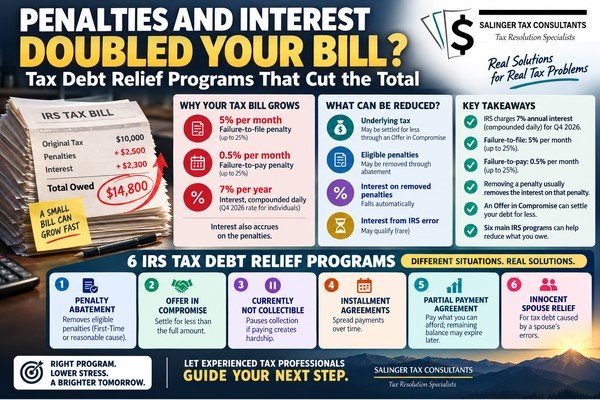
Your balance grows every month you leave it unpaid, and three forces stack on top of each other.
- Failure-to-file penalty: 5% of the unpaid tax per month, up to 25% of the total.
- Failure-to-pay penalty: 0.5% of the unpaid tax per month, up to 25% of the total.
- Daily compounding interest: currently 7% a year for individuals, recalculated every quarter under IRC §6621.
- Interest on the penalties themselves, which keeps adding to the pile once the penalty is assessed.
A $10,000 balance left unpaid for a year can realistically grow by $2,000 to $3,000 once you combine both penalties with compounding interest. That is how a manageable bill turns into one that feels impossible.
What Is Tax Debt Relief?
Tax debt relief is any IRS program that reduces, restructures, or delays collection of what a taxpayer owes. It is not the same as tax reduction. Tax reduction lowers your original liability through deductions, credits, or an amended return. Tax debt relief works on the balance after it is already assessed.
IRS tax debt relief may be available when:
- You cannot pay the full balance and have limited assets or income.
- A penalty resulted from circumstances beyond your control.
- Your financial situation changed significantly after the debt was assessed.
- You were left with a tax bill because of a spouse’s or ex-spouse’s reporting errors.
Parts of your IRS balance that can potentially be reduced:
- The underlying tax, through an Offer in Compromise.
- Eligible penalties, through IRS tax penalty abatement.
- Interest tied directly to a removed penalty.
- Rarely, interest itself, if the IRS caused an unreasonable delay.
Which Part of an IRS Tax Bill Can Actually Be Reduced?
Break your balance into three pieces: original tax, plus penalties, plus interest, equals your current bill. Each relief mechanism only covers one piece.
|
Balance component |
Potential relief |
| Underlying tax |
An Offer in Compromise may settle qualifying liabilities for less than the full amount |
|
Certain penalties |
May qualify for reasonable cause for penalty relief or First-Time Penalty Abatement |
| Interest on abated penalties |
Falls automatically once the related penalty is removed |
|
Interest from IRS error or delay |
May qualify for standalone interest abatement, a rare outcome |
| Future interest |
Depends entirely on how you resolve the remaining balance |
The table above shows why one relief request rarely clears an entire bill. The IRS confirms that interest keeps accruing on unpaid balances, penalties included, until the account is paid in full or resolved through one of the programs below.
6 IRS Tax Debt Relief Programs That May Reduce What You Owe
The IRS offers several tax debt relief programs, but each addresses a different reason your balance may be difficult to pay.
Here are six options that may reduce penalties, interest, or the amount you ultimately owe.
1. Penalty Abatement
IRS tax penalty abatement removes eligible penalties, most often through First-Time Penalty Abatement or a showing of reasonable cause. A clean three-year compliance history qualifies many taxpayers for the first-time version without any explanation required.
2. Offer in Compromise
The IRS determines an OIC settlement amount using your income, expenses, assets, and future earning potential, a figure called reasonable collection potential. If that number is lower than your total balance, the IRS may accept less than you owe.
3. Currently Not Collectible Status
This pauses IRS collection when paying anything would create real hardship. The balance still grows with interest, but wage garnishments and levies stop while your account carries this status.
4. Installment Agreements
A standard payment plan spreads your full balance over time. It does not reduce what you owe. Interest and any remaining penalty continue accruing on the unpaid portion.
5. Partial Payment Installment Agreement
A partial payment installment agreement sets a monthly payment based on what you can actually afford, which may be less than what would fully pay off the balance before the collection period ends. The remainder can expire once the ten-year collection statute runs out.
6. Innocent Spouse Relief
This applies when a current or former spouse’s unreported income or false claims created the debt, and you had no reason to know about it when you signed the joint return.
Which IRS Tax Relief Program Can Actually Reduce Your Total?
- Best option when you cannot pay the full balance: An Offer in Compromise or Currently Not Collectible status fits here, depending on whether your situation is temporary or long-term.
- Best option when penalties are the main problem: Penalty abatement, through either First-Time Penalty Abatement or a reasonable cause claim, targets the penalty piece directly without touching the underlying tax.
- Best option when your financial situation has changed: A partial payment installment agreement or Currently Not Collectible status adjusts to your current income rather than the amount originally assessed.
- Best option for settling tax debt for less than you owe: Only an Offer in Compromise legally reduces the tax itself. Every other program changes timing, not the total.
Which Tax Debt Relief Option Fits the Reason Your IRS Balance Increased?
The table shows a hard rule worth repeating: a payment plan should never be sold to you as a way to erase debt. Interest keeps accruing while the balance sits unpaid, even on an approved plan.
|
Situation |
Relief to investigate |
| Eligible penalty from a qualifying event |
IRS tax penalty abatement |
|
Clean compliance history for the past three years |
First-Time Penalty Abatement |
| Failure caused by illness, disaster, or similar hardship |
Reasonable cause for penalty relief |
|
Interest caused by unreasonable IRS error or delay |
Interest abatement |
| Cannot fully pay and collection potential is low |
Offer in Compromise |
|
Can repay over time |
Installment agreement |
| Cannot currently pay due to hardship |
Currently Not Collectible status |
What If Penalty Relief Is Not Enough to Make the IRS Debt Affordable?
- Use an OIC when the financial facts support settlement: Check the IRS Offer in Compromise eligibility factors first: filing compliance, no open bankruptcy, and a reasonable collection potential below your total balance.
- If those line up, an Offer in Compromise is worth pursuing before anything else.
- Use a payment plan when you can repay over time: A standard or streamlined agreement solves a cash-flow problem. It does nothing for the size of the debt itself.
- Consider collection delay when immediate payment creates hardship: Currently Not Collectible status buys time when your monthly expenses already exceed your income.
|
Decision rule: Remove penalties that qualify. Remove interest tied to those penalties. If what remains is still unaffordable, move to an Offer in Compromise or a collection alternative instead of filing a second penalty request that will not change the math. |
How to Find the Right Tax Debt Relief Strategy
- Verify the balance. Pull your IRS transcript to confirm the exact tax, penalty, and interest breakdown.
- Separate tax, penalties, and interest. Treat each piece as its own problem with its own fix.
- Check penalty eligibility. Confirm whether failure-to-file and failure-to-pay penalties qualify for First-Time Penalty Abatement or a reasonable cause claim.
- Check the linked interest. Interest tied to a removed penalty typically drops on its own once the penalty is gone.
- Investigate standalone interest abatement only if IRS error or delay caused part of the charge; this rarely applies outside audit-related cases.
- Recalculate what remains. The true remaining balance is often smaller than it first appears.
- Evaluate an OIC, payment plan, or collection delay for anything still unaffordable, based on your actual financial facts.
How Salinger Tax Consultants Helps With IRS Tax Debt
Our team at Salinger Tax Consultants handles complex tax-debt matters, including penalty abatement, Offers in Compromise, installment agreements, Currently Not Collectible status, liens, levies, and other IRS collection issues, tailoring the resolution strategy to your financial situation.
- We pull your full IRS transcript history to separate tax, penalty, and interest before recommending a strategy.
- We know how the IRS reviews an Offer in Compromise from having worked inside that department, which shapes how we get an Offer in Compromise approved on the first submission instead of the second.
- We prepare First-Time Penalty Abatement and reasonable cause requests with the documentation the IRS actually expects to see.
- We have resolved more than $100 million in tax debt nationwide, including a case where a rejected $102,000 offer was rebuilt and approved at $42,000.
- If an Offer in Compromise is denied, we handle the appeal directly instead of starting over from zero.
Every day your balance sits unresolved, interest adds to it. Book a consultation with Salinger Tax Consultants and get a former IRS insider reviewing your case before the next quarter’s interest hits.
Conclusion
A doubled IRS balance is tax, penalties, and interest stacked together, and each piece needs its own fix. Tax debt relief program options exist for nearly every cause of that growth, from IRS tax penalty abatement for qualifying penalties to an Offer in Compromise for settling the tax itself.
The fastest path to an accurate number is separating what is actually owed from what has piled on through IRS late payment penalty charges and compounding interest.
Salinger Tax Consultants helps taxpayers facing IRS debt by combining more than 30 years of direct IRS experience with a team that includes former IRS agents, tax attorneys, CPAs, Enrolled Agents, and Certified Tax Resolution Specialists.
We know how the IRS evaluates a balance because we used to be the ones evaluating it. Contact us for a consultation and find out which part of your balance can actually come down.
FAQs
Tax debt relief is any IRS program that reduces, restructures, or pauses collection on tax you already owe.
Yes, but only the Offer in Compromise program reduces the underlying tax itself; other programs change timing or remove penalties.
Failure-to-file penalties, failure-to-pay penalties, and daily compounding interest stack together, often adding 20% to 30% within a year.
The IRS late payment penalty charges 0.5% of your unpaid tax per month, capped at 25% of the total.
Yes. Interest compounds daily at 7% annually for individuals in Q4 2026 and resets every quarter.
Eligible penalties can be removed through abatement, and the interest tied to that specific penalty is removed with it.
The main IRS tax relief programs are penalty abatement, Offer in Compromise, Currently Not Collectible status, and installment agreements.
Yes. The IRS determines an OIC settlement amount using your reasonable collection potential, which can be far below your total balance.
Yes, though balances above $50,000 typically require a detailed financial statement before approval.
Yes, it pauses wage garnishments and levies, though interest keeps accruing during that status.
No. It only pauses active collection; the balance can still exist once the ten-year statute runs.
It depends on whether your problem is penalties, an unaffordable total, or a temporary hardship; each points to a different program.
Yes, removing a qualifying penalty also removes the interest that had built up on that specific penalty.
An IRS interest calculator applies the current 7% quarterly rate plus any penalty percentage to your unpaid balance by month.
You can, but IRS Offer in Compromise eligibility factors and financial disclosures are complex enough that most self-filed offers get rejected the first time.
Get help once your balance exceeds what you can pay within twelve months or once penalties and interest exceed the original tax.

