

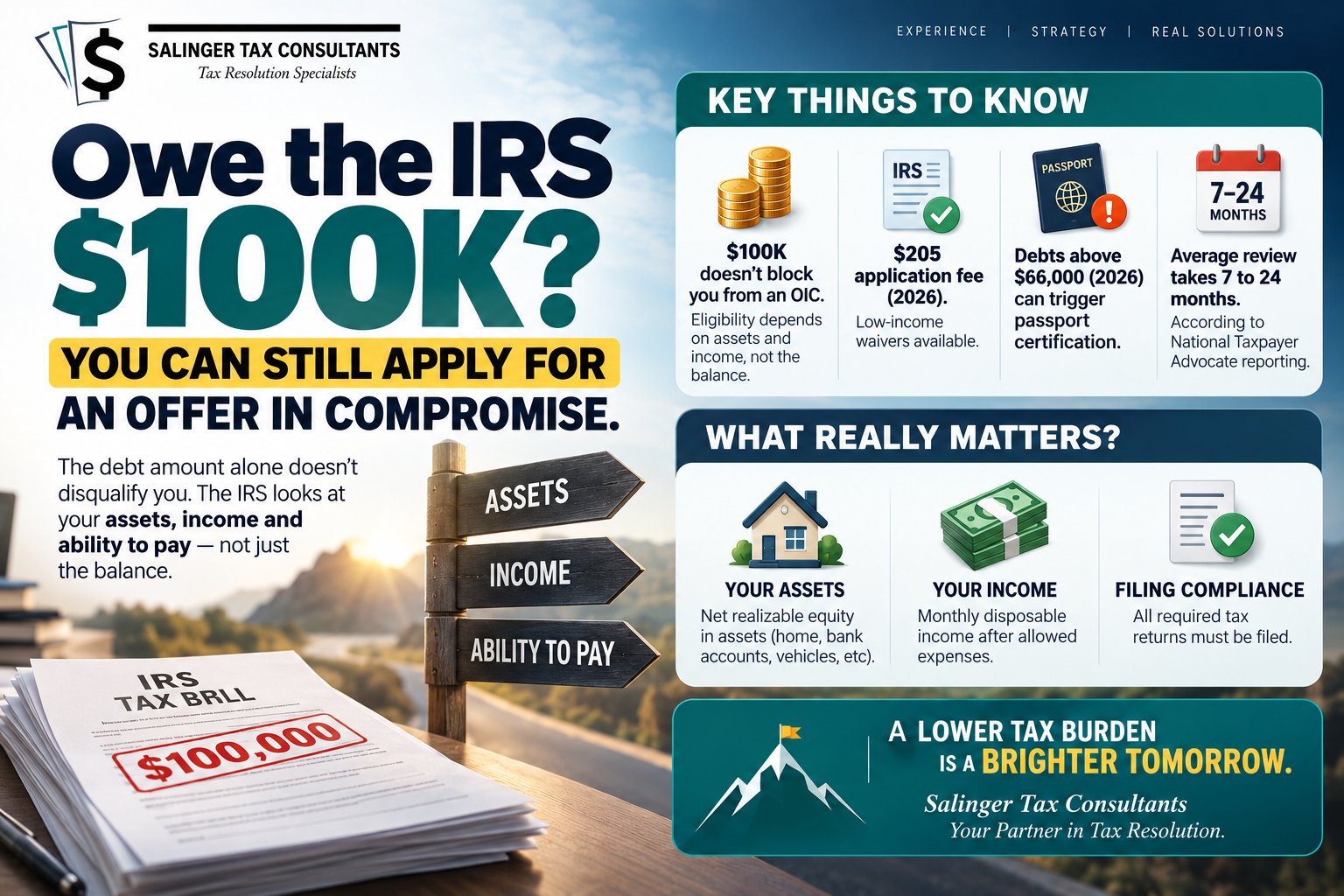
If you owe the IRS $100 K, you can still apply for an IRS offer in compromise. The debt amount alone never disqualifies you. What decides your case is whether the IRS believes it can collect more from you over time than you’re offering right now.
This article breaks down how the IRS pre-qualifier tool works, how the IRS actually calculates a settlement number, and what your realistic options are if the tool tells you no.
|
Key Takeaways
|
Can You Get an Offer in Compromise If You Owe the IRS $100K?
Yes. Debt size is not one of the IRS’s eligibility rules for an OIC. The IRS looks at what it calls your Reasonable Collection Potential, or RCP: the total it thinks it can realistically pull from your assets and future income before the collection window closes.
Yes, $100K of Tax Debt Does Not Automatically Disqualify You
A $100,000 balance and a $15,000 balance go through the identical review process. The IRS checks whether you can pay this in full through your equity and income before the 10-year collection statute runs out.
What Actually Determines Whether the IRS Accepts an OIC?
Three IRS Offer in Compromise eligibility factors decide most cases: your net realizable equity in assets, your monthly disposable income after allowed expenses, and your filing compliance. Missing a single required return puts your entire application on hold, according to the IRS Offer in Compromise Booklet (Form 656-B).
Why Your Ability to Pay Matters More Than the Size of the Debt
The IRS calculates your ability to pay using national and local expense standards, not your actual budget. A taxpayer with a paid-off house and a stable paycheck will struggle to qualify for an offer in compromise even at a $30,000 balance. Someone with no equity and a job that barely covers rent has a real shot at $100,000.
What Happens When You Owe the IRS $100,000?
A six-figure balance triggers specific IRS enforcement tools you may never see coming until a notice shows up. Here’s what’s already in motion the longer the debt sits:
- Penalties and interest compound monthly. Failure-to-pay penalties run up to 25% of the original balance, and interest accrues on top of that.
- Federal tax liens attach automatically. Once the IRS assesses and bills you, a Notice of Federal Tax Lien can be filed against your property, which shows up on public record and damages your ability to refinance.
- Levies and wage garnishment become possible. After required notices, the IRS can legally seize bank funds or garnish wages without a court order.
- Passport certification kicks in at $66,000 (2026). Under IRC Section 7345, debt above this inflation-adjusted threshold with a filed lien or issued levy gets certified to the State Department, which can block a passport renewal.
What Is an IRS Offer in Compromise?
An IRS Offer in Compromise is a legal agreement that settles your tax debt for less than the full balance. It exists because the IRS would rather collect a realistic amount now than chase an uncollectible debt for a decade.
There are three types, and most people only know about one:
|
OIC Type |
When It Applies |
| Doubt as to Collectibility |
You lack the assets and income to pay in full before the statute expires. This covers most $100K cases. |
|
Doubt as to Liability |
You genuinely dispute that you owe the tax, or owe as much as assessed. Filed on Form 656-L. |
| Effective Tax Administration |
You could technically pay, but doing so would create genuine economic hardship or be unfair given your circumstances. |
The table above shows the three legal grounds for an OIC. Almost every $100K acceptance we see falls under Doubt as to Collectibility, so that’s the standard the rest of this article focuses on.
How to Qualify for an Offer in Compromise
To qualify for an Offer in Compromise consideration, the IRS requires you to clear several gates before it even looks at your financial numbers:
- File every required tax return, including years you haven’t filed yet
- Make all required estimated tax payments for the current year if you’re self-employed
- Not be in an open bankruptcy proceeding
- Pay the $205 application fee, unless you meet the low-income exception
- Submit accurate Form 433-A (OIC) financial disclosures, backed by three months of bank statements
What Is the IRS Offer in Compromise Pre-Qualifier Tool?
The IRS pre-qualifier tool is a free online questionnaire at irs.treasury.gov that estimates whether you’re a likely candidate before you spend hours on paperwork. It gives you a preliminary read.
- The Pre-Qualifier asks for: ZIP code, household size, total tax debt, the tax years involved, and a breakdown of your bank balances, vehicles, real estate equity, income, and monthly expenses.
- The Pre-Qualifier estimates your preliminary offer: It runs a simplified version of the RCP formula: your net equity in assets, plus your disposable monthly income multiplied by 12 or 24, depending on your chosen payment terms. The result is a rough number, not a binding offer.
How Does the IRS Calculate Your Offer Amount?
The IRS determines an OIC settlement amount using this formula:
| Net Realizable Equity in Assets + (Monthly Disposable Income x 12 or 24) |
The multiplier is 12 months if you’ll pay the offer in 5 or fewer installments, or 24 months for a longer payment plan.
What Should You Do If the IRS Pre-Qualifier Says You Do Not Qualify?
If the Pre-Qualifier says you do not qualify, it means one specific thing needs fixing, and figuring out which one determines your next move.
First, Determine Whether the $100K Liability Itself Is Correct
If you dispute the underlying tax bill rather than your ability to pay it, your path is Doubt as to Liability, filed on Form 656-L, not the standard collectibility offer. This applies when the IRS assessed tax based on a return it filed for you, miscalculated income, or missed a deduction you can now document.
If the Debt Is Correct But Unaffordable, Examine Collection Alternatives
Three routes exist when the number is accurate but genuinely unaffordable right now:
- OIC based on Doubt as to Collectibility: The standard route for most $100K cases
- Installment agreement: Monthly payments spread over time, sometimes for the full balance
- Currently Not Collectible status: Collection pauses while your finances are reviewed
What Happens After Pre-Qualification if You Decide to Apply?
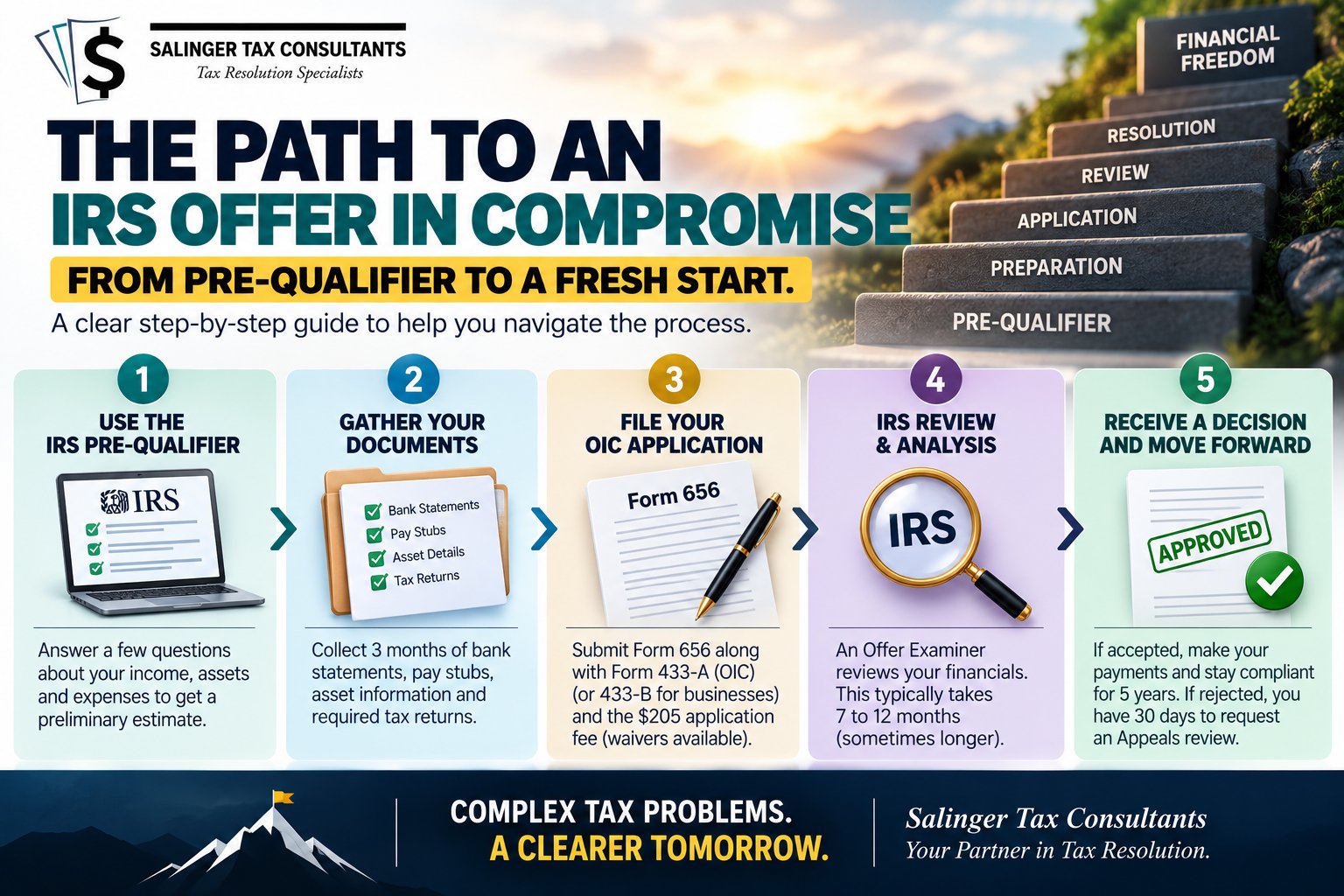
Once the tool gives you a workable estimate, four steps stand between you and a filed application.
- Review your preliminary result and decide which OIC basis fits
- Gather three months of bank statements, pay stubs, vehicle titles, and real estate valuations
- Complete Form 656 along with Form 433-A (OIC) for individuals or Form 433-B (OIC) for businesses
- Verify current Form 656-B instructions before filing, since fees and payment terms change
Current IRS guidance sets the application fee at $205, with an exception for taxpayers who meet the low-income certification on Form 656-B.
Can You Qualify for an OIC With $100K in Assets?
Having $100,000 in assets doesn’t automatically block you, but it depends entirely on what those assets are and how much equity is actually free:
- Home equity and other real property valued at 80% of fair market value minus what you owe, per IRS quick-sale rules
- Bank accounts counted in full as available equity
- Vehicles and investments: Vehicle equity above allowed exemptions counts; brokerage and stock accounts count at current market value
- Retirement accounts and other financial assets: 401(k) and IRA balances generally count even though early withdrawal would trigger penalties
What If You Cannot Qualify for an Offer in Compromise?
If your numbers don’t support an OIC settlement, these best tax relief programs are worth reviewing before you assume you’re stuck paying in full:
- IRS Installment Agreement: Structured monthly payments, often without full financial disclosure under $50,000
- Partial Payment Installment Agreement: Reduced monthly payments based on your actual disposable income
- Currently Not Collectible Status: Collection paused for taxpayers who genuinely cannot pay anything right now
- Penalty Abatement: Removes penalties for reasonable cause or first-time compliance, though the underlying tax still stands
What Are the Biggest Reasons $100K OIC Applications Fail?
The reasons we actually see behind failed six-figure offers are narrower and less obvious:
- Valuing home equity using Zillow estimates instead of the IRS’s 80% quick-sale standard, which inflates the offer the IRS expects
- Missing a dissolved retirement account or an old brokerage balance the taxpayer forgot existed, which resurfaces during IRS verification and kills credibility
- Offering a round number instead of showing the RCP math, which reads as guessing rather than calculating
- Filing while a joint bankruptcy or divorce proceeding is technically still open in the county system, even after the taxpayer believed it closed
How Long Does an IRS Offer in Compromise Take?
Running the Pre-Qualifier takes minutes. Assembling documentation and filing Form 656 with supporting schedules typically takes taxpayers 2 to 4 weeks when working with a preparer.
IRS Review and Financial Analysis
Once assigned to an Offer Examiner, review generally runs 7 to 12 months, based on National Taxpayer Advocate reporting on current OIC processing times. Complex $100K cases with real estate or business income often run longer.
What Happens After Acceptance or Rejection?
Accepted offers require full payment on your chosen schedule and five years of filing compliance after acceptance. Rejected offers come with a written explanation and 30 days to request an Appeals review.
What Happens If the IRS Rejects Your OIC?
If your Offer in Compromise is denied, you have 30 days from the rejection letter to file Form 13711 requesting an Appeals review. Appeals officers frequently reduce the required offer amount once updated financials, like the medical-expense example earlier in this article, show the original RCP calculation was outdated.
When Another Tax Relief Strategy May Be Better
- When your income just increased, and an installment agreement covers the full balance within a few years
- When your assets are mostly retirement funds, you genuinely can’t liquidate without a severe penalty
- When your dispute is really about the assessed amount, not your ability to pay it
How Salinger Tax Consultants Helps With a $100K IRS Tax Debt
Salinger Tax Consultants can help taxpayers facing IRS debt by combining more than 30 years of direct IRS experience with a team that includes former IRS agents, tax attorneys, CPAs, Enrolled Agents, and Certified Tax Resolution Specialists.
Here’s how exactly we help:
- We build your RCP calculation the way an Offer Examiner will, before the IRS ever sees it, so your number holds up under review
- We identify whether you can negotiate an OIC yourself or when your asset mix makes professional Offer in Compromise assistance worth the cost
- We handle Appeals directly when an offer gets rejected, using the same financial re-analysis approach that turned a rejected $102,000 offer into an accepted $42,000 settlement
- We stop collection actions, liens, and levies while your case moves through review, so the IRS isn’t seizing assets you’ll need for the offer itself
Getting an IRS offer in compromise approved on a six-figure balance takes more than filling out forms correctly; it takes knowing how the person reviewing your file was trained to think. Book a consultation and let our former IRS team build your case before you file.
Conclusion
Owing the IRS $100,000 does not close the door on tax debt relief; your Reasonable Collection Potential does. The IRS accepts offers based on documented equity and income, calculated against the 10-year collection window. If you use the IRS pre-qualifier tool as a first estimate and back it with current documentation, you can consistently outperform.
Salinger Tax Consultants brings former-IRS insight to exactly this calculation. We don’t promise a number before reviewing your financials, and we won’t tell you what you want to hear just to get you to sign.
What we will do is build the offer the way the IRS actually reviews it, appeal it correctly if it’s rejected, and stop collection activity while your case is pending. If a six-figure balance is sitting on your shoulders right now, talk to us before you file anything.
FAQs
Yes. Debt amount doesn't disqualify you; the IRS bases acceptance on your Reasonable Collection Potential, not your total balance.
You must be current on filed returns and estimated payments, not be in bankruptcy, and show an RCP lower than your total debt.
No single dollar amount creates eligibility. Eligibility depends on your assets, income, and filing compliance.
It's a free online tool at irs.treasury.gov that estimates your eligibility and a preliminary offer amount before you file.
No. It's a preliminary estimate only; the actual review verifies your numbers independently and can reach a different result.
Net realizable equity in assets plus monthly disposable income multiplied by 12 or 24, depending on your payment term.
It varies by case; settlements have ranged from a few thousand dollars to nearly the full balance, based entirely on RCP.
Only if your documented RCP equals roughly $10,000. The number comes from your finances, not from negotiation targets.
Yes. Home equity counts at 80% of fair market value minus the mortgage balance, using the IRS quick-sale valuation method.
Yes, but that balance counts in full as available equity and raises your required offer amount dollar for dollar.
You may qualify for an OIC, an installment agreement, or Currently Not Collectible status, depending on your documented finances.
It depends on your income. An installment agreement pays the full balance over time; an OIC settles for less if you truly can't.
Offer in Compromise, installment agreements, Currently Not Collectible status, and penalty abatement, chosen based on your specific finances.
Review generally runs 7 to 12 months from filing on current processing times.
You receive written reasons and 30 days to file Form 13711 requesting an Appeals review of the decision.
Yes. Appeals officers independently review your RCP calculation and frequently adjust the required offer based on updated financials.
Not legally, but complex asset situations often benefit from experienced Offer in Compromise assistance to avoid preventable rejections.

