
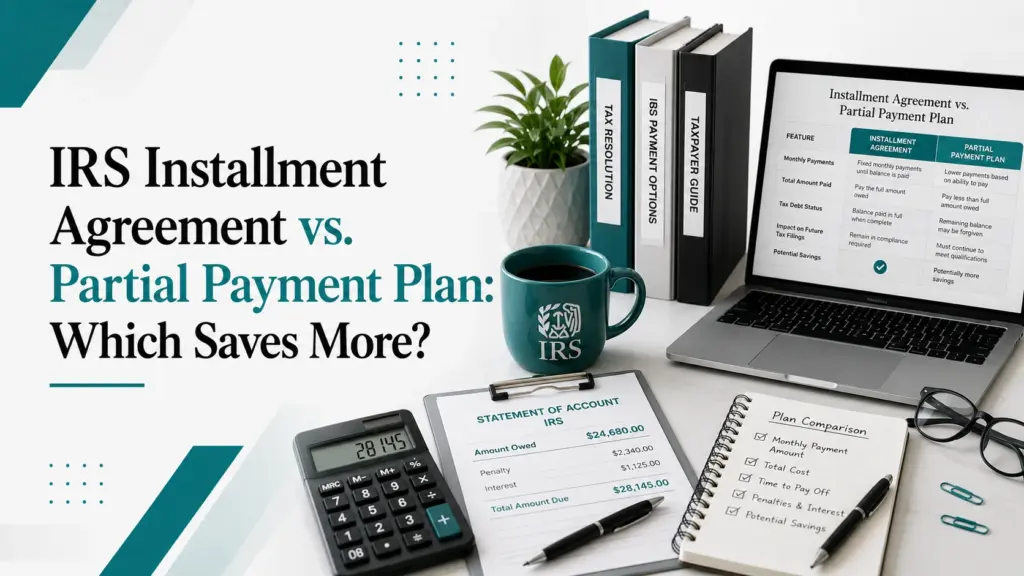
When you cannot pay your tax bill in full, the IRS offers multiple payment arrangements. An IRS installment agreement lets you pay the full amount owed over time, while a Partial Payment Installment Agreement (PPIA) settles the debt for less, with the remaining balance potentially forgiven. Understanding PPIA vs. full-installment arrangements helps you choose the option that saves you the most money.
The choice between these options affects how much you pay, how long you stay in debt, and what happens if your circumstances change.
This guide compares the IRS payment plan options, explains who qualifies for each, and helps you determine which one saves more money in your specific situation.
| Key Takeaways |
|
• An IRS installment agreement commits you to pay the full tax debt over time in fixed monthly payments, typically ranging from $25 to several thousand dollars per month depending on what you can afford. • A Partial Payment Installment Agreement allows the IRS to accept a lower total payment amount, with the remaining balance potentially forgiven after a set period, though interest and penalties continue to accrue during the plan. • A standard installment agreement costs more overall (you pay everything you owe) but typically requires no new financial documentation after approval, while a PPIA requires ongoing financial reviews and may be modified or terminated if your circumstances improve. • The total cost of a standard agreement includes interest and penalties that accrue for the entire repayment period, whereas a PPIA may result in a lower total payment if the forgiven balance exceeds the accrued interest. • Your monthly payment under either plan depends on the IRS’s analysis of your income, necessary living expenses, and available assets, calculated using IRS National Standards for your state and family size. |
What Is an IRS Installment Agreement?
An IRS installment agreement is a contract where you commit to paying your full tax debt owed in fixed monthly installments. While you remain responsible for the full principal plus accrued interest and penalties, this option typically avoids the intrusive, ongoing financial reviews required by more complex payment plans.
How Standard Installment Agreements Work
You agree to pay a fixed amount each month until the debt is satisfied. The IRS calculates the monthly payment based on your income and expenses, but you can also propose an amount you can afford. Interest and penalties continue to accrue on the unpaid balance until the agreement is paid off.
Eligibility Requirements
You must be current on all recent tax returns, have filed all required returns, and not be in bankruptcy. The IRS generally does not require you to prove financial hardship to qualify for a standard installment agreement if your debt is under $50,000.
Advantages and Limitations
Advantages include predictability (you know your monthly payment), no surprise changes unless you miss payments, and no ongoing financial reviews. Limitations include paying the full debt eventually, with interest and penalties mounting over the repayment period.
What Is a Partial Payment Installment Agreement (PPIA)?
A Partial Payment Installment Agreement is an arrangement where the IRS accepts a lower total payment, potentially forgiving a portion of your debt after a period.
How a Partial Payment Plan Differs
Unlike a standard agreement where you pay everything you owe, a PPIA settles for less. The IRS calculates the amount they could collect if they pursued aggressive enforcement (wage garnishment, levies, asset sales), then proposes a lower payment plan. If you do not increase your income sufficiently during the PPIA period, the remaining balance may be forgiven.
IRS Financial Review Process
The IRS requires detailed financial documentation for PPIA approval. They analyze your income, necessary living expenses, and net equity in assets using IRS National Standards. This process is more intensive than standard agreement approval.
Who Qualifies for a PPIA
You generally qualify if you demonstrate genuine financial hardship and have a minimal monthly income after living expenses. You must also show that the amount you can pay represents the most the IRS is likely to collect over a reasonable period.
Explore our IRS installment agreement services to see how this solution fits your tax relief needs.
IRS Installment Agreement vs. Partial Payment Plan
Comparing these two options side by side reveals when PPIA vs full installment arrangements make financial sense for your situation.
| Aspect | Standard Installment Agreement | Partial Payment Installment Agreement (PPIA) |
| Core Commitment | You agree to pay the full tax debt, including the original principal, plus all accrued interest and penalties over time. | You agree to a settlement for less than the total owed, where the IRS accepts smaller payments, forgiving the remaining balance after a set period. |
| Financial Documentation | Minimal requirement if total debt is under $50,000; does not require proof of financial hardship. | Intensive requirement; requires detailed disclosure of income, assets, living expenses, and bank statements to prove financial hardship. |
| Stability & Reviews | High stability; no ongoing financial reviews are required after the initial approval, unless you default on payments. | Variable stability; subject to ongoing reviews of financial situation; the plan can be changed or removed if income improves. |
| Ideal Candidate | Best for individuals with steady, reliable income or those who want the certainty of a fixed monthly payment. | Best for those with limited income or underemployment who cannot afford to pay full debt and are unlikely to have income growth. |
| Total Cost Impact | Generally results in a higher total cost because you are responsible for full principal plus ongoing interest and penalties. | Can result in a lower total cost if your income doesn’t improve and the forgiven portion exceeds the interest and penalties. |
Pros and Cons of Each Payment Option
Understanding the trade-offs helps you make a choice based on your situation.
Benefits of a Full Installment Agreement
You own the debt—there are no ongoing reviews or changes unless you miss payments. The payment and duration are stable. You avoid the more intrusive financial documentation required for a PPIA. Once you finish payments, the matter is closed.
Benefits of a Partial Payment Plan
Lower monthly payment than an IRS tax payment plan full agreement. Potential for debt forgiveness if your financial situation does not improve. The IRS acknowledges that collection of the full amount is unlikely. Possible lower total cost if forgiveness occurs.
Situations Where Each Makes Sense
A standard agreement fits someone with steady income likely to grow over time, or someone with modest debt relative to earning power. A PPIA fits someone with limited income, chronic underemployment, or older age where future earnings growth is unlikely.
How the IRS Determines Your Monthly Payment
Your monthly payment is calculated using IRS rules.
Income and Expense Analysis
The IRS calculates gross income from all sources, then subtracts allowable living expenses based on IRS National Standards for your state and family size. What remains is your available monthly amount.
Allowable Living Expenses
Housing, utilities, food, transportation, health insurance, and childcare are examples of allowable expenses. The IRS maintains standard amounts for each category, though you can claim actual higher amounts if documented.
Asset Equity Considerations
If you have equity in a home or vehicle, the IRS may expect you to liquidate or borrow against those assets to pay down the debt. This is more relevant in PPIA approvals than standard agreements.
Read about What Happens If You Miss an IRS Installment Payment?
How to Apply for an IRS Payment Plan
The application process varies slightly by plan type.
Applying Online
The IRS offers online applications for both plans through IRS.gov. The online process is fastest for standard agreements; PPIA applications usually require a phone call with an IRS representative due to their complexity.
Filing Form 9465
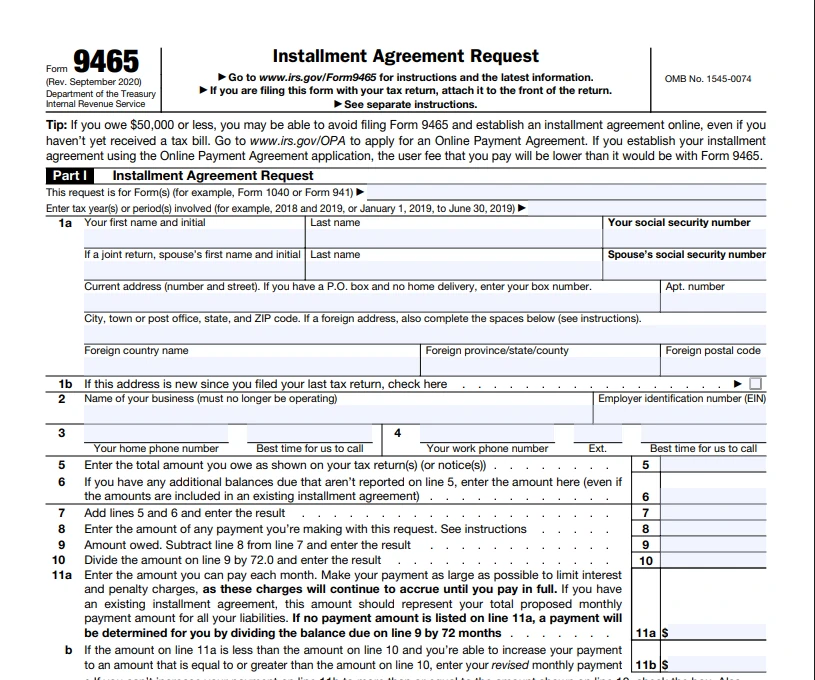
Form 9465 (Installment Agreement Request) is filed with your tax return or separately. For a PPIA, file Form 9465 along with Form 433-F (short financial form) or Form 433-B (detailed financial form) showing your IRS monthly payment capacity.
Required Documentation
Standard agreements require minimal documentation if debt is under $50,000. PPIA requires detailed financial records: recent pay stubs, bank statements, proof of expenses, asset statements, and a complete financial history.
Alternatives If Neither Option Fits
If neither plan works, other routes exist.
Offer in Compromise
An Offer in Compromise lets you settle for a negotiated amount less than the debt, with the remaining balance forgiven immediately rather than after a period. Learn about Offer in Compromise options to compare this route against installment and PPIA arrangements.
Currently Not Collectible Status
If you have no ability to pay, CNC status temporarily pauses collection. Find out if the Currently Not Collectible status is right for you as a bridge until your financial situation improves enough to qualify for an installment agreement or PPIA.
Penalty Abatement
If penalties make up a large portion of your debt, requesting relief under First-Time Penalty Abatement or Reasonable Cause Abatement reduces the total amount owed, making either agreement more affordable. Understand IRS penalties and interest to see whether abatement could lower your payment plan costs.
Common Mistakes Taxpayers Make
Understanding the most common pitfalls helps you avoid them.
Missing Monthly Payments
Missing payments terminates your agreement and triggers default procedures, including wage garnishment and bank levies. Missing even one payment can end the entire arrangement.
Failing to File Future Returns
If you fail to file a required return or pay current-year taxes while under an agreement, the IRS will terminate your plan. Staying current on filing and payment is mandatory.
Ignoring IRS Notices
The IRS sends periodic notices about payment status and any changes. Ignoring them can result in plan termination or collection action. Always open and respond to IRS notices.
How Salinger Tax Consultants Helps You Choose the Right IRS Payment Solution
Choosing the wrong plan costs money and creates unnecessary stress. At Salinger Tax Consultants, our tax resolution experts evaluate your financial situation, explain your available options, and negotiate with the IRS to help you pursue the most affordable and effective path toward resolving your tax debt.
Personalized Financial Analysis
We analyze your actual financial situation, income, living expenses, asset equity, and future earning potential to determine which plan is likely to result in the lower total cost.
IRS Negotiation Support
We handle discussions with the IRS about your monthly payment amount, appeal denials, and modify agreements if your circumstances change. We also advocate for maximum allowable living expenses so your payment is as low as possible.
Long-Term Tax Relief Planning
We help you understand that this payment plan is one step toward permanently resolving your tax debt. We identify the best steps for the future.
Which IRS Payment Plan Saves More?
The answer depends on your circumstances. A standard installment agreement typically costs more overall but offers stability and predictability. A Partial Payment Plan may cost less if your income remains limited and debt forgiveness occurs, but requires ongoing IRS scrutiny.
The key is understanding your likely income trajectory and being honest about what you can afford. Working with a professional to analyze both options before you commit ensures you choose the path that genuinely saves you money.
If you are unsure whether an IRS installment agreement, Partial Payment Plan, or another tax relief option is right for you, Salinger Tax Consultants can help. Speak with an experienced IRS tax resolution specialist today to discuss your options and start the application process.
FAQs
It depends on your circumstances. A standard agreement costs more overall because you pay the full debt. A PPIA may cost less if forgiveness occurs, but if your income increases during the agreement, the IRS may modify the plan and require higher payments.
Yes, you can request a modification if your income decreases or expenses increase. You must provide updated financial documentation to support a lower payment request.
The IRS calculates income from all sources, subtracts allowable living expenses based on IRS National Standards, and expects you to pay the remaining balance toward your tax debt each month.
No, both interest and penalties continue to accrue under any payment arrangement. They stop accruing only when the debt is paid in full.
Yes, if your financial circumstances deteriorate significantly, you can request a modification from a standard agreement to a PPIA. You must provide financial documentation to support the change.
Form 9465 is the Installment Agreement Request form. You use it to apply for both standard installment agreements and Partial Payment Plans.
Missing a payment can terminate your agreement and trigger collection action, including wage garnishment and bank levies. The IRS typically provides notice before termination, but the safest approach is to make every payment on time.
Yes, strongly recommended. A professional helps you choose the right plan based on your circumstances, ensures your financial documentation is accurate and complete, and represents you if the IRS proposes a payment amount you cannot afford.

