

If you owe the IRS and are considering an offer in compromise, Form 433-A OIC is the document that will shape your result. It asks about your bank balances, monthly bills, household income, and the assets you own. The IRS uses those answers to determine the lowest amount it would reasonably accept.
This guide walks through how the IRS reviews each part of the form, how it turns your answers into a minimum offer, and which mistakes slow a review down.
|
Key Takeaways
|
What Is Form 433-A (OIC), and Why Does It Matter?
Form 433-A (OIC) is the Collection Information Statement for Wage Earners and Self-Employed Individuals. This offer-in-compromise financial statement shows the IRS your income, expenses, assets, and debts. The answers on this form largely determine the minimum offer the IRS will consider.
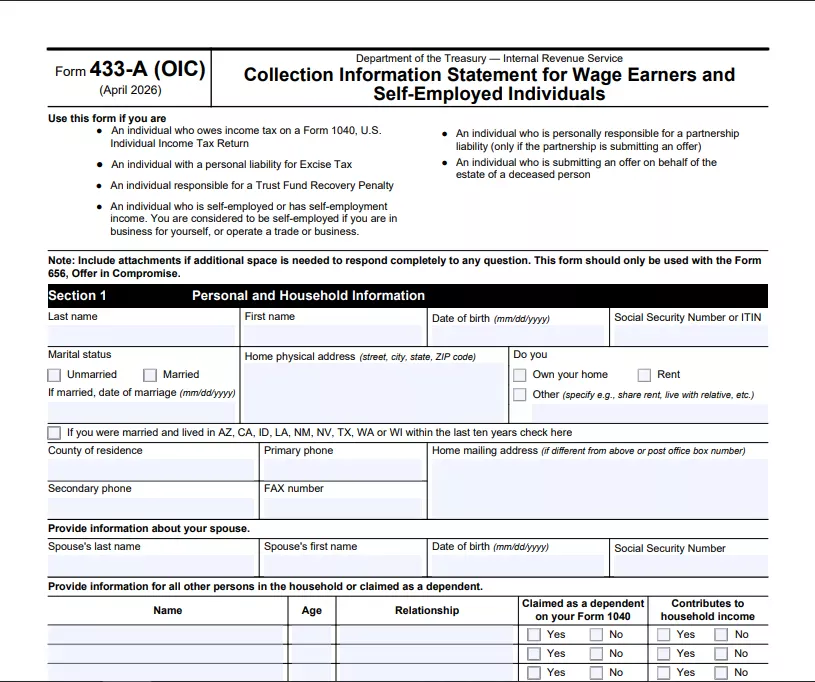
What Financial Information Does Form 433-A OIC Collect?
Each section gathers one part of your finances, and the final section turns those figures into a minimum offer amount.
- Section 1: personal and household information, including your spouse and other household members
- Section 2: employment information for wage earners
- Section 3: personal assets, including bank accounts, investments, retirement accounts, real estate and vehicles
- Sections 4 through 6: business information, assets and income for self-employed taxpayers
- Section 7: monthly household income and expenses
- Section 8: the minimum offer calculation
How Form 433-A OIC Works With Form 656
Form 656 is the offer itself. It names the tax years, the offer amount, and the payment option you choose. Form 433-A OIC supports that offer amount. The number on Form 656 must equal or exceed the amount calculated on Form 433-A OIC, unless you explain special circumstances on the offer. A complete package includes:
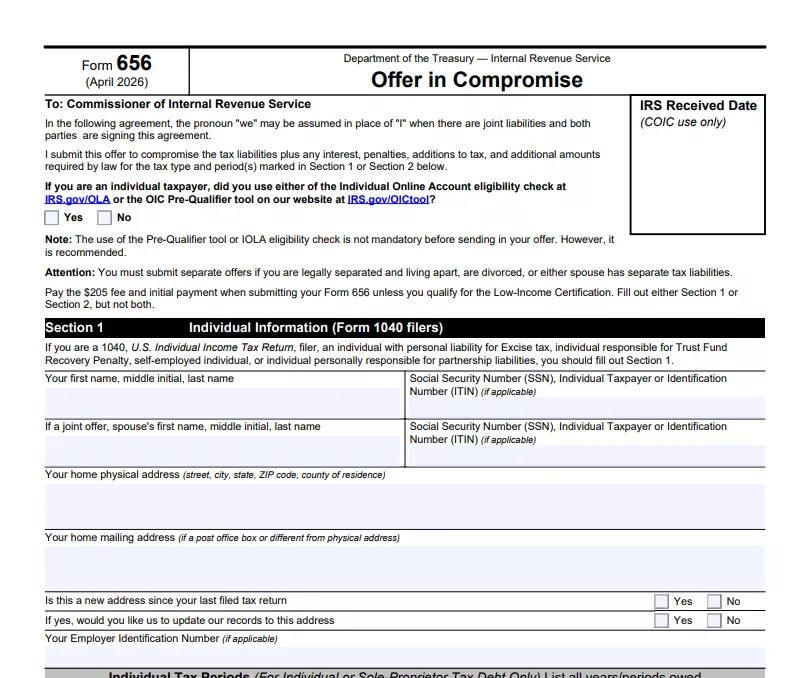
- Form 656, completed and signed
- Form 433-A OIC, completed and signed
- Supporting documents for each figure you report
- The $205 application fee, unless you qualify for low-income certification
- The initial payment, based on the payment option you choose
How the IRS Reviews Form 433-A (OIC)
The IRS checks more than arithmetic. Reviewers confirm that the figures agree with one another and with the records behind them, then compare your answers with IRS standards.
The review starts with this financial statement, tests it against documents, and then applies the formula to the results.
Does the Information Tell a Consistent Financial Story?
A reviewer looks for connections across the sections. Reported wages should match pay stubs, bank balances should match statements, and a housing payment should match a lease or mortgage statement.
When a figure does not match its record, the IRS may ask for clarification, which adds time. Explain any difference in writing and attach the record behind it. Reviewers commonly check:
- Income compared with pay stubs, 1099 forms, and tax returns
- Bank balances compared with the most recent statements
- Monthly bills compared with lease, loan, and utility records
- Asset ownership compared with titles, deeds, and account statements
Which Assets and Accounts Does the IRS Review?
Section 3 asks about nearly everything you own. The IRS wants accounts listed even when the balance is zero, because it needs to see where money could be held. Include online accounts, digital assets, and stored value cards such as a payroll card. For each asset, enter the amount you could sell it for today, not what you paid for it.
Real estate, vehicles, retirement accounts, and life insurance with cash value also appear here. A leased vehicle counts as zero. Asset values remain subject to IRS adjustment, so keep statements for every value you enter.
Why Supporting Documents Matter During the Review
The form is signed under penalties of perjury, so each figure needs a record behind it. The Form 656 booklet lists the attachments most applicants include, such as recent pay stubs, investment and retirement statements, lender statements, and complete bank statements for the three most recent months.
- Pay stubs or other proof of income
- Investment and retirement account statements
- Complete bank statements for the three most recent months
- Loan statements showing monthly payments and balances
- Court orders for any child support or alimony you claim
Self-employed applicants need more. The IRS asks for the six most recent statements for each business bank account.
How the IRS Calculates Reasonable Collection Potential
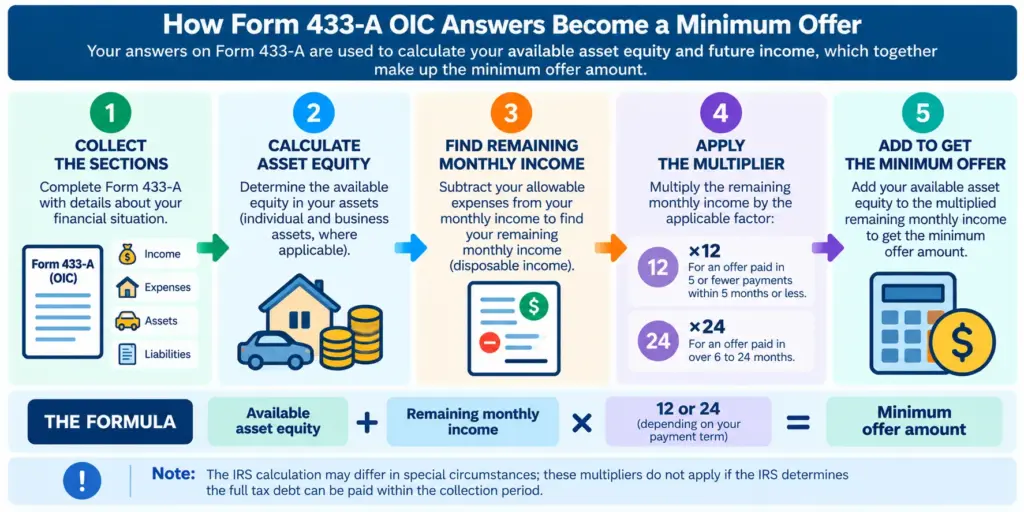
Reasonable collection potential, often shortened to RCP, is the IRS estimate of how much it could collect from you through its normal collection tools. The minimum offer on Form 433-A OIC is built from RCP. Two parts drive the number: the equity in your assets and your future monthly income.
If the math feels confusing, assistance with the OIC process can walk you through each step.
How Available Equity in Assets Is Calculated
Section 3 values each asset at a reduced share of its market value and then subtracts any loan balance. Some allowances apply to everyone, while others apply only to individual taxpayers. A line that works out to a negative number counts as zero. The main rules are:
- Bank accounts: total balance minus a $1,000 allowance
- Investments: current market value minus any loan balance
- Retirement accounts, real estate, vehicles, and other valuables: 80 percent of market value, minus any loan balance
- Vehicles: a $3,450 allowance for individual filers, applied as the form instructs
- Personal assets: an IRS deduction of $11,980 applied to the personal asset total
How Future Income Affects the Offer Amount
Future income starts with remaining monthly income, the figure in Box F that subtracts household expenses from household income. If you pay the offer within five months, Form 433-A OIC multiplies that figure by 12.
If you pay over six to 24 months, it multiplies by 24. A longer payment window produces a larger figure, which is why your payment terms change the minimum.
Remaining monthly income is never entered below zero. The multipliers also do not apply if the IRS determines that you can pay the full balance within the legal collection period. In that case, a different resolution option may fit better.
| Payment option | Multiplier on remaining monthly income | Future income with $300 remaining |
| Lump sum, paid within 5 months | Multiply by 12 | $3,600 |
| Periodic, paid over 6 to 24 months | Multiply by 24 | $7,200 |
How Asset Equity and Future Income Combine
The minimum offer is the sum of asset equity and future income. Here is a hypothetical example. Suppose your assets produce $4,000 of equity and your remaining monthly income is $300. Under the lump-sum option, the future income figure is $3,600, so the minimum offer is $7,600. The steps look like this:
- Minimum offer: $4,000 in equity plus $3,600 in future income, or $7,600
- Initial payment: 20 percent of the offer, or $1,520, submitted with the offer
- Remaining balance: $6,080, paid in five or fewer payments after acceptance
- Application fee: $205, due with the offer
Your real numbers will differ. Choosing a 24-month periodic plan would raise the minimum to $11,200 in this example.
Why the Offer Amount May Differ From What You Can Afford
Many taxpayers expect the IRS minimum to match their household budget, and it often does not. The IRS applies standards to some expenses and its own formulas to asset values, so a budget that feels tight can still produce a higher figure.
Read More: Owe the IRS $100K? Offer in Compromise Pre-Qualification and Realistic Outcomes
How the IRS Evaluates Income and Expenses on Form 433-A (OIC)
Income and expenses determine the monthly remaining figure that drives your offer, so accuracy matters here.
Wages and Business Income
Wage earners report gross monthly wages. Do not subtract tax withholding, insurance premiums, or union dues, because the form handles those amounts separately as expenses. Self-employed taxpayers report gross receipts, subtract business expenses, and arrive at net business income. The form asks for:
- An average of six to 12 months of receipts to find a gross monthly figure
- A current profit and loss statement, when one is available
- Depreciation and other non-cash deductions added back, because the form does not allow them as expenses
Rental, Retirement, and Other Income Sources
Household income includes more than wages. The form also asks about Social Security, pensions, unemployment benefits, rental income, interest, dividends, child support, and alimony.
Income from sharing-economy work, such as rideshare driving or short-term rentals, belongs on the form too. A non-liable spouse who contributes to household expenses may count, even if that spouse owes no tax.
What Expenses Does the IRS Allow in an Offer in Compromise?
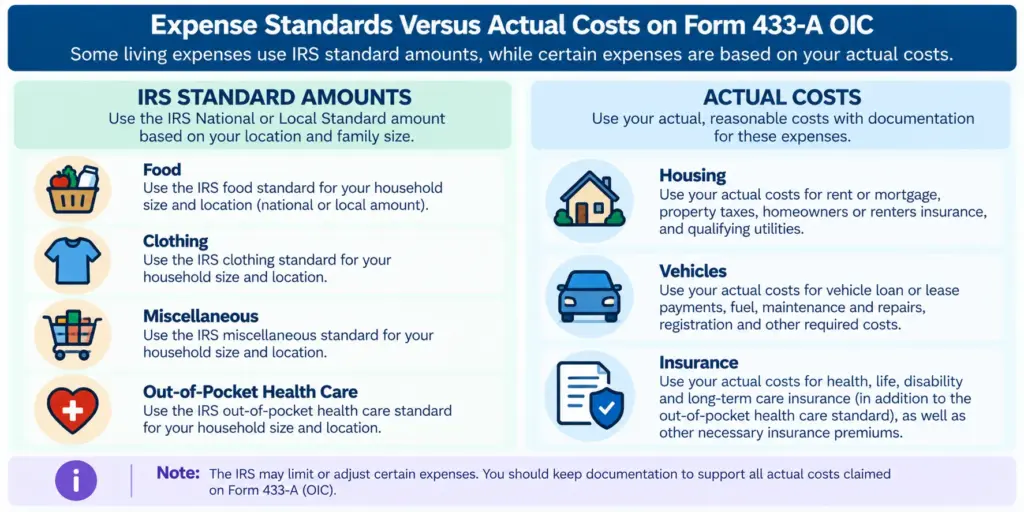
The IRS allows expenses that are necessary for your health and welfare or for producing income, and that are reasonable in amount. Some categories use national standards, which means the IRS applies a set amount even if you spend less.
Others use your actual costs, which you must verify when they run high. Current food, clothing, and miscellaneous standards, effective June 29, 2026, appear below.
| Household size | Food, clothing and miscellaneous standard |
| One person | $867 |
| Two persons | $1,558 |
| Three persons | $1,857 |
| Four persons | $2,176 |
For each person beyond four, add $397. Out-of-pocket health care costs use a standard of $90 per person under 65 and $163 per person 65 or older, effective April 21, 2025. Housing, vehicle, and insurance costs use your actual payments.
If standard amounts do not cover your necessary expenses, the IRS can allow reasonable costs above the standard, but you will need to document them. The IRS generally does not count private school tuition, charitable contributions, or unsecured debt payments.
How to Fill Out Form 433-A (OIC) Without Common Errors
Learning how to fill out Form 433-A OIC correctly often separates a smooth review from a stalled one. Most errors are simple, such as a missing signature, a blank field or a figure that does not match a record. If you want a second set of eyes before you send anything, consider help preparing an Offer in Compromise.
Report Personal, Household, and Employment Information Accurately
Section 1 asks for your personal details, marital status, home ownership, and everyone in the household. The IRS needs to know whether each household member contributes to household income or is claimed as a dependent on your return.
If you lived in a community property state within the last ten years, the form asks you to check a box and provide spouse details. Section 2 covers employer details and pay frequency, so match the pay period to your pay stubs.
Disclose Assets, Debts, and Other Financial Interests
Section 9 asks questions that many applicants overlook. The form asks about:
- Bankruptcy filed in the past seven years
- Time lived outside the United States for six months or longer in the past ten years
- Litigation, trusts, and estates in which you hold an interest
- Assets worth more than $10,000 transferred for less than full value in the past ten years
Common Errors That Can Delay Your Review
Many delays come from the same few problems. Before you submit, check the package for these issues:
- Forms that are unsigned or missing required pages
- Attachments left out of the package
- Expenses above standards with no supporting bills
- Bank balances or income that differ from the statements
Eligibility comes first. Your offer in compromise qualification depends on filing all required returns, keeping current estimated payments, and making any required federal tax deposits. The IRS checks these requirements before it considers an offer. The OIC Pre-Qualifier tool can also help you check eligibility before you complete the paperwork.
What Happens After You Submit Form 433-A (OIC)
After filing, the next stages follow a clear pattern, so knowing what to expect helps you respond on time.
How the IRS May Request More Information
Once the IRS confirms eligibility and begins processing, it may ask for updated financial records or clarification. Late replies can result in the return of your offer without appeal rights. The IRS can also suspend most collection activity during review, but interest and penalties continue to accrue, so keep filing and paying current taxes while the offer is pending.
What an Acceptance, Rejection, or Return Means
An accepted offer comes with conditions. You must meet its terms and stay current with filing and payment obligations, and the IRS will not release federal tax liens until the offer is paid in full.
A rejected offer keeps the application fee, applies your payments to the balance, and can be appealed to the IRS Independent Office of Appeals. A returned offer is different because it carries no appeal rights.
What to Review If the IRS Rejects Your Offer
A rejection is not the final word, but the clock starts quickly. Compare each figure in the rejection letter with your original form and records. Look for missing attachments, incorrect asset values, and expense standards applied in error. You generally must request an appeal in writing within 30 days of the rejection notice.
If you find an error, an appeal may be appropriate. If the numbers are correct and the offer is not workable, another option such as an installment agreement may fit better.
Read More: IRS Offer in Compromise Pre-Qualifier Tool: 5 Things It Gets Wrong
How Salinger Tax Consultants Can Help With Your Offer in Compromise
Salinger Tax Consultants helps taxpayers prepare the offer in compromise package and manage the IRS process after filing. Our work centers on the figures that drive your minimum offer.
- Eligibility review: we check your income, expenses, assets, and balance due against IRS offer rules
- Form preparation: we organize Form 433-A OIC, Form 656 and the supporting documents
- Offer calculation: we estimate a realistic offer amount from your records
- Pre-submission review: we check the package for missing signatures, attachments, and inconsistent figures
- IRS correspondence: we respond to IRS requests and assist with appeals when appropriate
Conclusion
Form 433-A OIC is where your offer begins. The IRS uses its figures to set the minimum amount, so accuracy, documentation, and clear explanations for unusual items carry real weight.
Salinger Tax Consultants can review your numbers, prepare the package, and handle IRS correspondence after you file. If you are unsure whether an offer in compromise fits your situation, a conversation can clarify your options. Contact our tax resolution team to discuss your situation before things get complicated.
FAQs
Form 433-A OIC is the collection information statement that individuals and sole proprietors use with an offer in compromise. The IRS uses this offer-in-compromise financial statement to calculate a minimum offer. Business entities use Form 433-B (OIC) instead.
The IRS compares your reported income, expenses, and assets with supporting records and IRS standards. It then calculates reasonable collection potential, which is the amount it estimates it could collect. Your offer generally must equal or exceed that figure.
The IRS allows necessary expenses for health, welfare, and producing income, within reasonable amounts. Food, clothing, and miscellaneous costs use national standards, while housing, vehicle, and insurance costs generally use actual payments. Amounts above the standards need documentation.
Complete each section that applies to you, match every figure to a current statement, sign the form, and attach the required documents. Then compare the totals with your Form 656 before you submit.
Reasonable collection potential is the IRS estimate of what it could collect from you. It adds the equity in your assets to your future income, which is remaining monthly income multiplied by 12 or 24. Your offer generally must match or exceed that total.
No. Completing the form correctly supports your offer in compromise qualification, but the IRS still reviews your eligibility, finances, and documents before it decides.
Professional help can organize records, check calculations, and flag gaps before you file. A tax resolution professional can also help you decide whether an offer fits your situation or whether another IRS option is a better match.

