

If the IRS Offer in Compromise (OIC) Pre-Qualifier Tool tells you that you don’t qualify, don’t assume your case is over. The tool is only an estimate based on your inputs and doesn’t reflect a final IRS decision. It often misses key factors like financial hardship or documentation that can support a successful offer.
This guide covers the tool’s limitations and why professional analysis can uncover opportunities the calculator misses.
|
Key Takeaways
|
What Is the IRS Offer in Compromise Pre-Qualifier Tool?
The Offer in Compromise eligibility tool is a free online calculator provided by the IRS. It helps taxpayers estimate whether they might qualify to settle their tax debt for less than the full amount owed.
The tool asks for financial information and compares it against IRS collection standards. Based on your responses, it estimates whether pursuing an Offer in Compromise may be worthwhile.
It’s important to understand that the tool is intended to help taxpayers decide whether pursuing an Offer in Compromise may be worthwhile. It does not approve or deny applications, and the IRS does not rely on the calculator when making its final decision. Every application is evaluated individually after reviewing the taxpayer’s financial information and supporting documentation.
Although useful, the calculator cannot replace the IRS’s formal review process.
How the IRS Pre-Qualifier Works
The IRS OIC pre-qualifier tool asks for information about your income, expenses, assets, tax debt, filing status, and dependents.
Using the information, it estimates your Reasonable Collection Potential (RCP), the amount the IRS believes it could collect from your assets and future income. If that amount exceeds your tax debt, the tool may indicate that you don’t qualify.
Because the results rely entirely on self-reported information, errors or overlooked expenses can affect the outcome.
Information the Tool Uses
Your OIC eligibility estimate depends entirely on the information you provide. Typical inputs include:
| Financial Information | Examples |
| Income | Wages, self-employment income, retirement income |
| Expenses | Housing, transportation, healthcare, food |
| Assets | Home equity, vehicles, investments, bank accounts |
| Liabilities | Loans, mortgages, certain debts |
Is the IRS OIC Pre-Qualifier Tool Accurate?
The short answer is yes, but only within its limits.
The IRS OIC pre-qualifier tool accuracy is generally good when taxpayers enter complete and accurate financial information that fits straightforward situations. However, it cannot evaluate every factor the IRS considers during a formal Offer in Compromise review.
What the Tool Does Well
The OIC calculator provides several benefits.
It helps taxpayers:
- Understand the general qualification process
- Estimate collection potential
- Identify obvious disqualifying factors
- Decide whether pursuing an Offer in Compromise may be worthwhile
| What the Tool Does | Benefit |
| Screens basic eligibility | Helps determine whether an OIC may be worth exploring |
| Uses IRS financial standards | Provides a consistent starting point |
| Estimates collection potential | Gives taxpayers a general idea of how the IRS evaluates ability to pay |
| Free to use | Allows taxpayers to assess their situation before applying |
For taxpayers with simple financial situations, it can provide a reasonable starting estimate.
Where It Falls Short
Many taxpayers searching for IRS OIC calculator wrong examples discover that the calculator cannot account for many real-world circumstances.
Some common limitations include:
- No review of supporting documents
- Limited hardship analysis
- No professional judgment
- No consideration of future financial changes
- No evaluation of unusual expenses
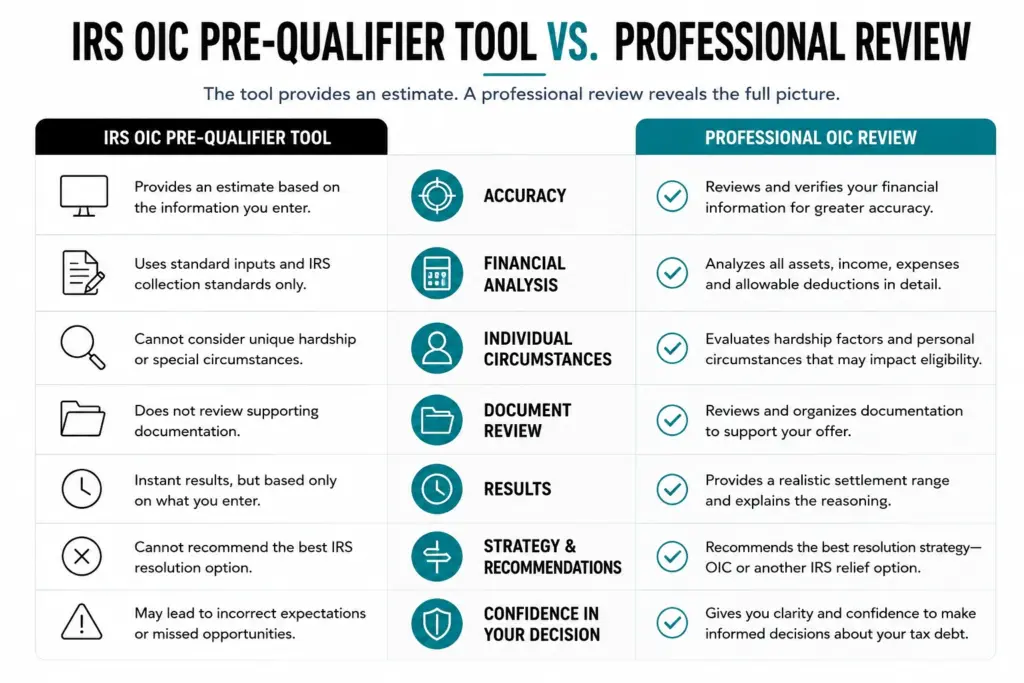
| IRS Pre-Qualifier Tool | Professional OIC Review |
| Estimates eligibility | Reviews actual eligibility |
| Uses entered data only | Verifies financial records |
| Cannot assess unique hardship | Evaluates special circumstances |
| Does not review documents | Analyzes supporting evidence |
| Cannot recommend strategy | Determines the most appropriate IRS resolution option |
These limitations mean the IRS may still approve an Offer in Compromise even if the calculator suggests otherwise.
|
Common Mistake Many taxpayers assume “Not Eligible” means they should never apply. In reality, the IRS reviews far more information than the online calculator. |
5 Things the IRS OIC Pre-Qualifier Tool Gets Wrong
While the calculator is useful, there are several areas where it simply cannot replace a complete case review.
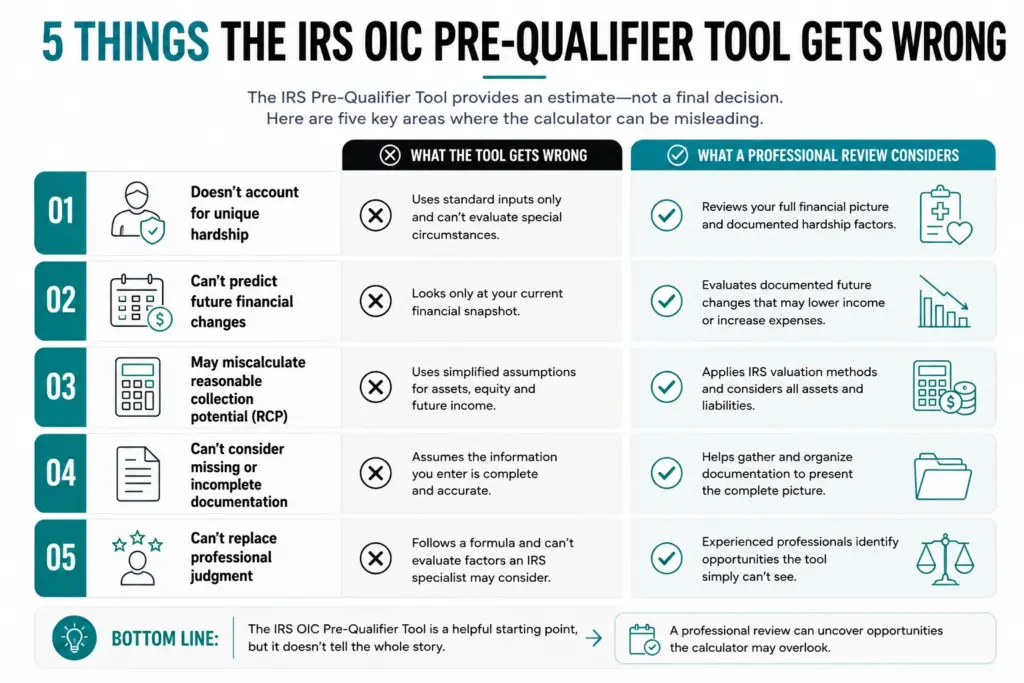
1. It Doesn’t Fully Consider Special Circumstances
The IRS has an option called Effective Tax Administration, which allows some taxpayers to qualify even when they technically can pay.
Examples include:
- Serious medical conditions
- Advanced age
- Permanent disability
- Extraordinary financial hardship
The calculator cannot properly evaluate these unique circumstances.
One issue we frequently encounter is taxpayers assuming they have no options simply because their income appears too high. A professional review often reveals hardship factors that deserve closer examination.
2. It Cannot Predict Future Financial Changes
Your current finances may not reflect your future ability to pay. Retirement, job loss, reduced hours, medical treatment, or a business downturn can significantly affect your financial situation, but the calculator primarily evaluates your current numbers.
For example, someone retiring in six months may currently appear able to pay, even though documented retirement could substantially reduce future income and affect their Reasonable Collection Potential.
3. It May Miscalculate Reasonable Collection Potential (RCP)
Reasonable Collection Potential represents the amount the IRS believes it could collect before the collection statute expires.
Although the calculator estimates this figure, it cannot account for every financial detail.
For example:
| Factor | Calculator | Professional Review |
| Asset valuation | Estimated | Detailed analysis |
| Allowable expenses | Limited | Full IRS standards applied |
| Income adjustments | Basic | Case-specific review |
| Collection timeline | Limited | Strategic evaluation |
Reasonable Collection Potential combines the equity in your assets with the amount the IRS believes it can collect from your future income. Because both figures depend on accurate financial information and IRS valuation methods, even small adjustments can significantly affect your settlement calculation. This is one reason a professional review may produce a different result than the online calculator.
4. It Doesn’t Review Supporting Documentation
The calculator never reviews your OIC documentation.
During a real Offer in Compromise review, the IRS may examine:
- Bank statements
- Pay stubs
- Medical bills
- Property valuations
- Loan documents
- Business records
Strong documentation often explains financial circumstances that simple numbers cannot.
Many clients who contact us have already completed the online calculator but never realized the importance of supporting evidence.
5. It Cannot Replace Professional Judgment
The calculator cannot replace professional judgment. A former IRS revenue officer or tax expert evaluates your full financial picture to spot hardship factors and details that an automated tool misses.
A former IRS agent OIC review looks beyond the calculator by considering:
- IRS settlement practices
- Collection procedures
- Documentation quality
- Potential appeal issues
- Collection statute timing
- Strategic filing decisions
Professional judgment helps identify risks and opportunities that software simply cannot evaluate.
|
Pro Tip Before you check your OIC eligibility, review your finances using the same documentation you’ll eventually submit to the IRS. Accurate records produce far more reliable estimates. |
Why the Tool Says “Not Eligible” When You May Still Qualify
A “Not Eligible” result from the IRS Pre-Qualifier Tool does not necessarily mean you cannot settle your tax debt. The Offer in Compromise eligibility tool provides an estimate based on the information entered and cannot assess every factor the IRS considers.
In some cases, additional documentation, IRS guidelines, or unique financial circumstances may affect your eligibility.
| If the Tool Says… | It May Actually Mean |
| Not eligible | More financial information may be needed. |
| Income is too high | IRS allowable expenses may reduce disposable income. |
| Assets have too much equity | A detailed valuation may lower the collectible amount. |
| An Offer in Compromise isn’t recommended | Another IRS relief program may be more appropriate. |
Doubt as to Collectibility Cases
The most common basis for OIC eligibility is Doubt as to Collectibility. This applies when the IRS determines that it is unlikely to collect the full tax debt before the collection period expires.
The IRS reviews much more than your monthly income. It also considers:
- Equity in assets
- Allowable living expenses
- Future earning potential
- Existing liabilities
- Collection time remaining
A professional review often produces a more accurate financial picture than the online calculator.
Effective Tax Administration Cases
Some taxpayers qualify under Effective Tax Administration, even if they technically can pay. These cases typically involve exceptional situations where collecting the full tax debt would create significant hardship or be unfair.
Examples include:
- Permanent disability
- Serious or chronic illness
- Advanced age
- Limited earning capacity
- Extraordinary caregiving responsibilities
The calculator cannot determine whether these factors justify relief, but the IRS may consider them during a full review.
Temporary Financial Hardship
Financial situations can change quickly. A recent job loss, reduced income, divorce, medical emergency, or business slowdown may create temporary IRS financial hardship that the calculator does not fully recognize.
If your financial circumstances have changed or are expected to change soon, the online estimate may not accurately reflect your true eligibility.
Read More: Back Taxes: Step-by-Step Catch-Up Plan Without Triggering More Issues
What a Former IRS Agent Looks at Instead
A former IRS agent’s OIC review goes beyond the numbers. Experienced professionals understand how IRS settlement officers evaluate financial information and supporting evidence.
Rather than relying solely on automated calculations, they analyze the complete financial picture before recommending an Offer in Compromise.
Allowable Living Expenses
One of the biggest differences between a professional review and an online estimate is the application of IRS allowable expenses. The IRS does not simply compare your actual monthly spending against your income. Instead, it uses national and local standards for many categories of living expenses.
These commonly include:
| Expense Category | Examples |
| Housing | Rent, mortgage, utilities |
| Transportation | Vehicle ownership and operating costs |
| Food and household | Groceries and personal care |
| Healthcare | Insurance, prescriptions, medical costs |
Asset Equity Analysis
The IRS also reviews asset valuation to determine how much equity may be available for collection.
This analysis may include:
- Real estate
- Vehicles
- Retirement accounts
- Investments
- Business assets
- Cash and bank accounts
A common mistake we see is taxpayers overestimating the value of their assets. Fair market value, outstanding loans, exemptions, and liquidation costs all affect the equity the IRS considers.
Future Income Potential
Future income plays a major role in determining whether an Offer in Compromise is appropriate.
The IRS evaluates factors such as:
- Employment stability
- Business income trends
- Retirement plans
- Expected salary changes
- Long-term earning capacity
Unlike the calculator, a professional review can explain why future income may reasonably decline.
Collection Statute Considerations
Every IRS tax debt has a collection deadline known as the IRS collection statute. In many cases, the IRS generally has ten years from the date of assessment to collect a tax debt, although certain events can extend this period.
The remaining collection time may influence settlement strategy because it affects how much the IRS believes it can realistically recover.
|
IRS Reminder: An Offer in Compromise should always be evaluated alongside the remaining IRS collection period and your long-term financial outlook. |
Common Mistakes Taxpayers Make When Using the Tool
Even the best calculator cannot provide reliable results when the information entered is incomplete or inaccurate.
Entering Incorrect Financial Information
Accuracy depends entirely on your inputs. If the information is incomplete or outdated, the estimate will be unreliable. Even small omissions can significantly skew your results. Gather current pay stubs and bank statements before using the tool to ensure your data reflects your true situation.
Ignoring Allowable Expenses
The IRS uses National and Local Standards for allowable expenses rather than your actual spending. Failing to account for these standards leads to unrealistic settlement expectations. Reviewing your finances against these IRS guidelines first provides a much more realistic estimate of your potential offer.
Overvaluing Assets
Reporting assets at full market value is a mistake. The IRS evaluates realizable equity after accounting for loans and potential liquidation costs.
For example, a vehicle’s value is reduced by its outstanding loan balance. Applying this principle to homes and investments prevents overstating your ability to pay.
How to Improve Your Chances Before Filing an OIC
Before submitting an application, take time to ensure your financial information is complete and accurate.
Gather Complete Financial Records
A well-prepared Offer in Compromise application includes complete and accurate financial records. Gathering your documentation before using the IRS Pre-Qualifier Tool or submitting an application helps ensure your financial information is consistent, verifiable, and less likely to raise questions during the IRS review process.
Before filing an Offer in Compromise, gather:
- Recent federal tax returns and any required supporting schedules
- The last three to six months of bank statements for all accounts
- Recent pay stubs or business profit and loss statements
- Mortgage statements, lease agreements, or rent documentation
- Vehicle loan statements and estimated vehicle values
- Retirement, investment, and savings account statements
- Medical bills or healthcare expenses, if claiming financial hardship
- Records of outstanding loans, credit card balances, and other debts
Organizing these documents before completing your application can help you calculate a more accurate settlement amount and reduce delays if the IRS requests additional information.
Review IRS Filing Compliance
Before considering an Offer in Compromise, the IRS generally requires taxpayers to be current with required tax filings and estimated tax payments.
Review your filing history to ensure you’re meeting current tax compliance requirements before applying.
Calculate a Realistic Settlement Amount
Your Offer in Compromise should reflect your actual reasonable collection potential. An unrealistic offer may lead to delays or rejection.
If you’re ready to resolve your IRS tax debt, a professional evaluation can help determine whether an OIC is the right option before you apply.
Offer in Compromise vs Other IRS Relief Options
An Offer in Compromise is only one method of resolving IRS tax debt. Depending on your circumstances, another resolution program may be more appropriate.
| IRS Resolution Option | Best For | Main Advantage |
| Offer in Compromise | Unable to pay the full balance | May settle the tax debt for less than the total amount owed |
| Installment Agreement | Can make monthly payments | Allows the balance to be paid over time |
| Currently Not Collectible Status | Experiencing financial hardship | Temporarily pauses IRS collection efforts |
| Penalty Abatement | Qualifies for reasonable cause relief | Removes eligible penalties and may reduce the total balance |
Installment Agreement
An IRS payment plan allows taxpayers to pay their balance through monthly payments when full payment is not immediately possible.
Currently Not Collectible Status
If paying any amount would create significant hardship, the IRS may place your account into CNC status, temporarily suspending collection efforts while your financial condition remains difficult.
Penalty Abatement
Some taxpayers may qualify for IRS penalty relief if they can demonstrate reasonable cause or meet other IRS requirements.
How Salinger Tax Consultants Can Help
The IRS Offer in Compromise process can be complex, particularly when changing income, asset equity, or hardship factors are involved. While the Pre-Qualifier Tool is a useful starting point, a professional review can provide a more complete assessment.
Professional Eligibility Review
Our former IRS agent OIC review looks beyond the calculator to evaluate:
- Reasonable Collection Potential
- Allowable living expenses
- Asset equity
- Future earning capacity
- Collection statute considerations
- Potential hardship factors
This review helps determine whether an Offer in Compromise or another IRS resolution option may better fit your situation.
OIC Application Preparation
We help organize financial information, review supporting documentation, prepare the required IRS forms, and calculate a realistic settlement amount.
A complete and accurate application can help reduce delays caused by missing or inconsistent information.
IRS Negotiation and Appeals
If the IRS requests additional information or disagrees with parts of your application, experienced representation can help keep the process moving.
Our team assists with IRS inquiries, additional documentation requests, negotiations, appeals, and alternative IRS tax settlement options when an Offer in Compromise is not accepted.
If you’re unsure whether you qualify, you can get professional Offer in Compromise help before starting the application process.
Conclusion
The IRS Offer in Compromise Pre-Qualifier Tool is an excellent starting point, but it should never be treated as the final word on your eligibility. Whether the calculator indicates that you qualify or not, the IRS makes its decision after reviewing your complete financial situation, supporting documentation, and collection potential.
Salinger Tax Consultants helps taxpayers evaluate their options, prepare complete applications, and communicate with the IRS throughout the process.
To resolve your IRS tax debt, contact our tax resolution experts for personalized guidance and the next steps toward resolving your tax matter.
FAQs
Yes, it provides a useful estimate based on the financial information you enter. However, it does not replace the IRS's formal review process and cannot evaluate every eligibility factor.
A "Not Eligible" result does not automatically mean you cannot receive an Offer in Compromise. A detailed financial review may identify circumstances the calculator does not consider.
Only to a limited extent. Complex hardship situations often require documentation and professional analysis that the calculator cannot evaluate.
You should have accurate information about your income, monthly expenses, assets, debts, and tax liabilities, along with supporting financial records.
In many cases, yes. An experienced professional can review collection potential, hardship factors, documentation, and IRS procedures that extend beyond the calculator's capabilities.
Reasonable Collection Potential generally includes the equity in your assets plus the amount the IRS believes it can collect from your future income after allowable living expenses.
Yes. The IRS makes its decision after reviewing your complete financial situation and supporting documentation, not solely on the online calculator's estimate.
Common mistakes include entering inaccurate financial information, overlooking allowable expenses, overvaluing assets, and relying on estimates instead of documentation.
Depending on your circumstances, alternatives may include an Installment Agreement, Currently Not Collectible status, or Penalty Abatement. A tax professional can help determine which option best fits your situation.

