

Falling behind on a payroll deposit can happen when cash is tight. The problem grows when it happens repeatedly, as unpaid taxes quickly pile up. The IRS treats a pattern of unpaid payroll taxes far more severely than a one-time late payment. This pattern is called pyramiding payroll taxes, and spotting it early gives you more time to respond.
This guide explains what pyramiding is, why the IRS escalates repeat late deposits, and how to stop the debt from growing.
|
Key Takeaways
|
What Is Pyramiding in Payroll Taxes?
Pyramiding is the pattern of falling behind on payroll taxes and then covering that gap by falling further behind. The debt stacks up quarter after quarter instead of getting paid down. The IRS’s internal guidance describes a pyramiding taxpayer as an in-business taxpayer who is not current with federal tax deposits and who has two or more balance-due trust fund accounts assigned to its field collection group.
How Employers Accumulate Unpaid Employment Taxes
Each payday, an employer withholds federal income tax from wages and the employee share of Social Security and Medicare tax. The employer also owes its own share of those payroll taxes. The IRS calls the withheld amounts trust fund taxes because the business holds that money in trust for the government until it is deposited.
Most pyramiding begins with an ordinary cash squeeze. A business may pay rent, inventory, or net wages with money that should have gone to the IRS, expecting to catch up when the next large invoice clears. Common triggers include:
- Customers paying later than expected, leaving the account short on deposit day
- Rising rent, supplier, or inventory costs that push tax deposits down the priority list
- An expectation that a strong upcoming season will cover last quarter’s shortfall
Why Using Withheld Payroll Taxes to Cover Business Expenses Is Risky
Using withheld taxes as an operating loan can seem like a short fix, but the IRS sees those dollars differently. They were collected for the government and credited to employees’ tax accounts, so they are not available for vendors or rent. The IRS and the courts also look at what the business chose to pay. Paying other creditors while withheld taxes remain unpaid can suggest a decision rather than an accident.
How Pyramiding Differs From an Ordinary Late Payment
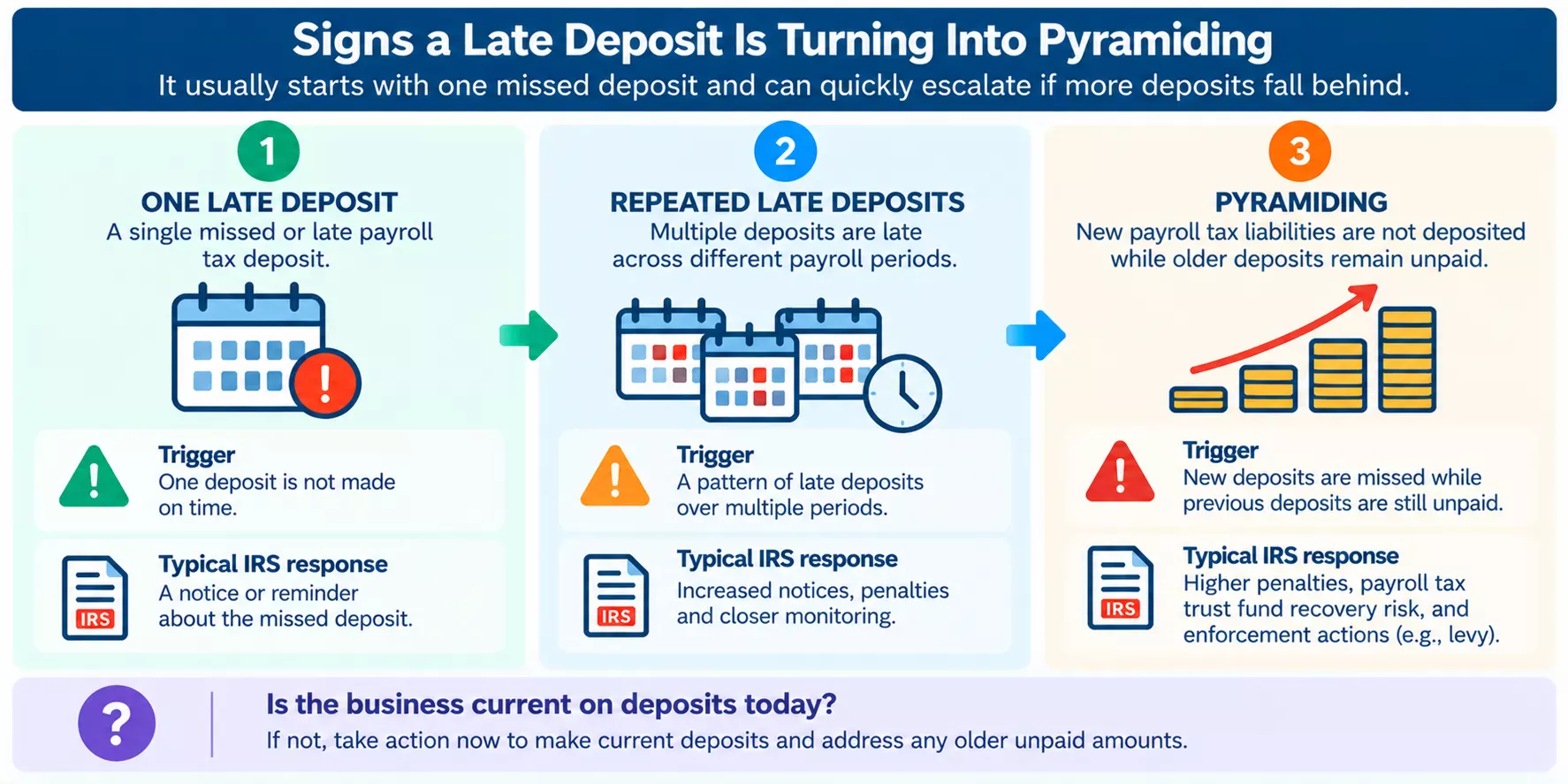
An ordinary late payment is usually a single event. The business pays the deposit, often with a penalty and interest, and returns to schedule. Pyramiding is a sequence. Current deposits keep getting missed while older balances keep growing in the background.
| Situation | What It Looks Like | Typical IRS Response |
| One late deposit | Deposit paid shortly after the due date | Failure-to-deposit penalty and interest |
| Repeated late deposits | Late deposits across several periods | Notices and closer monitoring |
| Pyramiding | Current deposits missed while older balances grow | Enforcement, possible injunction, and a personal liability review |
|
Quick Fact The IRS asks whether a business is current on its federal tax deposits at the time of review, which is why the most recent deposits carry so much weight. |
Why the IRS Escalates Repeat Payroll Tax Violations
Payroll tax compliance is a major focus for the IRS. Its manual notes that about two-thirds of federal taxes are collected through the payroll tax system, so repeat payroll tax pyramiding violations draw extra attention.
A pattern suggests the problem will continue unless something changes.
Repeated Missed Deposits and Unpaid Employment Tax Returns
A single missed deposit is a timing problem. A second or third one points to a pattern. The IRS tends to notice these warning signs together:
- Late deposits in more than one quarter
- Unpaid balances on two or more payroll tax periods
- Quarterly returns that are missing or do not match deposit records
Form 941 reports wages and withheld taxes each quarter. When returns are missing, the IRS cannot easily match what was reported with what was deposited.
IRS Notices, Collection Activity, and Revenue Officer Involvement
If the balance stays unpaid, the case can move to a revenue officer, a field collection employee who works the account directly with the business and its owners. Before certain enforcement steps, the IRS typically sends notices such as:
- Letter 1058: a notice of intent to levy that explains the right to request a collection due process hearing
- Letter 903: a warning that continued deposit failures can lead to a civil injunction
Falling behind again after a revenue officer is involved is especially costly. The IRS manual says revenue officers should tell pyramiding taxpayers that enforcement will follow without acceptable proof of compliance. Timely deposits and filed returns are what move a taxpayer out of pyramiding status, so they matter most while older debt is being resolved.
What Happens If You Keep Missing Payroll Tax Deposits?
Missed deposits in pyramiding payroll taxes cases add cost quickly, and the cost grows the longer a payment stays open. Businesses that need assistance with unpaid payroll tax liabilities often start by mapping each open balance and the penalties attached to it.
Failure-to-Deposit Penalties and Interest
Section 6656 of the Internal Revenue Code sets the failure-to-deposit penalty. The current structure works like this:
| How Late the Deposit Is | Penalty Rate |
| Not more than 5 days | 2 percent of the underpayment |
| More than 5 days, up to 15 days | 5 percent of the underpayment |
| More than 15 days | 10 percent of the underpayment |
The rate can rise to 15 percent in certain cases, such as when the amount is still unpaid 10 days after the IRS sends a first delinquency notice. Interest also continues to accrue until the balance is paid in full.
Say your business owes $10,000 in withheld taxes and pays that deposit 12 days late. At a 5 percent rate, the penalty on that deposit would be $500, before interest.
Read More: Payroll Tax Penalties: How a Tax Resolution Firm Gets Them Reduced or Removed
Tax Liens, Levies, and Other Collection Actions
When an employer’s balance stays unpaid, the IRS may file a Notice of Federal Tax Lien. A lien is a public claim against the business’s property and can make borrowing harder.
For pyramiding payroll tax cases, the IRS manual says a lien should generally be filed unless a group manager approves deferring it.
Payroll tax enforcement can also include levies on bank accounts and money owed to the business by customers, after it issues the required notice and hearing rights.
When the IRS May Investigate Responsible Persons
The Trust Fund Recovery Penalty under Section 6672 can be assessed against individuals who are responsible for collecting and paying over trust fund taxes and who willfully fail to do so.
The penalty equals the unpaid trust fund amount, which can mean 100 percent of the withheld taxes. Responsible means having the authority to make sure the taxes get paid. Willful generally means the person knew the taxes were due and chose to pay other creditors instead.
|
Important A job title does not settle the question. The IRS looks at actual authority over payroll and payment decisions, and revenue officers gather those facts in a Form 4180 interview. |
Can the IRS Shut Down Your Business for Payroll Taxes?
Many owners ask, can the IRS shut down my business for payroll taxes? The answer is more specific. The IRS can ask a federal court to restrict how a business handles payroll taxes, but a court order is not automatic. An injunction does not by itself close a business. An IRS injunction payroll taxes action usually follows several earlier collection steps.
How a Court Injunction Can Restrict Business Activities
Section 7402(a) of the Internal Revenue Code allows federal district courts to issue injunctions needed to enforce the tax laws. The IRS uses that authority against employers that keep pyramiding employment taxes.
Before recommending an injunction, IRS procedures require that a Letter 903 has been issued first. The Department of Justice files these cases on the government’s behalf, and a court order can bind the business, its owners, and certain related people.
What an Injunction May Require a Business to Do
Court orders in these cases tend to include specific duties. Sample injunctions from the Department of Justice show requirements such as:
- Depositing withheld income tax and employee and employer Social Security and Medicare taxes on time
- Filing employment tax returns, such as Forms 941 and 940, when they are due
- Paying federal employment taxes before paying other creditors
- Notifying the assigned revenue officer about new payroll or business involvement
Why an Injunction Is Not Automatic
An injunction is one tool among several. Routine case actions come first, and injunctive relief is considered when a taxpayer keeps pyramiding after contact and other remedies have not stopped it.
An injunction restricts conduct in pyramiding payroll tax cases rather than shutting doors. Owners in this position often seek payroll tax filing and resolution assistance early, before the case reaches that stage.
How to Stop Payroll Tax Pyramiding From Getting Worse
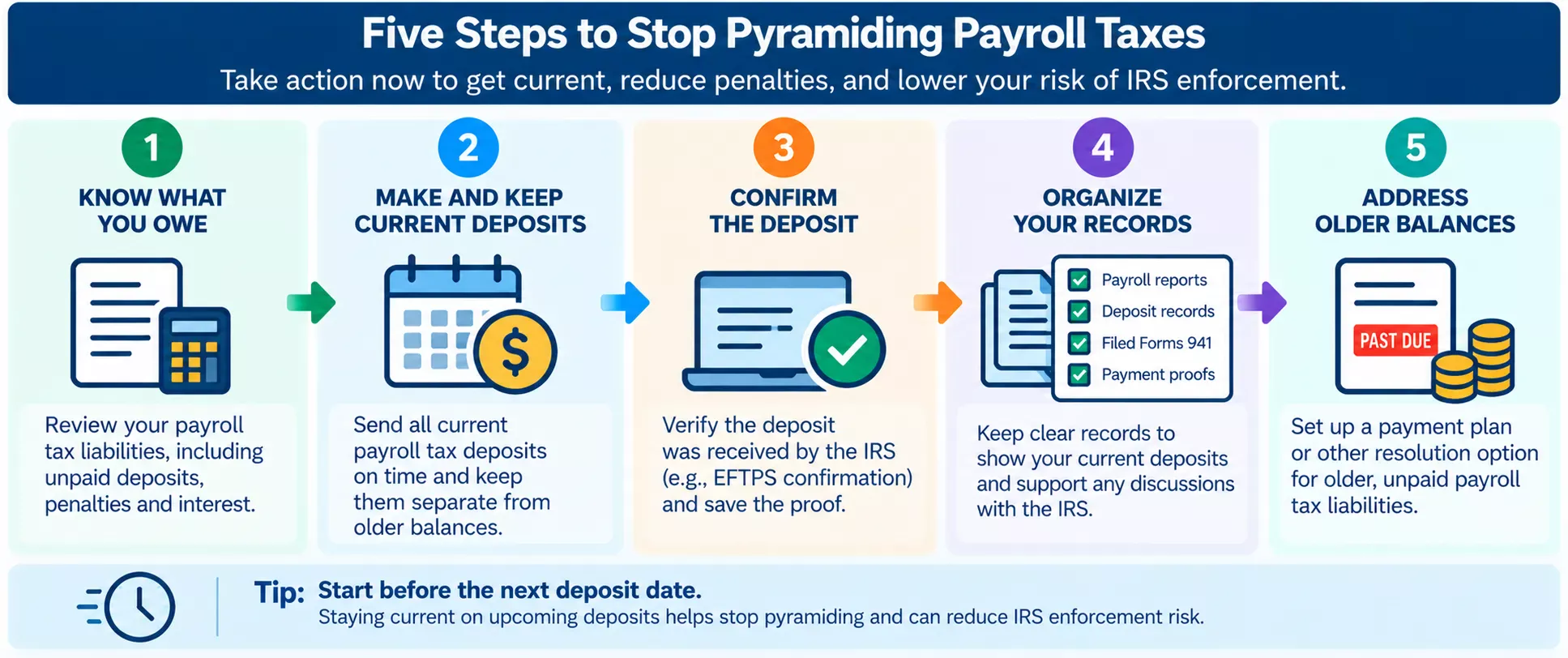
The first goal in payroll tax pyramiding cases is to stop new debt from building. The steps below work best when they start before the next deposit is due. Older balances still matter, but the IRS also looks closely at whether current deposits are being made. Working through the steps in order keeps the picture clear.
Step 1: List Each Unpaid Tax Period and Deposit
Start by listing each quarter that has an open balance. Gather the proof for each one, so the numbers come from records rather than memory.
- Record the tax due for each quarter
- Record the amount deposited and the deposit dates
- Note the deposit schedule the business must follow, whether monthly or semiweekly
- Pull bank records and EFTPS confirmations
- Compare the list with IRS notices so the figures in each notice match your records
Step 2: File Missing Employment Tax Returns
Unfiled returns can stall a case and add new penalties. Filing them correctly is one of the compliance steps the IRS expects.
- Prepare each missing Form 941 so the wage and tax figures match payroll records and deposits
- Check that the reported figures agree with what was actually deposited
- Salinger Tax Consultants offers support for missing employment tax returns, including gathering payroll registers, deposit records, and prior notices so the filed numbers are accurate the first time
Step 3: Prioritize Current Payroll Tax Deposits
The IRS expects current deposits while older balances are being worked on. Current compliance is part of how the IRS judges whether a business is still pyramiding.
- Keep deposits on the required schedule
- Save an EFTPS confirmation for each deposit
- Expect revenue officers to ask for this proof to verify that the business is no longer pyramiding
- If a deposit cannot be made in full, contact the assigned revenue officer before the deadline to explain the situation
Step 4: Organize Records and Respond to a Revenue Officer
Keep these items together so you can answer revenue officer requests quickly.
- Payroll registers and Forms 941 for each open quarter
- EFTPS confirmations and bank statements
- Copies of all IRS notices, with the response deadlines circled
Step 5: Evaluate Payment Arrangements and Other Resolution Options
Once current deposits are stable, a business dealing with pyramiding payroll taxes can review its options. Each option has different requirements, so timing matters.
- Installment agreement: a payment plan for the balance over time
- Offer in compromise: IRS guidance says the trust fund portion must be paid, the penalty assessed, or another qualifying step completed before the offer is investigated
- Penalty relief: a review of whether penalties can be reduced or removed
- In-business taxpayers must keep making timely deposits and filing returns while any offer is under review
How to Prevent Payroll Tax Pyramiding in the Future
Preventing pyramiding payroll taxes is easier than recovering from it. Strong systems make it harder for one late deposit to become a pattern, and they give owners a clear view of what is owed before the deposit date arrives.
Set Up a Reliable Payroll Tax Deposit Process
Put each deposit date on a calendar that both the owner and the person running payroll can see. Confirm the deposit schedule for the business, and have someone review each payroll run before it is processed. Check the amounts before each deposit is sent.
Separate Payroll Funds and Reconcile Deposits Monthly
Keep a separate payroll account, funded as soon as each payroll is processed, so withheld taxes are not spent by accident. Then compare payroll reports to deposit confirmations at least monthly. A reconciliation catches mismatches while they are still small and easier to correct, and it shows owners what is owed before the next deposit date.
Read More: Payroll Tax vs. Income Tax Debt: Why Business Owners Need a Different Resolution Strategy
How Salinger Tax Consultants Can Help With Payroll Tax Issues
Businesses dealing with pyramiding payroll taxes often turn to us for professional help with IRS payroll tax issues on unpaid deposits, missing returns, or revenue officer requests. Our team, led by a former IRS Revenue Officer, reviews the facts first and then builds a plan around them. Our work typically includes:
- Reviewing deposit history, notices, and balances to identify each open tax period
- Preparing missing employment tax returns from accurate payroll records
- Setting up a deposit schedule and checking proof of current deposits
- Handling revenue officer correspondence, documentation requests, and deadlines
- Evaluating installment agreements, offers in compromise, and penalty relief for your facts
Address Payroll Tax Problems Before They Escalate
Pyramiding payroll taxes can grow fast because each late deposit adds penalties, interest, and pressure on the next payroll. The IRS focuses on whether a business is current, so stopping new deposits from slipping is the first priority.
Salinger Tax Consultants can help business owners sort out their options, from current deposits to repayment and penalty relief. Acting before the next notice arrives leaves more choices on the table.
Contact our tax resolution team to discuss your payroll tax situation and the steps that fit your business.
FAQs
Pyramiding happens when a business uses withheld employment taxes for other expenses while current deposits fall further behind.
Penalties and interest grow the longer a deposit stays unpaid. The IRS can file a lien or pursue an IRS employment tax levy, and payroll tax enforcement can reach responsible individuals through the Trust Fund Recovery Penalty.
The IRS can ask a federal court for an injunction that limits how the business handles payroll taxes. An injunction is not automatic and does not by itself close the business.
Yes, in some cases. Under Section 6672, the IRS can assess the Trust Fund Recovery Penalty against a responsible person who willfully fails to pay over trust fund taxes.
Yes, through a federal court under Section 7402(a). The IRS generally issues a Letter 903 first, and an IRS injunction payroll taxes order requires ongoing deposits and filed returns.
Yes. The IRS expects current deposits while older balances are worked on, and it watches whether payroll tax compliance continues.
Respond promptly, read each requested item, and track every deadline. A quick response shows the IRS that the business is working toward compliance.
An IRS payroll tax payment plan, called an installment agreement, may be possible once the business is current on deposits and filing. It is generally not available while new unpaid taxes keep accruing.

