
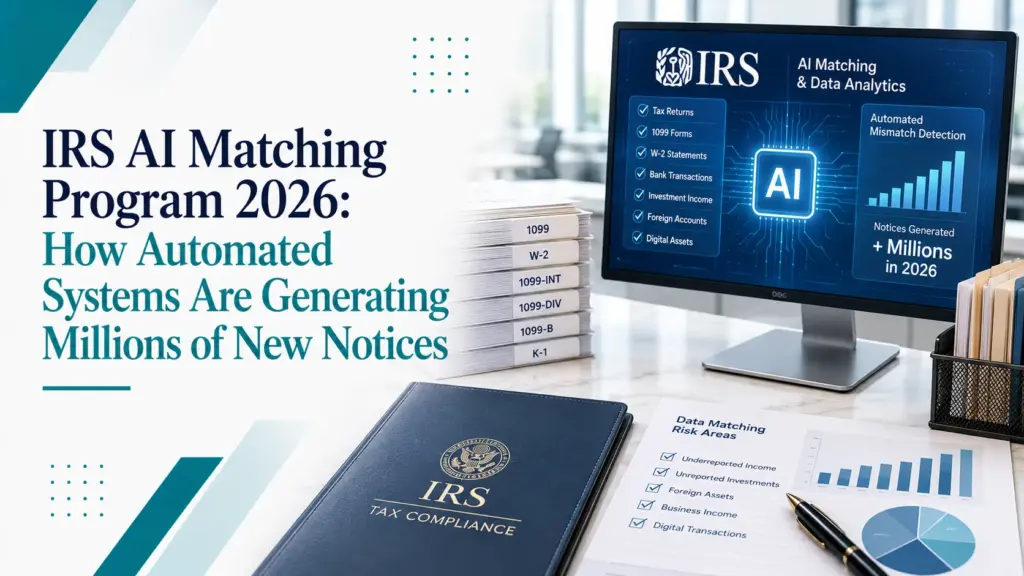
An IRS letter can arrive even when no examiner has opened your return. The agency has long used computer matching to compare tax returns with Forms W-2, 1099, K-1, and other records. In 2026, artificial intelligence and advanced analytics will also help the IRS sort large volumes of data, flag unusual patterns, and prioritize cases for review.
The phrase IRS AI matching program notices 2026 describes several connected processes rather than one newly announced program. Some notices come from established rules-based systems, while AI may support risk scoring and case selection.
If a mismatch creates a proposed balance, early review can prevent a manageable issue from becoming a collection problem.
|
Key Takeaways
|
What Is the IRS AI Matching Program?
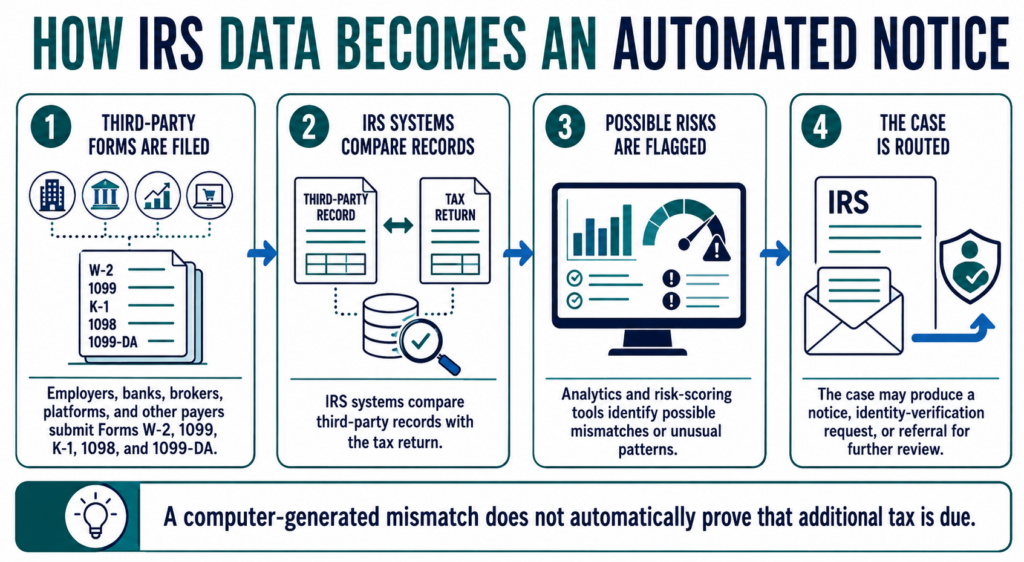
The IRS AI matching program notices 2026 label refers to the IRS’s growing use of automation, analytics, and AI alongside established compliance systems. The IRS receives tax data from taxpayers, employers, banks, brokers, platforms, and other parties. Its systems compare records, identify discrepancies, and rank work for employee review.
An AI audit IRS 2026 concern should therefore be kept in perspective. A computer flag does not automatically prove that a return is wrong, and receiving a notice does not necessarily mean you are under audit. If a mismatch involves unpaid tax from another year, back taxes resolution services can help separate the matching issue from the collection balance.
How IRS Technology Has Evolved
IRS automation predates current AI tools. For years, the Automated Underreporter program has compared individual returns with information returns. Math-error authority also permits the IRS to correct certain clear filing mistakes during processing. Newer technology adds data integration, anomaly detection, and faster workload prioritization.
AI vs Traditional IRS Data Matching
Traditional matching applies defined rules, such as comparing wage income on Form 1040 with Forms W-2 received under the same taxpayer identification number. An IRS AI system may examine broader patterns and assign a risk score. According to the U.S. Government Accountability Office, AI commonly provides a score or recommendation, while an IRS official decides whether to pursue an audit or investigation.
Why 2026 Marks a Major Shift in IRS Enforcement
IRS modernization is bringing more digital records into compliance work. New reporting, including Form 1099-DA for certain digital asset transactions, expands the data available for comparison. Separate reporting rules for qualified tips and overtime also create new fields that must agree with a return. The shift increases matching opportunities, although it does not remove human review or taxpayer appeal rights.
Read More: Offer In Compromise Eligibility: How The IRS Calculates Your Ability To Pay
How the IRS AI Matching Program Works
An IRS computer match letter usually begins with data supplied under your Social Security number or employer identification number. The system compares that data with the return, identifies a possible difference, and may route the case for further processing.
Information Returns the IRS Matches
Common records include Forms W-2 for wages, Forms 1099 for interest, contract work, payment-card transactions, securities, and digital assets, Schedules K-1 for pass-through income, and Forms 1098 for items such as mortgage interest. A form may be correct, duplicated, late, or issued under the wrong taxpayer identification number.
Cross-Checking Employer and Third-Party Data
IRS information matching looks for amounts that appear on third-party records but seem absent or different on the return. A mismatch can also occur when income was reported on another schedule, a corrected form arrived late, or the payer used the wrong amount. An automated comparison identifies a question. It does not establish all the facts needed to answer it.
Machine Learning and Risk Scoring
AI risk scoring can help rank returns or transactions based on indicators associated with noncompliance or fraud. The exact models and thresholds are generally not public. Risk scoring may determine which cases receive attention, while the legal adjustment still depends on tax records, applicable law, and the agency’s review process.
What Types of IRS Notices Are Being Generated?
An IRS automated CP notice can address a mismatch, processing correction, unpaid balance, or identity concern. The notice number and explanation determine what you need to do next.
CP2000 Underreported Income Notices
A CP2000 notice proposes changes when Automated Underreporter matching finds that third-party income does not appear to agree with the return. It is a proposal, not a bill or formal audit. You may agree, partially agree, or disagree and provide an explanation with documents.
Math Error Notices
An IRS math error notice may correct arithmetic, a missing entry, or another issue covered by the agency’s statutory math-error authority. The notice should explain the change and the time allowed to request reversal. That deadline can protect your right to have the issue handled through normal deficiency procedures.
Automated Collection Notices
IRS collections generally begin after tax has been assessed and remains unpaid. Collection notices may request payment and later warn of enforcement action. If the balance is correct but unaffordable, Offer in Compromise services may be one option, depending on income, expenses, assets, and compliance.
Identity Verification Letters
IRS identity verification letters, including Letters 5071C, 4883C, 5447C, and 5747C, ask the recipient to confirm identity and return information. Use only the contact method listed on the official letter or IRS.gov. Verification is separate from agreeing that the return is accurate.
|
Notice or Letter |
What It Usually Means | First Step |
|
CP2000 |
Third-party income appears different from the filed return | Compare the notice with the return and information forms |
|
Math error notice |
The IRS changed a calculation or qualifying entry |
Review the correction and dispute deadline |
| Collection notice | An assessed tax balance remains unpaid |
Confirm the balance and review payment options |
| Identity verification letter | The IRS needs to confirm identity or return information |
Follow the verification instructions on the official letter |
Common Triggers That Lead to IRS AI Notices
The triggers behind IRS AI matching program notices 2026 often involve differences between the return and records already in IRS systems. A difference may reflect omitted income, payer error, timing, identity theft, or an incorrect tax position.
Income Mismatches
Unreported income is a common matching trigger. It may involve wages, interest, dividends, retirement distributions, brokerage proceeds, or self-employment receipts. Sometimes the amount was reported elsewhere, so compare the entire return before accepting a proposed change.
Incorrect 1099 Reporting
A 1099 mismatch can result from duplicate forms, gross proceeds treated as profit, a corrected form that was not processed, or income assigned to the wrong person or business.
Cryptocurrency Transactions
Crypto reporting now includes Form 1099-DA for certain broker transactions. A proceeds figure is not necessarily taxable gain because basis may need to be calculated. Report digital asset income, gains, and losses even when no form arrives, and reconcile forms with wallet and exchange records.
Employee Retention Credit Claims
An ERC audit may examine eligibility, wage calculations, related entities, and the effect of the credit on wage deductions. The IRS continues reviewing and auditing remaining claims. Businesses should retain payroll records, government-order support where relevant, gross-receipts calculations, and amended return records.
New OBBBA Tax Deductions
New deductions for qualified overtime and tips rely on specific definitions, limits, and information reporting. For 2026, separately reported qualified overtime may appear on Form W-2, box 12, code TT. A mismatch between employer reporting and Schedule 1-A can prompt questions, especially when ordinary overtime pay is confused with the deductible qualified portion.
Large Business Expense Deductions
Large Schedule C deductions compared with reported receipts may receive attention, particularly when records are incomplete or personal costs are mixed with business costs. The amount alone does not make a deduction improper. The taxpayer must still show the expense was ordinary, necessary, properly classified, and supported.
business.
|
Quick Tax Tip Do not automatically change your tax return to match an incorrect Form 1099. Ask the payer to issue a corrected form and keep proof of your request. Compare both forms with the income actually received. |
Who Is Most Likely to Receive AI-Generated IRS Notices?
The AI audit IRS 2026 risk within IRS AI matching program notices 2026 is often higher where a return contains numerous third-party forms, complex transactions, inconsistent taxpayer identification numbers, or claims requiring detailed substantiation. No occupation or income level automatically causes a notice.
Self-Employed Individuals
- Multiple Forms 1099-NEC
- Direct client payments
- Cash or unreported platform income
- Business deductions requiring records
Gig Workers
- Forms 1099-K and 1099-NEC from different platforms
- Gross payments reported before fees or refunds
- Income received without an information form
Small Business Owners
- Payroll and contractor-reporting differences
- Merchant-processor records
- Business and personal expenses mixed together
- Late or corrected filings
Cryptocurrency Investors
- Transactions across several wallets and exchanges
- Missing or incomplete cost-basis information
- Transfers incorrectly appearing to be taxable sales
- Form 1099-DA reporting differences
High-Income Taxpayers
- Partnership and pass-through income
- Securities and foreign transactions
- Large or complex deductions
- Multiple third-party information returns
IRS AI Matching vs a Full IRS Audit
An IRS automated CP notice and an audit involve different procedures. The notice may propose one or more adjustments based on existing data. An examination can request broader records and test additional return positions.
Computer-Generated Notices
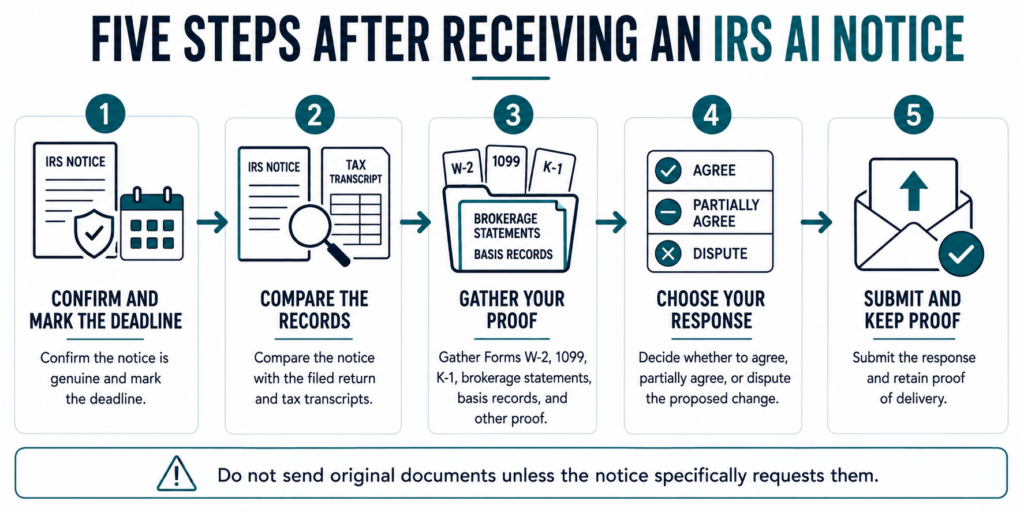
Automated notices normally identify a specific account, processing, matching, or payment issue. An IRS computer match letter should be answered according to its instructions. Do not send original documents unless the notice specifically requires them.
Correspondence Audits
An IRS correspondence audit is conducted by mail and asks for proof of selected items, such as deductions, credits, or filing status. The examination letter identifies what is being reviewed and where to send the response.
Field Audits
A field examination involves direct contact with an IRS revenue agent and may occur at a business, representative’s office, or another agreed location. It is usually broader and more fact-intensive than automated matching.
Criminal Investigation Referrals
IRS criminal investigation focuses on possible willful tax crimes and related financial offenses. A data flag alone is not a criminal referral. If a notice raises concerns about false documents, concealed income, or deliberate conduct, obtain qualified representation before giving substantive explanations.
|
Important Notice A reporting threshold controls when a payer must send a form. It does not create an exclusion from taxable income. State reporting thresholds may also differ. |
What to Do If You Receive an IRS AI Notice
Your response should be based on the exact letter, return, and account transcript. Effective IRS notice assistance begins by checking whether the IRS used complete and correct information.
Don’t Ignore the Notice
Ignoring a notice can allow a proposed adjustment to become assessed tax or a collection matter. Open it promptly, confirm it is genuine, and calendar the response date. If you suspect a scam, compare the notice number and contact details with IRS.gov.
Review IRS Calculations
Compare the notice with the filed return, schedules, information returns, and account or wage-and-income transcripts. A tax transcript review may reveal a missing form or corrected entry. It may also show that the IRS treated proceeds as income without accounting for basis or related expenses.
Gather Supporting Documents
Useful IRS documentation can include W-2s, 1099s, K-1s, brokerage statements, basis schedules, invoices, bank records, payroll reports, mileage logs, and amended forms. Organize documents by disputed item and explain how each record supports your position.
Respond Before the Deadline
Follow the address, fax number, upload option, and signing rules stated on the letter. Keep copies and proof of delivery. If you agree, confirm the resulting tax, interest, and penalty. If you disagree, explain each contested figure clearly.
When Professional Representation Matters
Representation may matter when the amount is large, several years are involved, records are incomplete, penalties are substantial, or the notice could expand into an examination.
How to Reduce the Risk of Future IRS AI Notices
Reducing AI audit IRS 2026 exposure and future IRS AI matching program notices 2026 starts with consistent reporting and documentation. These steps cannot guarantee that you will avoid contact, but they can reduce preventable mismatches and make any response easier.
Report All Income
- Track income from every employer, client, platform, and payment source.
- Report taxable income even when no information form arrives.
Verify Third-Party Forms
- Check names, taxpayer identification numbers, income, withholding, proceeds, and basis.
- Request corrected forms before filing whenever possible.
Maintain Accurate Records
- Separate business and personal transactions.
- Keep invoices, bank records, receipts, mileage logs, and basis documents.
File Corrected Returns When Necessary
- Determine whether the error is material.
- Check whether an IRS notice or examination is already open.
- Avoid sending duplicate or conflicting submissions.
Read More: How to Apply for IRS Non-Collectible Status: Step-by-Step Process
How Salinger Tax Consultants Help Resolve IRS AI Notices
Salinger Tax Consultants provides IRS notice assistance for taxpayers facing IRS AI matching program notices 2026 who need to understand a proposed adjustment, correct the record, or address a resulting balance. The work begins with the notice and supporting account data rather than assumptions about how the case was selected.
IRS Notice Review
A review identifies the notice type, deadline, tax period, proposed change, and procedural options. The response can then address the actual mismatch instead of sending unrelated records. This is especially helpful when an IRS computer match letter combines several information returns.
Back Tax Resolution
If the proposed change becomes a valid balance, IRS back tax resolution may include full payment, an installment agreement, Currently Not Collectible consideration, or an Offer in Compromise when eligibility requirements are met. Offer in Compromise services can assess whether an offer fits the taxpayer’s financial facts.
Penalty Reduction Strategies
Penalty relief may be available through first-time abatement, reasonable cause, statutory exceptions, or correction of the underlying assessment, depending on the penalty and facts. IRS penalty assistance helps identify the correct request and supporting evidence.
IRS Representation
Authorized representation can manage communications, obtain transcripts, prepare a documented response, and help protect deadlines.
Conclusion
The IRS AI matching program notices 2026 trend reflects a combination of long-standing automated matching and newer AI-assisted analytics. A notice may be triggered quickly, but its proposed result can still be incomplete or wrong. Read the letter, verify third-party data, compare the IRS calculation with your return, and respond with focused evidence before the deadline.
If the notice creates penalties or a balance you cannot pay, the next step may require both a technical response and IRS back tax resolution planning. Contact Salinger Tax Consultants for a case review and a clear response strategy.
FAQs
The term IRS AI matching program notices 2026 describes the IRS's use of automated matching, analytics, and AI-supported risk scoring. It is not the formal name of one public program. Established systems compare returns with third-party data, while newer AI tools may help prioritize cases.
Yes. The IRS uses AI and advanced analytics in some compliance and fraud-detection work. An AI audit IRS 2026 flag may contribute to case prioritization, but IRS personnel generally decide whether to pursue an audit or investigation.
It is a letter generated after IRS records appear inconsistent with a filed return. A common example is CP2000, which proposes changes based on information supplied by employers, banks, brokers, or other payers.
An IRS automated CP notice may result from a processing error, income mismatch, unpaid balance, or account action. Read the notice number and explanation because each IRS automated CP notice can cover a different issue.
Yes. Payer errors, duplicate forms, missing basis, identity theft, timing differences, and incorrect IRS assumptions can produce an inaccurate proposal. Effective IRS notice assistance checks the source data and calculation before responding.
The proposed adjustment may become assessed tax, and later IRS collection notices may add interest or lead to enforcement steps. Some notices also carry short dispute deadlines, so delay can reduce available options.
Yes, depending on the issue and response. A limited mismatch can lead to a correspondence or broader examination if questions remain. Many notices are resolved through written explanation and documents without a full audit.
Follow the letter's instructions, state whether you agree or disagree, explain each disputed item, and attach copies of relevant proof. Keep the response and delivery record. Professional IRS notice assistance may help when several forms or years are involved.
Taxpayers with multiple information returns, self-employment income, digital asset transactions, complex businesses, or large deductions may have more matching points. Risk depends on the return and data, not merely the taxpayer's occupation.
Seek help when the deadline is close, the proposed amount is significant, the records are unclear, several years are involved, or the issue may expand. Professional review is also useful when penalties or payment problems require IRS back tax resolution planning.

