
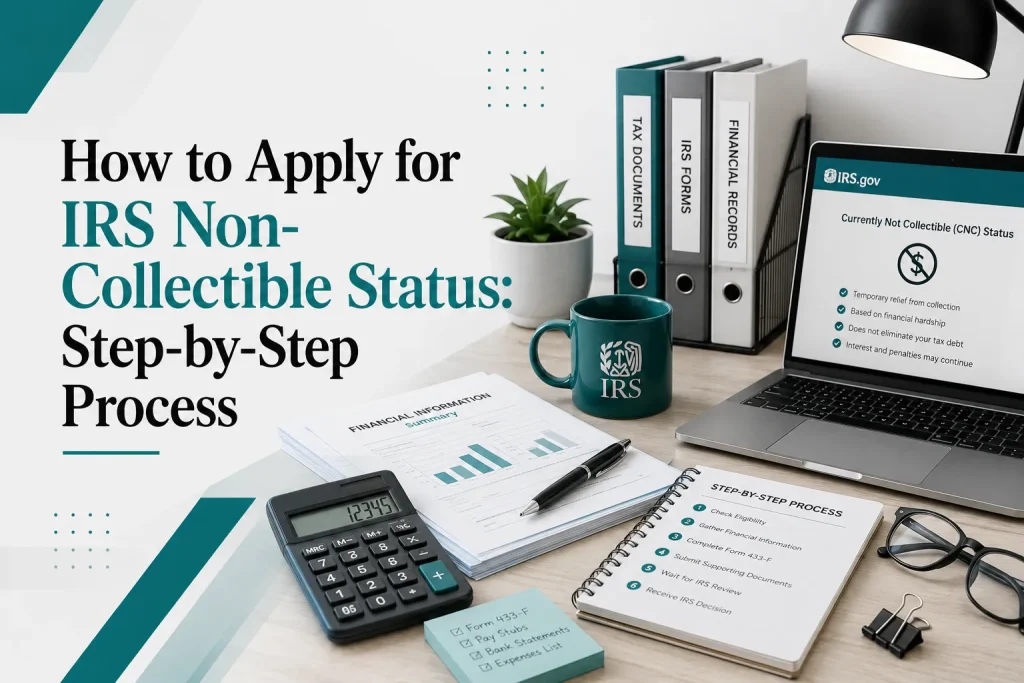
When tax debt becomes impossible to manage, many taxpayers worry about wage garnishments, bank levies, and constant collection notices. Fortunately, the IRS offers relief for individuals who genuinely cannot afford to pay.
Understanding how to apply IRS non-collectible status can help you protect your income while working through a difficult financial situation. If paying your tax debt would prevent you from covering necessities such as housing, food, utilities, or medical expenses, you may qualify for Currently Not Collectible (CNC) status.
This guide explains who qualifies, how the CNC application process works, what documentation you’ll need, and what to expect after submitting a hardship request.
Key Takeaways
|
What Is IRS Currently Not Collectible (CNC) Status?
Currently Not Collectible (CNC) status is a temporary hardship designation that allows the IRS to pause collection efforts when a taxpayer cannot reasonably afford to pay their tax debt.
The program is intended for individuals facing serious financial challenges. Rather than forcing collection activity that could worsen a taxpayer’s situation, the IRS may temporarily suspend enforcement actions until finances improve.
How CNC Status Works
CNC status temporarily delays collection efforts against eligible taxpayers.
Once approved, the IRS may stop active collection actions such as:
- Wage garnishments
- Bank levies
- Certain payment demands
- Other collection activities
The underlying tax debt does not disappear. Interest and penalties may continue to accrue while the account remains in hardship status.
Many taxpayers researching how to apply for IRS non-collectible status mistakenly assume the program forgives tax debt. In reality, it serves as a temporary form of relief for people who cannot currently afford to pay.
When the IRS Places an Account in CNC Status
The IRS may place an account into non-collectible status after reviewing a taxpayer’s financial condition and determining that collection would create hardship.
To make this determination, the IRS typically reviews:
- Income sources
- Household expenses
- Assets
- Employment status
- Family size
- Financial obligations
In our experience helping taxpayers resolve IRS debt, many people qualify even though they are employed full-time. The key issue is whether sufficient income remains after necessary living expenses are paid.
How CNC Differs From Other Tax Relief Programs
CNC status differs from other relief programs because it focuses on temporary collection relief rather than repayment or settlement.
| Program | Primary Purpose |
| CNC Status | Temporarily pauses collection activity |
| Installment Agreement | Allows repayment through monthly payments |
| Offer in Compromise | Settles debt for less than the full balance |
| Penalty Abatement | Removes qualifying penalties |
Unlike a payment plan, CNC status generally does not require monthly payments. Unlike a settlement, it does not reduce the balance owed. Instead, it provides temporary protection while a taxpayer experiences financial hardship. Learn more about IRS Currently Not Collectible status if you’d like a deeper understanding of how the program works and who qualifies.
Who Qualifies for IRS Non-Collectible Status?
Taxpayers may qualify for non-collectible status when paying their tax debt would prevent them from meeting necessary living expenses.
The IRS evaluates each case individually. There is no automatic income threshold that guarantees approval.
Financial Hardship Requirements
The foundation of any CNC request is the demonstration of financial hardship.
The IRS wants to determine whether collecting the debt would leave a taxpayer unable to pay for basic necessities, such as:
- Housing
- Utilities
- Food
- Transportation
- Healthcare
A common mistake we see is taxpayers assuming hardship means complete unemployment. Many approved applicants are working but still struggle to meet essential expenses.
Income and Expense Evaluation
A detailed financial review is one of the most important parts of the CNC application process.
The IRS examines:
- Employment income
- Self-employment income
- Monthly household expenses
- Medical costs
- Childcare expenses
- Transportation expenses
- Existing financial obligations
The agency compares income against allowable living expenses to determine whether disposable income is available for tax payments.
Financial disclosures provided through Form 433-F often play a central role in this evaluation.
Situations That May Qualify for CNC Status
Several circumstances may support a hardship request.
Common examples include:
- Job loss
- Reduced work hours
- Serious illness
- Disability
- High medical expenses
- Divorce or separation
- Unexpected financial emergencies
No single situation automatically qualifies a taxpayer. The IRS reviews the complete financial picture before deciding.
Successfully learning how to apply IRS non-collectible status starts with accurately documenting these circumstances and providing evidence that collection activity would create an undue financial burden.
Benefits and Limitations of CNC Status
Currently Not Collectible status can provide meaningful relief for taxpayers facing financial hardship. However, it is important to understand both the advantages and the limitations before beginning the CNC application process.
While the CNC status may temporarily stop collection efforts, it does not eliminate the underlying tax debt. Knowing what this program can and cannot do will help you make informed decisions about your tax resolution strategy.
Collection Activities That May Stop
One of the biggest benefits of the CNC status is the temporary suspension of certain IRS collection actions.
Depending on your circumstances, approval may stop:
- Wage garnishments
- Bank levies
- Collection notices
- Certain enforcement actions
For taxpayers struggling with financial hardship, this relief can create valuable breathing room and allow them to focus on essential living expenses.
Many clients who contact us are already facing aggressive collection efforts. In these situations, obtaining hardship status can immediately reduce financial pressure.
What Happens to Penalties and Interest
A common misconception is that non-collectible status stops all tax-related charges. Unfortunately, that is not the case.
Even after approval:
- Interest generally continues to accrue
- Penalties may continue to accumulate
- The tax balance typically remains outstanding
Although collection activity may pause, taxpayers should understand that the debt does not disappear. This is one reason why CNC status is often considered a temporary relief option rather than a permanent solution.
How Long Does CNC Status Last
There is no fixed timeframe for how long hardship status remains in effect. The IRS periodically reviews accounts to determine whether a taxpayer’s financial condition has improved.
Several factors may affect the duration of relief, including:
- Changes in income
- Employment status
- Asset ownership
- Household expenses
If the IRS determines that a taxpayer can afford to make payments in the future, collection activity may resume.
For this reason, taxpayers should continue monitoring their financial situation even after approval.
Documents Needed Before Applying for CNC Status
Accurate documentation is one of the most important parts of learning how to apply IRS non-collectible status.
The IRS relies heavily on financial records to evaluate whether a taxpayer truly qualifies for hardship relief. Missing or incomplete information can delay approval and create additional requests for documentation.
Gathering records before starting the CNC application process can help streamline the review.
Income Documentation
The IRS needs a clear picture of all household income sources.
Common income documents include:
- Recent pay stubs
- Social Security statements
- Pension income records
- Self-employment income reports
- Unemployment benefits documentation
Taxpayers should provide accurate and current information to avoid delays during the review process.
Monthly Expense Records
Necessary living expenses play a major role in determining eligibility.
The IRS may review records relating to:
- Rent or mortgage payments
- Utilities
- Food expenses
- Transportation costs
- Medical expenses
- Insurance premiums
Providing organized expense documentation can strengthen a hardship request and support claims of financial difficulty.
Bank Statements and Asset Information
The IRS also reviews assets when evaluating a hardship claim.
Examples include:
- Bank account statements
- Investment account records
- Vehicle ownership information
- Real estate holdings
- Retirement account balances
Many taxpayers are surprised by the level of detail requested during the review process. Providing complete information from the beginning often helps avoid unnecessary delays.
Step-by-Step CNC Application Process
Understanding how to apply IRS non-collectible status becomes much easier when the process is broken into manageable steps.
Although every case is different, most taxpayers follow a similar path when requesting hardship relief from the IRS.
Step 1: Become Tax Compliant
Before the IRS considers a hardship request, taxpayers generally must be current with their filing obligations.
This means:
- Filing required tax returns
- Addressing missing tax years
- Correcting outstanding filing issues
Failure to become compliant can prevent the IRS from reviewing a CNC request.
In our experience, unresolved filing problems are one of the most common reasons hardship applications stall before they even begin.
Step 2: Gather Financial Information
The next step is collecting financial records that accurately reflect your current situation.
This typically includes:
- Income documentation
- Expense records
- Asset information
- Banking records
The stronger and more organized your documentation, the smoother the review process is likely to be.
Step 3: Complete IRS Form 433-F
Form 433-F is one of the most commonly used financial disclosure forms in hardship cases.
The form requests information regarding:
- Income
- Expenses
- Assets
- Liabilities
- Household finances
Many hardship requests rely heavily on information provided through Form 433-F. Accuracy is critical because IRS representatives use this information when evaluating financial eligibility.
A common mistake we see is taxpayers estimating figures rather than providing accurate financial data. Small inconsistencies can trigger additional questions and delays.
Step 4: Submit Financial Documentation
Once financial disclosures are complete, supporting documentation must be provided.
Depending on the case, the IRS may request:
- Pay stubs
- Bank statements
- Utility bills
- Medical expense records
- Housing expense documentation
Providing complete documentation upfront can help reduce processing delays and improve the overall experience.
Step 5: Communicate With the IRS
Communication is an important part of the CNC application process.
The IRS may:
- Request additional information
- Clarify financial disclosures
- Verify income sources
- Ask follow-up questions
Responding promptly helps keep the review moving forward and demonstrates cooperation throughout the process.
Step 6: Await IRS Review and Decision
After all required information is submitted, the IRS reviews the taxpayer’s financial situation.
The agency evaluates:
- Income
- Expenses
- Assets
- Ability to pay
- Financial hardship indicators
If approved, the account may be placed into non-collectible status, and collection activity may be suspended.
If additional information is required, the IRS may contact the taxpayer before making a final determination. If you’re unsure how to respond to IRS requests or need help organizing documentation, get expert help before delays affect your application.
Understanding IRS Form 433-F for Hardship Requests
Form 433-F is one of the most important documents used during the CNC application process. The IRS relies on this financial statement to evaluate a taxpayer’s ability to pay and determine whether hardship relief may be appropriate.
Because the information provided on this form directly impacts the IRS’s decision, accuracy and completeness are essential.
What Information Form 433-F Requires
Form 433-F collects detailed financial information about a taxpayer’s current situation.
The form typically requests information regarding:
- Employment and income
- Bank accounts
- Cash on hand
- Monthly living expenses
- Real estate ownership
- Vehicles
- Investments
- Outstanding debts
The purpose of the Form 433-F hardship review is to determine whether paying tax debt would create a financial burden that prevents a taxpayer from covering necessary living expenses.
Many taxpayers researching how to apply for IRS non-collectible status are surprised by the amount of financial detail required. The IRS uses this information to build a complete picture of the taxpayer’s financial condition.
Common Errors That Delay Approval
Mistakes on financial disclosure forms can significantly slow the review process.
Some of the most common issues include:
- Missing financial information
- Inaccurate income figures
- Incomplete expense documentation
- Failure to disclose assets
- Unsupported hardship claims
A common mistake we see is taxpayers estimating expenses rather than using actual records. Even small discrepancies can result in additional IRS inquiries and delays.
When completing Form 433-F hardship documentation, accuracy is far more important than speed.
Tips for Accurate Financial Reporting
Careful preparation can improve the likelihood of a smooth review.
Consider the following best practices:
- Use current financial records
- Keep income and expense figures consistent
- Organize supporting documentation
- Double-check all disclosures before submission
- Respond promptly to IRS requests
The CNC application process often moves more efficiently when taxpayers provide complete and well-organized financial information from the beginning.
How the IRS Reviews CNC Applications
After receiving a hardship request, the IRS conducts a detailed financial analysis to determine whether to suspend collection activity.
The review focuses on a taxpayer’s ability to pay while maintaining necessary living expenses.
Income Analysis
The IRS begins by reviewing all available sources of income.
This may include:
- Employment income
- Self-employment earnings
- Pension income
- Social Security benefits
- Investment income
The agency compares household income against allowable expenses to determine whether disposable income is available for tax payments.
For taxpayers experiencing IRS financial hardship, this income review often plays a critical role in the final decision.
Asset Evaluation
The IRS also examines assets when evaluating hardship requests.
Examples include:
- Bank account balances
- Real estate
- Vehicles
- Investment accounts
- Retirement assets
Ownership of assets does not automatically disqualify a taxpayer. However, the IRS may consider whether assets could reasonably be used to satisfy outstanding tax debt.
Many hardship determinations depend on the overall financial picture rather than any single factor.
Allowable Living Expenses Standards
The IRS uses national and local standards to evaluate certain household expenses.
These standards help determine whether expenses are considered necessary and reasonable.
Common categories include:
- Housing
- Utilities
- Food
- Transportation
- Healthcare
When reviewing IRS financial hardship claims, the agency often compares reported expenses against these allowable standards before deciding.
What happens after the CNC Status Is Approved?
Approval can provide immediate relief from certain collection activities, but taxpayers should understand what happens next.
Non-collectible status is not necessarily permanent. The IRS may continue monitoring a taxpayer’s financial situation over time.
Suspension of Collection Actions
One of the primary benefits of approval is the temporary suspension of collection activity.
Depending on the circumstances, the IRS may stop:
- Wage garnishments
- Bank levies
- Active collection efforts
- Certain enforcement actions
For taxpayers facing severe IRS financial hardship, this relief can provide valuable time to regain financial stability.
Annual Financial Reviews
The IRS periodically reviews hardship accounts to determine whether financial circumstances have changed.
During these reviews, the agency may request updated information regarding:
- Income
- Expenses
- Assets
- Employment status
If a taxpayer’s financial condition improves significantly, the IRS may decide to resume collection efforts.
This ongoing review process is one reason why CNC status should be viewed as temporary relief rather than permanent resolution.
Future Tax Filing Requirements
Taxpayers must continue meeting future tax obligations while in hardship status.
This generally includes:
- Filing tax returns on time
- Paying current tax liabilities
- Responding to IRS requests when necessary
Failure to remain compliant can jeopardize existing relief and create additional tax problems in the future.
Common Reasons CNC Requests Are Denied
Not every hardship request receives approval. Understanding the most common reasons for denial can help taxpayers avoid mistakes during the application process.
Incomplete Financial Information
Incomplete documentation is one of the most common reasons requests are denied. Missing records may prevent the IRS from accurately evaluating:
- Income
- Expenses
- Assets
- Financial obligations
Providing complete Form 433-F hardship information and supporting records can help reduce this risk.
Excess Disposable Income
The IRS may deny a request if it determines that sufficient income remains after allowable living expenses are paid.
In these situations, the agency may conclude that the taxpayer is able to make monthly payments through another resolution program.
Even taxpayers experiencing financial stress may be denied if the IRS believes they have disposable income.
Missing Tax Returns
Tax compliance is a basic requirement for most hardship requests.
Taxpayers who have unfiled returns often encounter difficulties during the CNC application process.
Before seeking hardship relief, taxpayers should ensure all required tax returns have been filed, and any outstanding filing issues have been addressed.
In our experience, resolving compliance problems early can significantly improve the chances of obtaining relief.
Alternatives If You Do Not Qualify for CNC Status
Not every taxpayer qualifies for hardship status. If the IRS determines that you can pay some or all of your tax debt, other resolution programs may be available.
Understanding your alternatives is important because the right solution can help you avoid aggressive collection actions while resolving your balance in a manageable way. Before choosing a path forward, review available IRS tax resolution options that may fit your financial situation.
Installment Agreements
An installment agreement allows taxpayers to pay their tax debt through monthly payments over time.
This option is often suitable for individuals who cannot pay their balance in full but can afford a structured payment plan.
Benefits of an installment agreement may include:
- More manageable monthly payments
- Reduced risk of collection actions
- Improved compliance with IRS requirements
- Flexibility based on financial circumstances
Many taxpayers who do not qualify for hardship relief find that an installment agreement provides a practical path toward resolving their debt.
Offer in Compromise
An Offer in Compromise (OIC) allows eligible taxpayers to settle their tax debt for less than the full amount owed.
The IRS reviews several factors when evaluating an offer, including:
- Income
- Expenses
- Assets
- Future earning potential
- Ability to pay
Unlike the CNC status, which temporarily pauses collections, an accepted Offer in Compromise can permanently reduce the amount of tax debt owed.
However, qualification requirements can be strict, and careful preparation is often necessary. Taxpayers considering settlement programs should also explore offer in compromise alternatives to compare all available debt resolution strategies.
Penalty Abatement
Some taxpayers may qualify for penalty relief even if they do not qualify for CNC status.
Penalty abatement may be available when taxpayers can demonstrate:
- Reasonable cause
- Serious illness
- Natural disasters
- Significant financial hardship
- Other qualifying circumstances
Reducing penalties can lower the overall balance owed and make resolving tax debt more manageable.
When evaluating IRS hardship relief options, penalty abatement is often overlooked but can provide meaningful savings in the right situation.
How Salinger Tax Consultants Helps Taxpayers Obtain CNC Status
At Salinger Tax Consultants, we help taxpayers understand how to apply IRS non-collectible status and navigate every stage of the process with confidence.
Our team works closely with clients to evaluate their financial situation, prepare documentation, and communicate with the IRS on their behalf.
Financial Hardship Analysis
Every hardship case begins with a detailed review of the taxpayer’s financial condition.
We help clients evaluate:
- Income sources
- Monthly expenses
- Assets
- Existing tax liabilities
- Collection risks
This analysis helps determine whether hardship status is the most appropriate solution or whether another tax resolution strategy may provide better results.
Many taxpayers are unsure whether they meet IRS financial hardship requirements. A professional review can help identify available options before submitting a request.
Form 433-F Preparation Assistance
One of the most important parts of the CNC application process is preparing accurate financial disclosures.
Our team assists clients with:
- Completing Form 433-F
- Organizing supporting documentation
- Verifying income and expense information
- Addressing potential issues before submission
Because the IRS relies heavily on Form 433-F during hardship reviews, accuracy is critical. Proper preparation can reduce delays and improve the overall application experience.
IRS Representation Throughout the Process
Communicating directly with the IRS can feel overwhelming, particularly when collection actions are already underway.
Salinger Tax Consultants provides representation throughout the process by:
- Communicating with the IRS
- Responding to information requests
- Monitoring application progress
- Assisting with additional documentation
- Exploring alternative resolution options when necessary
Whether you are facing wage garnishments, collection notices, or other enforcement actions, professional representation can help simplify the process and improve your chances of securing relief.
Taking the Right Steps Toward IRS Hardship Relief
Financial hardship can make it difficult to stay current on tax obligations, but taxpayers facing genuine challenges may have options available.
Understanding how to apply IRS non-collectible status is an important first step for individuals who cannot afford to pay their tax debt while covering basic living expenses. Through the CNC application process, the IRS evaluates income, expenses, assets, and overall financial circumstances to determine whether temporary collection relief is appropriate.
If you’re struggling with IRS financial hardship and are unsure which solution is right for your situation, professional guidance can make a significant difference.
Speak with a tax resolution specialist today to discuss your options and determine whether CNC status or another relief program may help you move forward with confidence.
FAQs
Currently Not Collectible (CNC) status is a temporary hardship designation that allows the IRS to suspend collection actions when a taxpayer cannot afford to pay their tax debt while meeting necessary living expenses.
Learning how to apply IRS non-collectible status typically involves becoming tax compliant, gathering financial records, completing financial disclosure forms, submitting supporting documentation, and working with the IRS during its review process.
Form 433-F is a financial disclosure form used by the IRS to evaluate a taxpayer's income, expenses, assets, and overall ability to pay. It is commonly used during hardship reviews and CNC requests.
The CNC application process varies depending on the complexity of the case, the completeness of documentation provided, and the IRS's workload. Some cases are resolved relatively quickly, while others may require additional review.
No. CNC status temporarily pauses collection activity but does not eliminate the underlying tax debt. Interest and penalties may continue to accrue while the account remains in hardship status.
Yes. In most cases, penalties and interest continue to accumulate even after hardship status is approved.
The IRS generally reviews income, expenses, assets, liabilities, bank accounts, and supporting documentation to determine whether a taxpayer qualifies for hardship relief.
Yes. Self-employed taxpayers may qualify if they can demonstrate that paying their tax debt would create financial hardship and prevent them from covering necessary living expenses.
If a request is denied, taxpayers may still qualify for other IRS hardship relief options, including installment agreements, Offers in Compromise, or penalty abatement programs.
Many taxpayers benefit from professional assistance because hardship applications often require detailed financial analysis, accurate documentation, and communication with the IRS throughout the review process.

