

When the IRS places a levy on your wages, your employer receives IRS Form 668-W. This official notice legalizes the wage garnishment, instructing your payroll department to withhold a specific portion of your paycheck to pay down an outstanding federal tax liability.
This guide breaks down how Form 668-W works, how your employer calculates the exact garnishment amount using IRS Publication 1494, and what steps you can take to stop or release a wage levy.
If you have recently received a notice, professional IRS wage garnishment assistance can help you understand your options and protect your income.
|
Key Takeaways
|
What Is IRS Form 668-W?
Form 668-W is the IRS notice of levy on wages, salary, and other income. The IRS generally uses Form 668-W(ICS) or Form 668-W(ACS) to reach wages, and it sends the notice to your employer rather than to you. Because the order goes to payroll, many people first notice the problem on a pay stub.
A levy is a legal order to take property that belongs to you in order to satisfy a tax debt. For wages, the property is your earnings. The IRS usually reaches this stage after earlier notices have gone unanswered, including a final notice of intent to levy such as Letter 1058 or LT11. Those notices give you a window to request a hearing or arrange payment, so reading them closely matters.
Which Types of Income Can Be Subject to an IRS Wage Levy?
For levy purposes, the IRS treats salary and wages broadly. The term covers more than a regular paycheck, so check the notice for every income type it lists. Income that can be reached typically includes:
- Regular wages and salary
- Fees, commissions, and bonuses
- Certain benefit and retirement payments, when the notice covers them
Quick Fact
The IRS uses Form 668-A for other property held by third parties, such as bank accounts. Wage levies use the 668-W forms.
How Does the IRS Wage Levy Calculation Work?
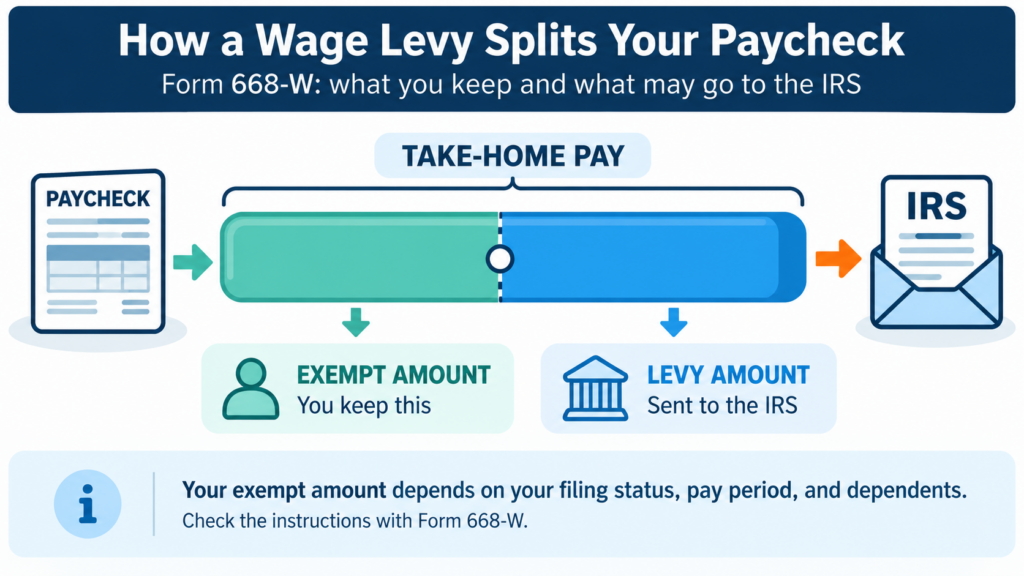
Under Form 668-W, the IRS does not take a fixed percentage of your pay. It protects part of your take-home pay for basic living costs, and only the amount above that protected portion goes toward the tax debt. The protected amount comes from IRS Publication 1494, which your employer receives with the levy.
Take-home pay is what remains after required deductions like federal income tax, Social Security, and Medicare. Your employer subtracts the exempt amount for the pay period, and the remainder goes to the IRS. Because the exempt amount depends on your household, two people with the same gross pay can see different withholding.
What Is the Exempt Amount?
The exempt amount is the part of your pay you can keep each pay period. Your employer reads it from the Publication 1494 tables using three inputs:
- How often you are paid
- Your filing status
- The number of dependents you claim
Employers generally rely on the statement you return, not your Form W-4, so accurate inputs matter most. If your household has changed, update the statement and keep records to support it.
How Filing Status and Dependents Affect the Calculation
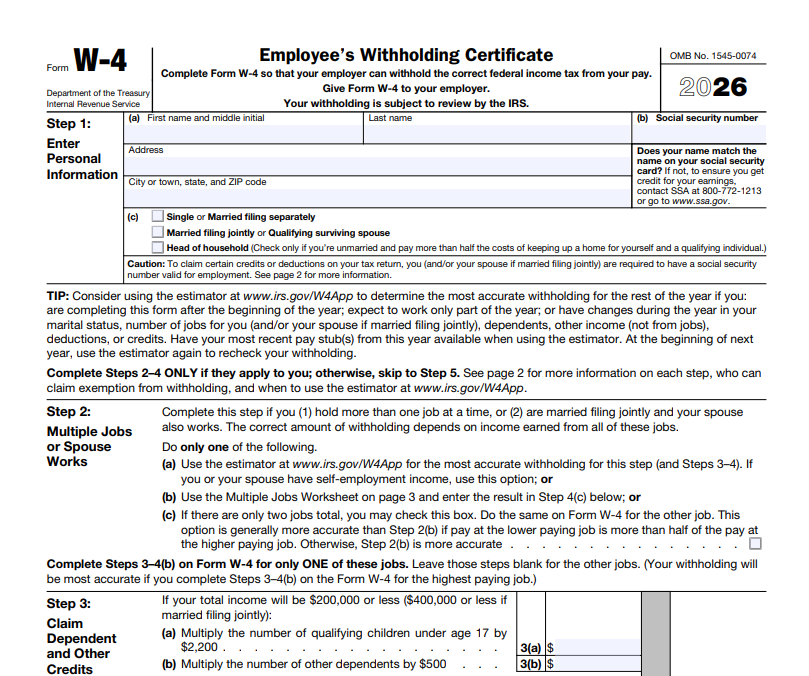
Filing status and dependents change the protected amount more than any other inputs. Each dependent you can claim on your tax return raises the amount that stays exempt. Only count people you can actually claim, and never list someone who appears on another levy statement. If you’re unsure, confirm with a tax professional before you sign.
How Do Filing Status and Dependents Affect the Calculation?
Filing status and dependents change the protected amount more than any other inputs. Each dependent you can claim on your tax return raises the amount that stays exempt. Only count people you can actually claim, and never list someone who appears on another levy statement. If you’re unsure, confirm with a tax professional before you sign.
A 2026 Example
|
Step |
Amount |
| Take-home pay for the week |
$1,000.00 |
|
Exempt amount (IRS example for 2026) |
− $615.38 |
| Sent to the IRS for the pay period |
$384.62 |
If the amount looks wrong, ask payroll for the worksheet and compare its inputs with your statement. If the mismatch is hard to resolve, tax resolution support for wage garnishment can help you confirm the numbers.
How IRS Publication 1494 Determines Exempt Wages in 2026
Employers use IRS Publication 1494 to figure exempt wages, and its tables are updated each year. Bloomberg Tax reported that the 2026 amounts rose from 2025, so last year’s table would understate your protected amount.
| Input | Where It Comes From | Why It Matters |
| Pay frequency | Your pay stub or payroll schedule | Selects the correct table |
| Filing status | Your statement, matched to your tax return | Selects the correct column |
| Dependents | Your statement and tax return | Each dependent raises the exempt amount |
Reading the right table takes only a few minutes once you have the inputs in hand. Your pay stub and last year’s return usually supply everything needed.
What to Confirm on the Payroll Worksheet
Before you rely on the worksheet, check that it reflects the correct facts. Ask payroll to confirm these four items:
- The publication year used for the calculation
- Your pay frequency as shown on your pay stub
- The filing status from your statement
- The number of dependents listed on your statement
How to Fill Out Form 668-W Part 3 and the Dependents Statement
The dependents statement is the part of a Form 668-W levy that you control directly. Your employer gives it to you along with the notice, and your answers determine the protected amount. Taking time to complete it accurately is the most useful step you can take early on.
What Information Do You Need Before Completing the Statement?
Gather these documents before you start, so the answers come from records rather than memory:
- Your most recent federal tax return
- Your filing status for that year
- A list of household members you can claim as dependents
- A recent pay stub that confirms how often you are paid
Check whether anyone you plan to list appears on another levy statement, since the form asks you to list only dependents who are not claimed on another 668-W. Write each name and relationship clearly, and sign and date the form before returning it.
Why You Must Return the Statement Within Three Days
The IRS expects you to complete and return the statement within three days. If your employer does not receive it in that window, the exempt amount is figured as if you are married filing separately with no dependents. That default protects the least amount of your pay.
IRS Reminder
Return the statement within three days, and keep a copy of what you submitted.
A late statement does not stop the levy, but it can reduce the amount you keep until a corrected statement is processed.
Read More: Penalties and Interest Doubled Your Bill? Tax Debt Relief Programs That Cut the Total
How Long Does an IRS Wage Levy Continue?
A wage levy is continuous. It attaches to your current and future pay until the tax shown on the levy is paid in full, or until the IRS releases it for another reason. When the tax is paid, the IRS issues Form 668-D, Release of Levy/Release of Property from Levy, and your employer stops withholding.
Many levies run for months, so the calculation matters every pay period. Ask payroll to apply any new table at the start of a new year, and file an updated statement whenever your household changes. Keeping the statement current is part of keeping the levy accurate.
When a Wage Levy Can End
A levy usually ends in one of a few ways. The most common are:
- The tax shown on the levy is paid in full
- You enter an installment agreement whose terms do not allow the levy to continue
- The IRS releases the levy because it creates economic hardship
How Can You Stop or Get an IRS Wage Levy Released?
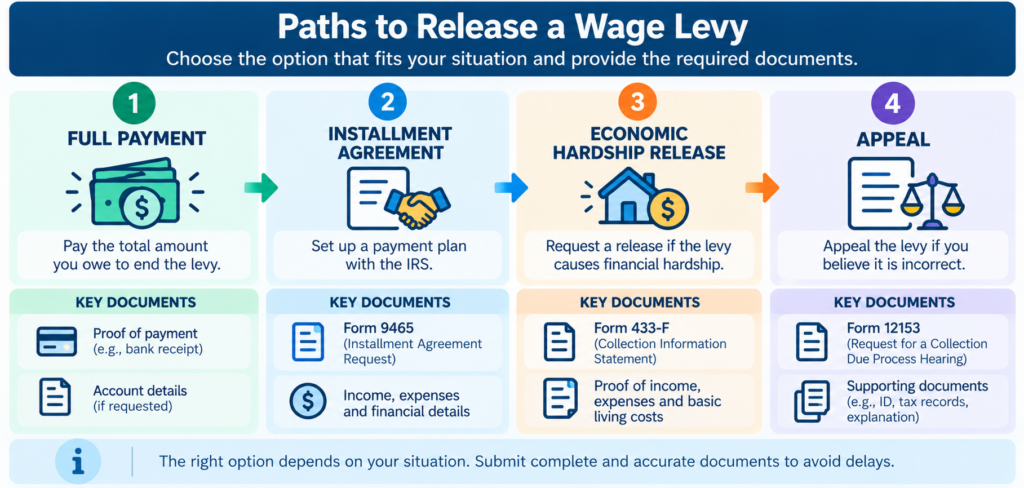
People searching for how to stop IRS wage garnishment usually want to know whether a levy can end before the balance is cleared. Explore options for stopping wage garnishment with your situation in mind. A levy can be released in several situations, but a release does not wipe out the debt. Understanding the paths helps you choose the one that fits your facts and act before the next pay date.
Important
Releasing a levy does not mean you no longer owe the balance. You still need to arrange payment, or the levy may be reissued.
Resolve the Tax Debt or Explore an Installment Agreement
Paying the balance in full is the most direct route, and the IRS then issues a release. Many taxpayers cannot pay at once, so an installment agreement is often the practical choice. The IRS is required to release a levy when you enter an installment agreement whose terms do not allow the levy to continue.
An agreement carries obligations of its own. Missing payments can lead to renewed collection, so choose a monthly amount your budget can support.
Read More: What Happens If You Miss an IRS Installment Payment?
Ask About Release Based on Financial Hardship
The IRS can release a wage levy when it creates economic hardship, meaning the levy prevents you from meeting basic, reasonable living expenses. This request needs documentation. The IRS decides based on the facts you provide, so complete records carry real weight. Typical documents include:
- A completed financial statement
- Recent pay stubs and proof of income
- Receipts or bills for essential living expenses
A hardship release is temporary relief rather than a settlement. Pair the request with a plan for the balance, such as an agreement or a proposal, so the levy does not return.
|
Path |
Typical Use | Effect on the Levy |
| Full payment | You can pay the balance |
Release follows payment |
|
Installment agreement |
You can make monthly payments | Release if the terms do not allow the levy |
| Economic hardship | The levy blocks basic living costs |
Release possible with documentation |
Review Appeal and Other Resolution Options
If the IRS turns down your release request, you still have options. Appeals and other resolution paths can change the outcome, but each one has its own rules and deadlines, so it helps to know what is available before you choose.
- If the IRS denies a release request, you may be able to appeal, before or after a levy is placed.
- Appeals have strict deadlines. Publication 1660 explains your collection appeal rights.
- Other options may fit your situation, including an offer in compromise, currently not collectible status, or penalty relief.
- Compare each option against your income and expenses, not just the levy.
- Acting early can keep more of your paycheck while the review is underway.
How Salinger Tax Consultants Can Help
Salinger Tax Consultants helps taxpayers check levy calculations and organize the records a resolution requires. We help taxpayers
Reviewing Your Levy Notice
We review the levy notice, the statement, and your pay records. Our review covers:
- Filing status and dependents
- Pay frequency and take-home pay
- Whether a correction or a different resolution path fits better
Negotiating With the IRS
Our team offers help with an IRS wage levy from start to finish, including document preparation and timely responses to IRS correspondence.
Understand Your Form 668-W and Wage Levy Options
Form 668-W directs your employer to withhold wages, and the protected amount depends on your pay frequency, filing status, and dependents. Returning an accurate statement within three days and checking the calculation each pay period keeps your paycheck correct while the levy is in place.
If a levy has already started, review your options now rather than waiting for the next pay date.
Salinger Tax Consultants can review your notice and explain which paths may apply to your situation. Schedule a free consultation with our tax resolution team to discuss your wage levy.
FAQs
Form 668-W is a notice of levy on wages, salary, and other income. The IRS sends it to your employer, who then withholds part of your pay until the tax is paid or released. The statement you complete with your filing status and dependents helps determine how much stays protected.
There is no single fixed amount. The IRS wage levy calculation takes take-home pay above the exempt amount, which depends on your pay frequency, filing status, and dependents under the 2026 Publication 1494 tables. The payroll worksheet shows your exact figure.
No. The levy takes what remains after the exempt amount is subtracted, so the amount changes each pay period. Two people with similar gross pay can see different withholding because their household details differ.
Use your most recent tax return to confirm your filing status and dependents, then complete the statement with the same facts. Keep these items ready:
- Your tax return for the year
- Names and relationships of each dependent
- Your signature and date
Return the form to your employer within three days, and keep a copy for your records.
Your employer figures the exempt amount as if you are married filing separately with no dependents. That default usually protects less of your pay. Returning the statement quickly limits how long the default applies.
Yes, the IRS can release a levy that creates economic hardship, meaning it prevents you from meeting basic living expenses. You need documentation of your income and expenses. A release does not erase the balance, so pair the request with an arrangement for the debt.
A tax resolution professional can review your notice, organize records, and communicate with the IRS for you. Knowing how to stop IRS wage garnishment starts with that review, and the IRS wage levy calculation is the first thing to check. Salinger Tax Consultants can review your notice and the options that may apply.

