

Self-employed individuals usually learn about an IRS levy from a client rather than the IRS directly. A client’s accounting department might hold a payment or pause an invoice after receiving a levy notice, deciding where your funds go before you are even aware of it.
Because of this delay, it is crucial to understand how an IRS levy on 1099 income works. The process follows a clear timeline of notices and deadlines, giving you key opportunities to take action and protect your business income.
This article explains how the levy process works so you can handle it calmly and choose the best path forward.
|
Key Takeaways
|
Is an IRS Levy on 1099 Income Possible for Self-Employed Workers?
Yes, the IRS can levy property and rights to property a taxpayer holds, and money a third party owes you counts as exactly that. Many owners searching for self-employed wage garnishment expect a paycheck-style deduction, and that expectation misreads the process.
Can the IRS garnish 1099 income the way it garnishes W-2 wages?
Not in the same way. The IRS reaches self-employment income through a targeted levy on the people who owe it to you, and that distinction shapes every decision that follows.
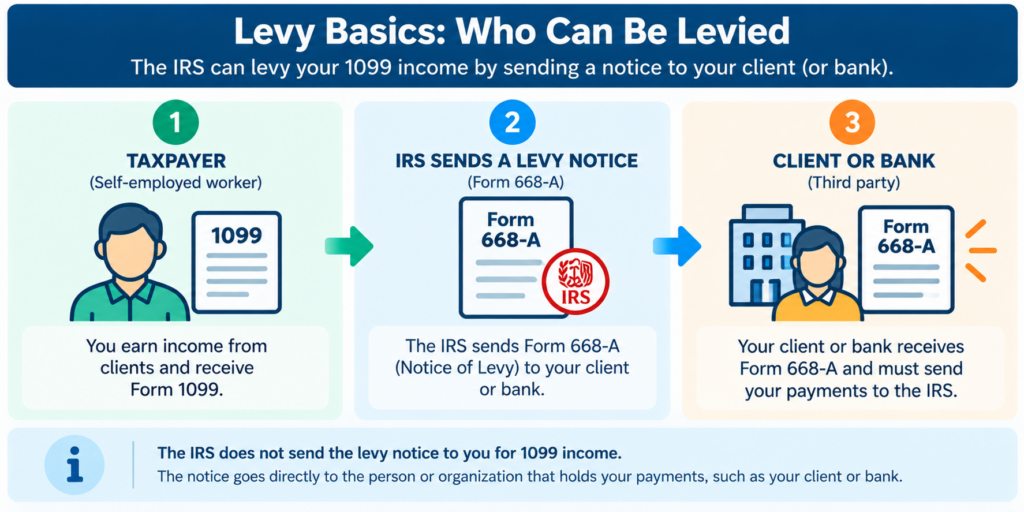
How IRS Collection Differs for W-2 Employees and 1099 Contractors
The two situations travel down different paths, and the path determines how much money the IRS can reach and for how long. A W-2 employee and a 1099 contractor can owe the same amount and still face very different collection actions. Start with the core distinction, because every later step of an IRS levy on 1099 income depends on it.
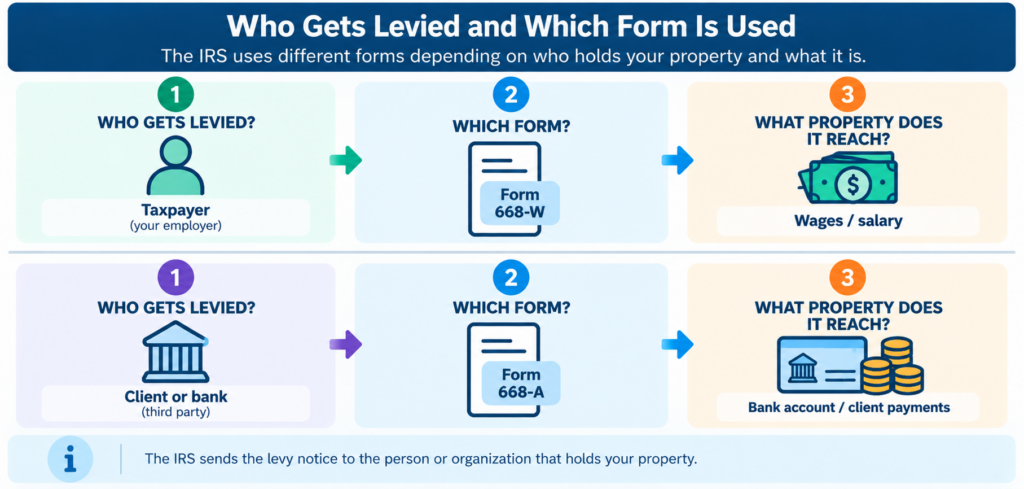
- W-2 employees: the IRS levies the employer, and the levy continues on each paycheck until the debt is paid or released.
- 1099 contractors: the IRS usually levies the client with Form 668-A, which reaches only the amount owed when the levy is served.
| Income Type | Typical IRS Action | How Long It Lasts |
| W-2 wages | Levy on the employer for wage garnishment | Continuous until paid or released |
| 1099 client payments | Levy on the client using Form 668-A | Reaches amounts owed when served |
Can the IRS Take Payments Before a Client Pays You?
Generally, no. An IRS levy on 1099 income reaches what exists when the levy is served. Suppose a client owes you $4,000 for completed design work, and the IRS serves a levy on that client on a Tuesday.
The levy attaches to that $4,000. An invoice you send the following month sits outside the levy, although the IRS can issue a new one to reach it later.
What Is an IRS Levy on Accounts Receivable?
Accounts receivable are the amounts customers owe your business for work already delivered. When the IRS pursues those amounts, it issues an IRS levy on accounts receivable notice that directs the customer to pay the government instead of you.
The IRS generally uses Form 668-A for this purpose, and the notice requires the recipient to turn over property belonging to the taxpayer, up to the amount specified on the form.
How Client Invoices and Outstanding Receivables Are Affected
Your invoices do not all respond to a levy in the same way. The status of each invoice on the day the notice arrives determines what your client must send to the IRS, so sorting your receivables early pays off. Here is how each category typically plays out:
- Open invoices: the levy reaches the balance owed on the date it is served, such as an open $6,500 invoice.
- Partly paid invoices: the levy generally reaches only the remaining balance.
- Later invoices: these usually require a new levy notice before the IRS can reach them.
What Is IRS Form 668-A and How Does It Work?
Form 668-A is the Notice of Levy the IRS uses to reach property held by a third party, generally bank accounts and business receivables. It turns an unpaid balance into a direct demand on someone else’s payments. Three features matter most to self-employed owners:
- It is delivered to the client or bank that holds your money.
- The recipient must surrender the funds described on the notice.
- If no release arrives within 21 days, funds the recipient held on the levy date generally must be sent to the IRS.
What a Notice of Levy on a Third Party Means
The 21-day window is the most important number on the form. During that period, the IRS may issue a release once the tax issue is resolved or a payment arrangement is reached, and a release stops the transfer. The clock starts when the recipient receives the notice, so speed matters.
What Clients Must Do After Receiving a Levy Notice
Once the notice arrives, your client generally needs to:
- Follow the instructions printed on the form.
- Send the required funds to the IRS within the timeframe stated.
- Avoid holding back money the notice covers, since doing so can create personal liability.
Payments made to you before the levy was served generally are not reached. When an IRS levy on payments from clients begins to affect your work, tell your client that you are working with the IRS on the balance and will share any release promptly.
Keep the notice, your invoices, and your IRS correspondence together, so every question can be answered from one organized file.
One-Time Levy vs. Continuous Levy
The difference between a one-time levy and a continuous levy determines whether the IRS can reach future income. Here is how the two compare:
- One-time levy: attaches to money owed when it is served. Most client levies work this way, which means later invoices need a new notice.
- Continuous levy: keeps attaching to future income until the debt is paid or released. Federal law makes wage and salary levies continuous.
Form 668-A vs. Form 668-W: What Is the Difference?
Many owners confuse these two forms, especially when an IRS levy on 1099 income is involved. Both are levy notices, yet they travel to different recipients and reach different kinds of money. Getting the distinction right tells you who must act and how quickly.
| Form | Typical Recipient | What It Reaches |
| Form 668-A | Bank, client, or other third party | Bank accounts and business receivables |
| Form 668-W | Employer or other payer of wages | Wages and salary, usually on a continuous basis |
Read More: What Happens If You Miss an IRS Installment Payment?
Why Your Contract Terms Matter
Your contracts often decide whether a particular payment falls within a levy. The language you use with clients and the schedule you agree to can clarify exactly what is owed and when. Whether an IRS levy on 1099 income reaches a payment depends heavily on these details:
- Fixed-price contracts for finished work create a clear debt that is easy to document.
- Retainers or payments for work not yet performed may be harder to pin down.
- Signed agreements and written payment schedules show what is owed and when it is due.
What Should You Do If an IRS Levy on 1099 Income Reaches Your Clients?
A levy notice is serious, but it is rarely the end of the road. The first days matter most, because the 21-day period moves quickly. If you need help with an IRS levy on client payments, our team can review the notice with you before you respond to anyone. Work through the four steps below in order, since each one builds on the one before it.
Step 1: Review the IRS Notice and Identify the Type of Levy
Every response starts with an accurate reading of the notice. Confirming the form type, the recipient, and the amount prevents wasted effort and keeps you from answering a question nobody asked. Check these items first:
- Confirm whether the form is a 668-A aimed at a client or bank, or a 668-W aimed at wages.
- Check the names, tax periods, amount due, and dates printed on the notice.
- Locate the Final Notice of Intent to Levy, which the IRS generally must send at least 30 days before a levy.
Step 2: Review the Tax Balance and Collection Deadlines
A levy notice usually addresses only part of a larger balance. Mapping the full picture shows how much is at stake and which deadlines control your options. Build that map before you contact anyone at the IRS:
- Total the balance across all tax years, including penalties and accrued interest.
- Note each deadline and set a calendar reminder a few days ahead of it.
- Remember that a single client’s levy may cover only part of what you owe.
Step 3: Document Your Business Income and Essential Expenses
The IRS evaluates your ability to pay using real financial information, so organized records carry real weight. Start with these items:
- Gather recent bank statements, open invoices, and current business income.
- List essential living and business expenses with supporting receipts.
- Use actual statements rather than estimates when you can, since estimates often trigger follow-up questions.
Step 4: Explore Appropriate Levy Release or Resolution Options
Resolution is rarely a single decision. Each route carries its own costs and rules, so compare them against your balance before choosing. The main routes are these:
- Paying the balance in full leads to a release of the levy.
- Other paths include a payment plan, an offer in compromise, a hardship release, or an appeal.
- Choose a monthly payment you can sustain, since a failed plan can bring collection action back.
How to Stop an IRS Levy on Self-Employed Income
Learning how to stop an IRS levy on self-employed income starts with a realistic, documented path forward. The right route for an IRS levy on 1099 income depends on your balance, your income, and whether your filings are current. Our team can explain the options for stopping an IRS levy that fit your records, and the table below compares the most common choices.
| Option | Best For | Effect on the Levy |
| Payment plan | Taxpayers who can make monthly payments | May release levies while payments stay current |
| Offer in compromise | Taxpayers who cannot reasonably pay the full balance | May pause certain collection while under review |
| Hardship release | Taxpayers whose basic living needs would be affected | May release the levy after review |
Request a Payment Plan if You Qualify
A payment plan is often the simplest route for owners whose income is steady but whose balance is too large to pay at once. Approval depends on your filing status and the size of the balance. Here is what a plan typically involves:
- An installment agreement lets you pay the balance over time in monthly amounts.
- An approved plan may release levies while payments stay current.
- Interest and penalties continue to accrue, so the total cost grows the longer the balance remains open.
Explore an Offer in Compromise if Eligible
An offer in compromise is a serious option, but it works only when the IRS agrees the full balance cannot reasonably be collected. The review is thorough, so it rewards owners who prepare complete and accurate financial statements. The core features are these:
- An offer settles the debt for less than the full balance, based on your reasonable collection potential.
- The IRS reviews your income, assets, expenses, and future ability to pay.
- Certain collection actions generally pause during review, but interest and penalties usually continue to accrue.
Read More: IRS Offer in Compromise Pre-Qualifier Tool: 5 Things It Gets Wrong
Ask About Levy Release Due to Economic Hardship
A hardship release addresses one specific problem: collection that would leave you unable to cover basic living costs. The IRS does not grant these requests on general concern alone, so the request needs documentation that shows the pattern clearly. Prepare these items before you ask:
- Provide financial statements that show your income, expenses, and assets.
- Document any sharp drop in income with bank statements and invoices.
- Explain how collection would prevent you from meeting basic living expenses.
Understand Your Appeal Options and Important Deadlines
Appeal rights protect you when you believe a levy is wrong or premature. They also come with strict timing, so knowing the options early keeps them available. The essentials are these:
- If you disagree with a levy, you may have the right to a Collection Due Process hearing.
- The request is typically made on Form 12153.
- A timely request generally pauses the levy while the hearing is pending.
Important
The hearing deadline comes from the notice itself. Count from the date printed on it, not from the day you opened the envelope.
When Should You Get Professional Help With an IRS Levy?
Professional help makes the most difference when an IRS levy on 1099 income touches several parts of your business at once. A skilled representative can review the notice, confirm the balance, and check each deadline before you respond. Consider reaching out early if any of the following apply:
- Your clients have received levy notices and are asking questions you cannot yet answer.
- You have unfiled returns or current-year payments that may be behind.
- Your business bank account and client payments are both affected.
How Salinger Tax Consultants Can Help With IRS Levy Issues
At Salinger Tax Consultants, our work starts with clarity. We read the notice, map the balance, and build a response around what the IRS needs to see:
- Levy review: we check your IRS notices, balance, and ability to pay, and identify whether a client, bank, or employer is holding funds.
- Documentation: we help prepare financial statements and organize your records.
- Support: Our team assists with self-employed tax debt, from notice review through resolution.
- IRS communication: We speak with the IRS about the levy and any payment arrangement.
- Release requests: We prepare hardship requests and appeals when appropriate.
Protect Your Business Income by Addressing an IRS Levy Promptly
An IRS levy on 1099 income can reach client payments and receivables faster than most owners expect. The process is also predictable. Knowing how Form 668-A works, which payments it can reach, and which deadlines apply gives you the time and clarity to respond well. Early action almost always leaves more room to choose a sensible path, and that room is worth protecting.
Salinger Tax Consultants helps self-employed taxpayers review levies, prepare the paperwork, and pursue the relief path that fits their records. Schedule a consultation with our tax resolution team to talk through your notice and your options.
FAQs
Yes, through an IRS levy on 1099 income, usually using Form 668-A. Self-employed wage garnishment follows different rules because it applies to W-2 wages. Can the IRS garnish 1099 income beyond what clients owe you at the time of service? Generally no, so a new notice is needed for later amounts.
Yes, once the required notices are sent. An IRS levy on payments from clients tells your client to pay the IRS instead of you, and it covers amounts owed on the date the notice is served.
It is an IRS levy on unpaid invoices and other money customers owe your business. The IRS generally uses Form 668-A for this, and the customer must send the amount listed on the form to the IRS.
Most levies on client payments are one-time, so an IRS levy on 1099 income reaches only the balances owed when it is served. Wage levies are continuous under federal law. Later invoices need a new notice.
To stop an IRS levy on self-employed income, you can pay the balance, set up a payment plan, request a hardship release, or file a Collection Due Process request before the deadline. Confirm the notice date and balance first.

