

The 2026 filing season gives many workers and vehicle owners new ways to lower taxable income. The no-tax tips overtime and car loan deduction 2026 rules may apply if you earned qualified tips, received overtime required by federal law, or paid interest on an eligible new vehicle loan. These benefits come from the One Big Beautiful Bill Act, or OBBBA, and generally apply to tax years 2025 through 2028.
This guide explains how the deductions work, which records support them, and how to coordinate more than one benefit. If you want your return reviewed before filing, tax preparation & IRS help can help you organize the information and report each deduction correctly.
|
Key Takeaways
|
What Changed Under the One Big Beautiful Bill Act (OBBBA)?
The OBBBA new deductions 2026 rules affect returns filed during the 2026 filing season for tax year 2025, as well as eligible tax years through 2028. The no-tax-tips overtime car loan deduction 2026 provisions are deductions from taxable income. They are available to eligible taxpayers whether they itemize deductions or take the standard deduction.
The phrase “no tax” can be misleading. Your tips and overtime still appear as income, and the deductions do not remove Social Security or Medicare taxes. Each benefit also has its own limits, income phaseouts, filing rules, and record requirements. A taxpayer who claims the wrong amount may face a delayed refund or an IRS notice.
Overview of the New 2026 Tax Deductions
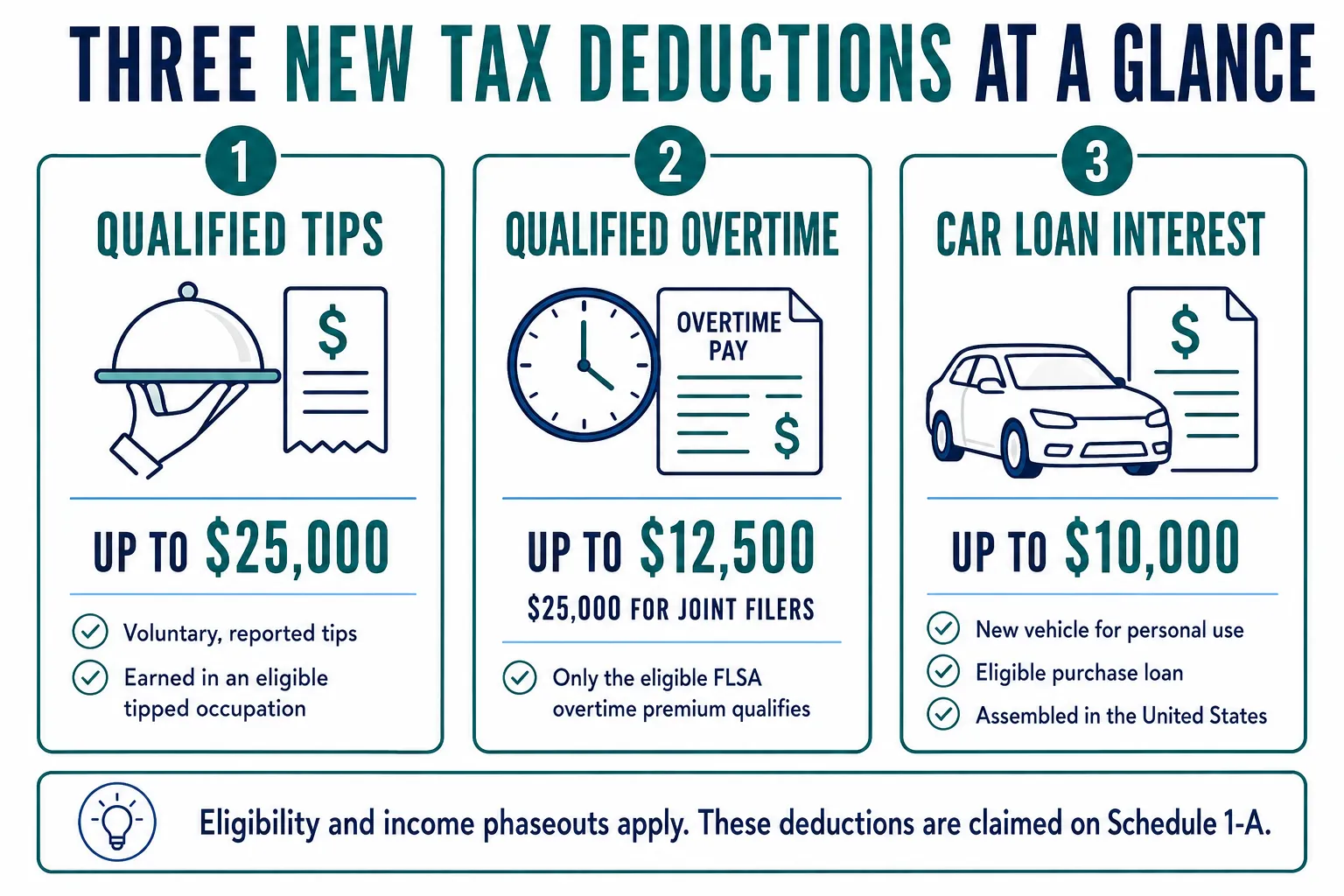
The law created separate deductions for qualified tips, qualified overtime compensation, and interest on certain passenger vehicle loans. These are maximums before income phaseouts and other restrictions.
| Deduction | Maximum deduction | Main qualification | Income phaseout begins |
| Qualified tips | $25,000 per return | Voluntary tips earned in an eligible tipped occupation and properly reported | $150,000 MAGI, or $300,000 for joint filers |
| Qualified overtime | $12,500, or $25,000 for joint filers | The FLSA-required premium above the regular pay rate | $150,000 MAGI, or $300,000 for joint filers |
| Car loan interest | $10,000 | Interest on an eligible loan for a new, personal-use vehicle assembled in the United States | $100,000 MAGI, or $200,000 for joint filers |
These deductions are available to eligible taxpayers who take the standard deduction as well as those who itemize. Each deduction is calculated on Schedule 1-A and then carried to Form 1040.
Who Benefits From These Changes?
Tipped employees and some self-employed workers in occupations that customarily received tips before 2025 may benefit. Workers entitled to overtime under the Fair Labor Standards Act may qualify for the overtime benefit. Buyers who financed an eligible new, U.S.-assembled passenger vehicle for personal use may benefit from the interest deduction.
Higher-income taxpayers may receive a smaller deduction or none because each provision has a modified adjusted gross income phaseout.
Effective Dates and Filing Rules
The deductions generally apply to eligible amounts paid or received in tax years 2025 through 2028. Taxpayers filing 2025 returns in 2026 use Schedule 1-A to calculate them. The Schedule 1-A result flows to Form 1040. This no-tax tips overtime car loan deduction 2026 filing route applies whether you itemize or use the standard deduction.
|
Quick Tax Tip “No tax” is shorthand for an income tax deduction. Tips and overtime must still be reported as income, and applicable Social Security and Medicare taxes may still apply. The deductions reduce taxable income when eligibility requirements are satisfied. |
Understanding the New No Tax on Tips Deduction
The tips deduction Form 1040 process begins by separating qualified tips from wages, service charges, and other receipts. The no-tax tips overtime car loan deduction 2026 law allows up to $25,000 of qualified tips to be deducted, although the final amount can be lower.
Who Qualifies for the Tips Deduction?
Employees and self-employed individuals may qualify when they receive tips in an occupation that customarily and regularly receives tips on or before December 31, 2024. The IRS publishes the qualifying occupation list. The taxpayer receiving the tips must have a valid Social Security number. A married taxpayer must generally file jointly to claim the deduction.
Eligible Tip Income
Qualified tips are voluntary cash tips, charged tips, and amounts received through tip sharing. The customer must determine the amount without negotiation or a consequence for refusing to pay. Mandatory service charges are generally not voluntary tips.
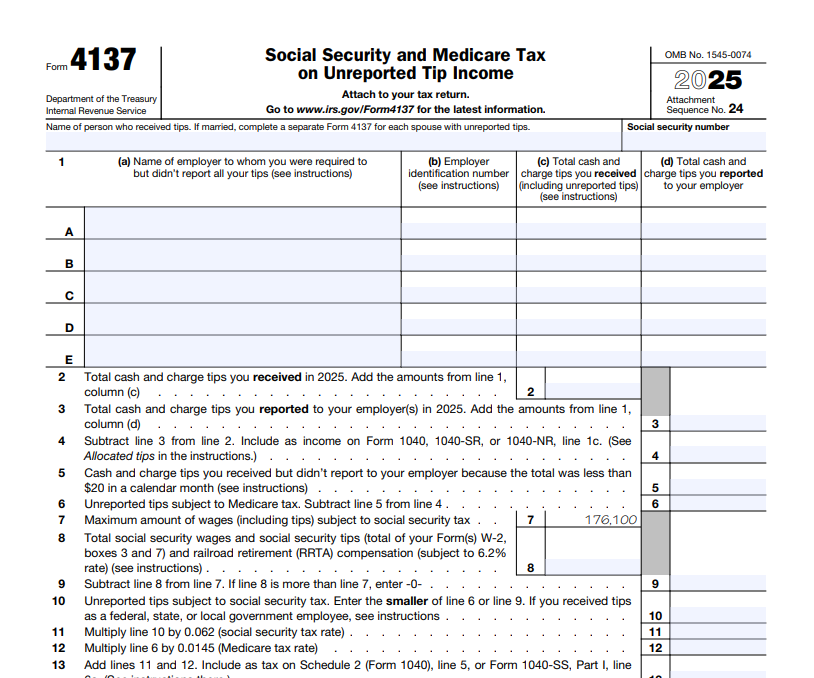
Tips must be reported on an eligible information statement or directly by the taxpayer through Form 4137 when applicable. Income still must be reported even if no information form arrives.
| May qualify | Does not qualify |
| Voluntary cash tips | Mandatory service charges |
| Tips paid by credit or debit card | Amounts negotiated with the customer |
| Tips received through an eligible tip-sharing arrangement | Amounts paid outside an eligible tipped occupation |
| Properly reported tips shown on relevant tax or employment records | Unreported income without supporting records |
Remember: The payment method does not determine eligibility. The payment must be a voluntary tip, earned in a qualifying occupation, and reported to the employer or IRS.
Income Limits and Restrictions
The annual cap is $25,000 per return. The deduction begins to phase out when modified adjusted gross income exceeds $150,000, or $300,000 for joint filers. It is reduced by $100 for each $1,000, or part of $1,000, above the threshold.
Tips received in certain specified service trades or businesses do not qualify. The occupation, nature of the payment, reporting method, income level, and filing status must all be checked before the amount is claimed.
How to Claim the Deduction on Form 1040
For the tips deduction Form 1040 filing process, calculate the eligible amount in Part II of Schedule 1-A. Use the qualified amount from the applicable statement or permitted records, apply the cap and phaseout, and transfer the completed Schedule 1-A deduction as directed by the Form 1040 instructions.
Keep W-2s, 1099s, Form 4137, tip logs, payroll reports, point-of-sale summaries, and employer statements. A complete tips deduction Form 1040 file should show both the reported income and the deduction calculation. Tax preparation assistance can help reconcile daily records with annual forms before filing.
Read More: Self-Employed Tax Deductions: The Complete List for 2026
No Tax on Overtime: How the Deduction Works
If you are researching how to claim the overtime deduction, begin with the source of the overtime. The deduction covers qualified overtime compensation required under Section 7 of the Fair Labor Standards Act. It generally covers the premium above the regular rate, such as the extra one-half portion of time-and-a-half pay.
What Counts as Qualified Overtime?
A voluntary weekend premium, holiday premium, or overtime required only by state law may not qualify unless it also meets the federal requirement.
|
Quick Example An employee earns $20 per hour and receives $30 per hour for FLSA-required overtime. Only the additional $10 overtime premium may qualify for the deduction. The employee cannot deduct the entire $30 paid for each overtime hour. |
Eligibility Requirements
The worker must receive qualified overtime compensation included on a W-2, 1099, or other specified statement. A valid Social Security number is required. Married taxpayers must file jointly.
The maximum is $12,500 per return, or $25,000 for a married couple filing jointly. The phaseout begins above modified adjusted gross income of $150,000, or $300,000 for joint filers.
Documentation You’ll Need
Keep your W-2, year-end employer statement, pay stubs, time sheets, regular hourly rate, overtime hours, and any payroll explanation showing the federal overtime premium. For 2025, employers received transition relief, so the W-2 may not separately show the qualified amount.
If the figure is unclear, request a written calculation from payroll. Do not assume that every entry labeled “OT” is fully deductible. Strong payroll records provide the clearest answer to how to claim the overtime deduction.
How to Claim the Overtime Deduction
Calculate the eligible premium in Part III of Schedule 1-A, apply the annual limit and income phaseout, and transfer the resulting deduction according to the Form 1040 instructions. Retain the calculation with your records. This overtime deduction how to claim process helps connect Schedule 1-A to the payroll evidence.
If an employer later corrects its reporting, compare the corrected statement with the filed return. Tax preparation assistance may help determine whether an amended return is appropriate.
Car Loan Interest Deduction Explained
Under the no tax tips overtime car loan deduction 2026 rules, eligible taxpayers may deduct up to $10,000 in interest paid on a qualifying passenger vehicle loan. Income limits apply.
Which Vehicles Qualify?
The vehicle must be new, purchased for personal use, and assembled in the United States. Eligible vehicles include cars, minivans, vans, SUVs, pickup trucks, and motorcycles weighing less than 14,000 pounds.
Car Loan Interest Eligibility Checklist:
- The taxpayer is the vehicle’s first owner.
- The vehicle was purchased for personal use.
- Final assembly occurred in the United States.
- The loan originated after December 31, 2024.
- The loan is secured by a lien on the vehicle.
- The taxpayer has the VIN and interest records.
|
Quick Tax Tip A vehicle brand may be American while a particular model is assembled elsewhere. Check the dealership label or confirm the plant of manufacture using the VIN before claiming the deduction. Used vehicles and lease payments do not qualify. |
Used vehicles and leased vehicles do not qualify. The vehicle identification number can help verify final assembly, but buyers should also retain purchase and manufacturer information.
Eligible Auto Loans
The loan must finance an eligible vehicle, originate after December 31, 2024, and be secured by a first lien. Loans from related persons do not qualify. Refinanced loans may qualify only up to the remaining principal of the original eligible loan.
Deduction Limits
The deduction is limited to $10,000 annually. It begins to phase out when modified adjusted gross income exceeds $100,000, or $200,000 for joint filers. The deduction is reduced by $200 for every $1,000, or part of $1,000, above the threshold.
Only eligible interest is deductible. Principal, insurance, lease payments, and non-interest fees do not qualify.
Required Records and Documentation
Keep the purchase agreement, financing contract, lender statements, VIN, proof of interest paid, personal-use records, and evidence of U.S. final assembly. Tax planning services can help determine the amount to report on Schedule 1-A.
Common Filing Mistakes That Could Trigger IRS Notices
The no-tax tips, overtime car loan deduction 2026 provisions are new, and mismatches may attract questions when third-party statements do not agree with the return.
Filing Red Flags:
- Deducting all overtime pay instead of only the eligible overtime premium
- Treating mandatory service charges as qualified tips
- Claiming tips that were not properly reported
- Claiming interest for a used, leased, business-use, or nonqualifying vehicle
- Entering an incorrect or incomplete VIN
- Claiming the same vehicle interest on Schedule 1-A and a business schedule
- Ignoring the applicable MAGI phaseout
- Filing separately when the deduction requires married taxpayers to file jointly
Claiming Ineligible Income
Common errors include treating mandatory service charges as tips, deducting the full overtime payment instead of the premium, or claiming interest on a used or leased vehicle. Check the legal definition before entering an amount.
Missing Supporting Documentation
A deduction may be challenged if the taxpayer cannot show how it was calculated. Keep contemporaneous tip logs, complete payroll reports, and lender records. A single year-end estimate with no supporting detail may be difficult to defend.
Duplicate Deduction Claims
Do not count the same tip as both tip income and overtime compensation, or deduct the same vehicle cost under personal and business rules. Review the complete return for overlap. Tax planning services should also consider phaseouts across the household’s complete return.
Reporting Errors on Form 1040
Schedule 1-A calculations must reach the correct Form 1040 line. Incorrect Social Security numbers, filing status, modified adjusted gross income, or transcribed amounts can change the result. If a mistake creates a balance or penalty, IRS penalty assistance can review possible correction and relief options.
Documents You Should Keep Before Filing
Organize records before tax preparation assistance begins. A complete file reduces guesswork and helps explain the return if the IRS asks for support.
| Deduction | Records to retain |
| Tips deduction | Form W-2, relevant Forms 1099, Form 4137 when applicable, daily tip logs, platform statements, and employer tip reports |
| Overtime deduction | Form W-2 or applicable Form 1099, final pay stub, payroll summaries, regular hourly rate, overtime rate, hours worked, and employer verification |
| Car loan interest deduction | Lender statement, purchase agreement, loan documents, VIN, vehicle information label, proof of final assembly, and personal-use records |
| All deductions | Filed Form 1040, Schedule 1-A, income records used to calculate MAGI, worksheets, and correspondence supporting corrections |
Keep the records used to calculate the deduction even when the amount is not separately identified on an information return.
How These New Deductions Affect Your Tax Refund
The no-tax tips overtime car loan deduction 2026 benefits reduce taxable income, which may lower federal income tax or increase a refund when withholding and other return items remain the same. They do not guarantee a refund.
Examples of Potential Tax Savings
Assume an eligible taxpayer has $8,000 of qualified overtime premium and is below the phaseout threshold. The deduction may reduce taxable income by $8,000. The tax saved is not necessarily $8,000 because savings depend on the taxpayer’s marginal tax rate and overall return.
Impact on Taxable Income
Schedule 1-A deductions are available with either the standard deduction or itemized deductions. They reduce taxable income after the applicable calculation. Payroll taxes may still apply to tips and overtime, and the car payment principal remains nondeductible.
Planning Ahead for Future Tax Years
Track qualified amounts during the year. Tax planning services can review pay records, lender statements, and withholding, while tax preparation assistance can carry the supported figures into the return. Continuing tax planning services may also help you prepare for later eligible years.
Read More: Tax Preparation Services Florida: Find the Best Professional Help
How Salinger Tax Consultants Help Maximize Your Deductions
Salinger provides tax preparation services for taxpayers who need help reviewing income, records, deductions, and filing requirements. The no tax tips overtime car loan deduction 2026 review should connect each claimed figure to a reliable document.
Tax Return Review
As part of tax planning services, a preparer can compare Forms W-2 and 1099, Schedule 1-A, Form 1040, and supporting statements. Tax preparation & IRS help is especially useful when reporting is incomplete or more than one deduction may apply.
Deduction Verification
The review can separate voluntary tips from service charges, qualified overtime premiums from other extra pay, and eligible vehicle interest from principal or unrelated charges. This supports a more accurate return.
IRS Notice Assistance
If the IRS questions a deduction, Salinger can help compare the notice with the return and documentation. IRS penalty assistance may also help when an error leads to penalties and the facts support relief.
Back Tax Resolution
A new deduction may reduce current taxable income, but it does not automatically resolve an older assessed balance. The no-tax tips overtime car loan deduction 2026 provisions affect the return for the eligible year.
Taxpayers who cannot pay qualifying IRS debt in full may explore Offer in Compromise services or another collection option after their compliance and finances are reviewed.
Conclusion
The no-tax tips-overtime car loan deduction 2026 rules can reduce taxable income for eligible taxpayers, but each benefit requires a separate calculation. Confirm the payment type, income limits, filing status, Social Security number requirements, and documentation before claiming the amount. Remember that “no tax” refers to an income-tax deduction and does not erase reporting or payroll-tax duties.
The OBBBA new deductions 2026 filing process is easier when your records agree with Schedule 1-A and Form 1040. For a return review or help correcting a problem, contact Salinger Tax Consultants. Their tax preparation services can help you claim supported deductions and respond if the IRS raises a question.
FAQs
Employees and self-employed workers may qualify if they receive voluntary qualified tips in an occupation on the IRS list, report the income correctly, meet filing and Social Security number rules, and remain within the deduction limits. The tips deduction Form 1040 calculation is completed on Schedule 1-A.
For the overtime deduction how to claim, identify the federally required premium above regular pay, document it, and complete Part III of Schedule 1-A. Apply the cap and income phaseout before transferring the deduction according to Form 1040 instructions.
Yes, if you independently qualify for both. The OBBBA new deductions 2026 rules require separate calculations, and the same payment cannot be deducted twice.
A qualifying vehicle is generally a new car, minivan, van, SUV, pickup truck, or motorcycle under 14,000 pounds that was purchased for personal use and finally assembled in the United States. The loan must also satisfy origination, purchase, and lien requirements.
Keep W-2s, 1099s, Form 4137 (when applicable), tip logs, pay stubs, time sheets, employer statements, loan agreements, interest statements, the vehicle identification number, and final assembly evidence.

