

A penalty notice adds costly charges to an already heavy tax bill. If events outside your control caused the issue, you can request reasonable cause penalty abatement to remove the penalty based on your facts.
Many requests fail due to vague explanations, missing dates, or mismatched notices. However, some taxpayers qualify for automatic relief without writing a letter. Knowing your situation protects your chances and saves time.
This guide covers how the IRS evaluates reasonable cause, what qualifies, how to write a strong abatement letter, and how to handle a denial.
|
Key Takeaways
|
What Is Reasonable Cause Penalty Abatement?
Reasonable cause penalty abatement is the IRS process for removing or reducing a penalty after you show a valid reason for missing a filing, payment, or deposit requirement.
The IRS weighs your reasons against the specific penalty, so results can differ from one taxpayer to the next. The purpose of IRS penalty relief is to help people who tried to comply and were stopped by events they could not control.
How the IRS Defines Reasonable Cause
You may qualify for relief when you used ordinary care and prudence (the level of care a sensible person would take with their tax duties) and still could not file or pay on time. A reviewer is asking two questions:
- Did you act responsibly before the problem began?
- Did something outside your control stop you anyway?
When the honest answer to both is yes, you have the foundation of a reasonable cause penalty abatement case. Keep two limits in mind:
- For a business, the reasons apply to the person with authority to submit the return, deposit, or tax.
- Some penalties, such as the estimated tax penalty, cannot be removed this way.
How the IRS Evaluates Your Facts
A reasonable cause penalty abatement request is decided case by case, using all the facts and circumstances. When you ask for relief, the IRS wants you to explain the following points.
- What happened and when it happened.
- How the situation kept you from filing or paying on time.
- What you did to try to comply while the problem lasted.
- What you did to correct the issue once the problem ended.
The first three points come from IRS guidance, and the fourth shows good faith once the obstacle passes. Attach a date and, where possible, a document to each point.
|
Quick Fact When the IRS removes or reduces a penalty, it also reduces or removes the interest charged on that penalty. |
What Qualifies for IRS Penalty Relief and What Usually Does Not
Reasonable cause penalty relief depends on the penalty involved, because the qualifying reasons differ for filing and payment penalties, accuracy-related penalties, and information return penalties.
The IRS lists examples of reasons that may support relief and reasons that generally fall short. These lists guide reviewers, yet they are not automatic answers, and strong supporting facts and records can change the outcome.
Circumstances That May Qualify
For failure-to-file and failure-to-pay penalties, the IRS names fires, natural disasters, and civil disturbances as valid reasons. It also lists inability to get records, death, serious illness, or unavoidable absence of you or an immediate family member, and system problems that delayed a timely filing or payment.
Suppose a hospital stay kept you from your records for six weeks before a deadline. A doctor’s letter with start and end dates connects the illness to the missed date. The table shows what proof helps.
| Situation | What the IRS Looks For | Helpful Proof |
| Serious illness or death | Dates that overlap the deadline | Doctor’s letter, hospital or court records |
| Fire or natural disaster | A link between the event and your ability to file or pay | Insurance claims, property records, disaster documentation |
| Unable to get records | Efforts to obtain records and to file anyway | Copies of written requests and replies |
| System problems | Proof you tried to file or pay on time | Error messages, confirmations, receipts |
Each row pairs an event with a date and a document, which a reviewer can verify. That is the standard your explanation has to meet.
Reasons That Usually Fall Short
The IRS says several common reasons generally do not qualify on their own. Reliance on a tax professional usually fails because you remain responsible for what your preparer files. Lack of knowledge fails because you are expected to know or find out the filing rules, deadlines, and amounts.
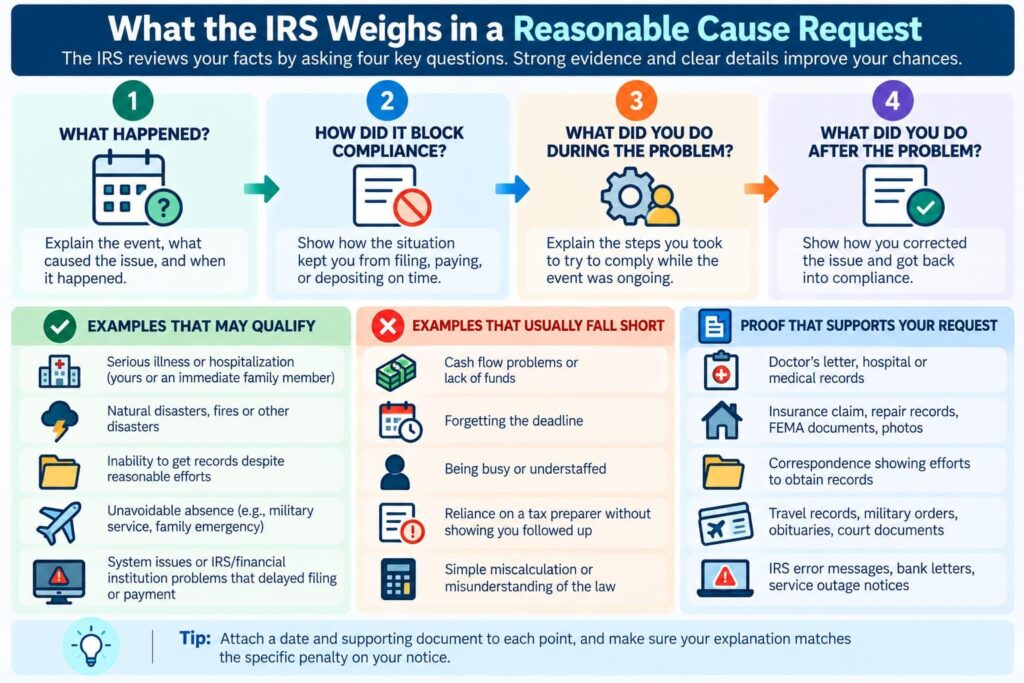
Forgetting a deadline or a simple oversight does not qualify unless you can show you actively tried to comply. Lack of funds also does not automatically excuse payment penalties without proof that you exercised ordinary care. Claims supported by clear timelines and documentation are much more likely to succeed.
Reasonable Cause vs. Automatic Penalty Relief
Before you write anything, check whether automatic relief already applies. The IRS is replacing First Time Abate with a new program called Automatic Exemption from Penalty, or AEP. Which route fits you depends on your compliance history and the tax year involved, so confirming it first can save you a full reasonable cause penalty abatement request.
How AEP and First Time Abate Work
AEP began phasing in during July 2026. If you file or pay late but filed on time and paid your tax for the prior three years (or 12 consecutive quarters for quarterly filers), the IRS does not assess the penalty. Here is what to know:
- AEP covers failure to file, failure to pay, and failure to deposit penalties.
- It applies to 2025 tax year returns, 2026 quarterly returns, and later periods.
- The IRS sends a notice explaining that relief was applied, and you do not need to respond.
- First Time Abate still applies to earlier periods, and some 2025 or 2026 returns processed before AEP launched may still need it.
| Option | Who It Fits | How You Get It |
| AEP | Timely filing and payment for the prior three years, on eligible returns | Applied automatically when the return is processed |
| First Time Abate | Same clean history, for earlier periods or returns processed before AEP | Call or write to the IRS to request it |
| Reasonable cause | Documented circumstances beyond your control, including penalties AEP does not cover | Explain the facts with dates and proof |
Both automatic options depend on a clean record, so reasonable cause fills the gap for taxpayers with a recent penalty or late return.
Which Option Should You Request?
- Clean record and an assessed penalty: call the number on your notice. If you ask for reasonable cause penalty abatement but qualify for First Time Abate, the IRS applies First Time Abate.
- Unclear history: Get help with IRS penalties before you commit to a route. A transcript review shows which years and penalties are involved.
Reasonable Cause for an IRS Accuracy-Related Penalty
An IRS accuracy-related penalty follows different rules than a late filing or late payment charge. It applies when the IRS finds that you underpaid the tax required to be shown on your return. Reasonable cause penalty abatement can still remove it, but the IRS judges your good faith in preparing the return, not your reasons for missing a date.
What Is an Accuracy-Related Penalty?
The IRS accuracy-related penalty has two common versions for individuals, and both are 20% of the portion of the underpayment the IRS attributes to the problem:
- Negligence or disregard of the rules: you did not make a reasonable attempt to follow the tax laws, such as leaving out income shown on a Form 1099.
- Substantial understatement of income tax: you understate your tax by the greater of 10% of the tax required to be shown or $5,000. The percentage drops to 5% if you claim the Section 199A deduction.
The IRS sends a notice if it assesses this penalty.
Reasonable Cause and Good Faith
For an IRS accuracy-related penalty, the IRS asks whether you acted with reasonable cause and good faith. It considers:
- The efforts you made to report the correct tax
- How complex the tax issue was
- Your education, experience, and knowledge of tax law
- The steps you took to understand your obligation or get help from a tax advisor
If you relied on an advisor, the IRS may ask whether you gave the advisor all the needed information and whether the advisor was competent and experienced. Reliance can help here, unlike with late filing penalties.
Read More: First Time Penalty Abatement IRS Guide
How to Request Relief With a Strong Penalty Abatement Letter
The right method depends on how complex your facts are and what the IRS has already said. A well-built penalty abatement letter gives the reviewer a clear timeline to verify, which supports your reasonable cause penalty abatement request.
What a Penalty Abatement Letter Should Include
A reasonable cause penalty abatement letter should name the penalty, the tax period, and the notice date. It should then tell the story in order and tie each statement back to the penalty the IRS assessed:
- What happened and when it happened
- How it stopped you from filing or paying
- What you did to comply
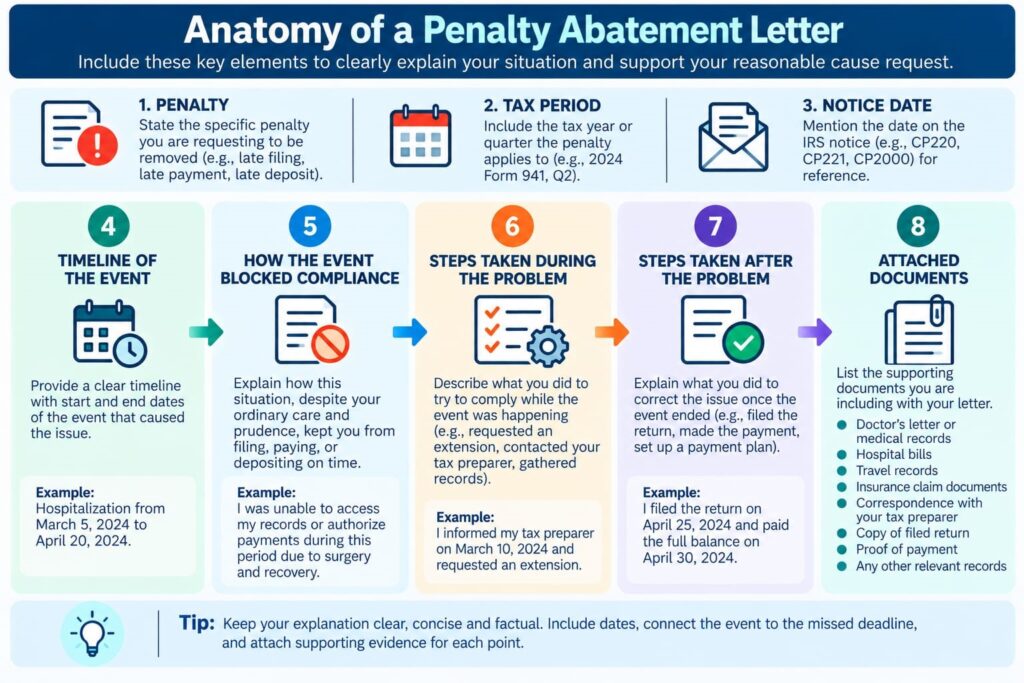
Supporting documents turn your penalty abatement letter into evidence. The IRS suggests:
- Hospital, court, or doctor records with start and end dates
- Documentation of disasters
- Copies of relevant letters and responses
- Receipts or forms
A generic penalty abatement letter that lists a hardship without dates, proof, or a link to the penalty is a common reason requests fail.
How to Submit Your Request
Start by reading the IRS notice and confirming which penalty was assessed, since the reasons that qualify differ by penalty. Then choose the method that fits your facts.
| Method | When It Fits | What to Have Ready |
| Phone call | Simpler situations, using the number on your notice | The notice, the penalty, and your reasons |
| Written statement | Complex facts or a long timeline | Signed explanation with supporting documents |
| Form 843 | When the IRS cannot approve relief by phone | Completed form and documents, sent as its instructions direct |
Keep a copy of your penalty abatement letter and all attachments, and note the date you send them. If the IRS has already collected the penalty, you can still ask for a refund in writing.
Read More: IRS Substantial Understatement Penalty Explained
If the IRS Denies Your Request and Why Experience Matters
A denial does not have to end the matter. The IRS gives appeal rights when it rejects a reasonable cause penalty abatement request, and the experience of the person preparing your case can shape both the first request and the appeal. Because appeal deadlines are short, it helps to understand both steps before you file anything.
What Happens After a Denial
You generally have 30 days from the date of the rejection letter to request an appeal, and your letter states the exact deadline. You qualify if all three of these are true:
- The IRS assessed a failure-to-file or failure-to-pay penalty.
- You asked in writing for removal.
- The IRS denied the request in a letter that gives appeal rights.
|
Pro Tip Mark the appeal deadline on your calendar the day the rejection letter arrives. |
The IRS Independent Office of Appeals reviews these cases. To prepare:
- Read the denial carefully and review your original penalty abatement letter.
- Find the gap the reviewer saw.
- Add facts or documents that close it.
An IRS penalty appeal can include a detailed explanation even if your facts fall outside the usual examples.
When to Hire a Tax Relief Attorney or Other IRS Professional
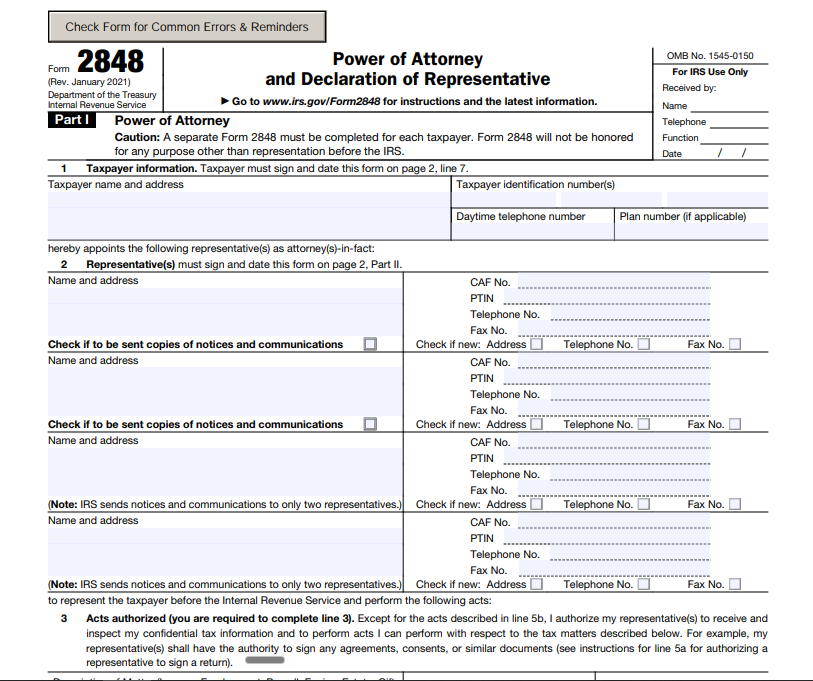
Many people start with a search for an IRS tax attorney near me, yet location matters less than experience with penalty cases. A tax relief attorney, enrolled agent, or CPA can represent you before the IRS with Form 2848.
IRS penalty relief assistance is worth considering when:
- The penalty is large.
- Several tax periods are involved.
- An earlier request was denied.
How Salinger Tax Consultants Can Help
Salinger Tax Consultants resolves IRS problems for clients nationwide, and penalty abatement is part of that work. Our team handles IRS penalty relief from the first notice through any appeal.
Review Your Penalty and Tax History
We start by reading your notice and pulling your IRS account history. That shows which penalties were assessed, which periods are affected, and which route fits best: AEP, First Time Abate, or reasonable cause. We also note any deadline on the notice and check for related issues, such as unfiled returns.
Build and Submit Your Reasonable Cause Penalty Abatement Request
We gather your timeline and records, test them against what the IRS looks for, and draft the penalty abatement letter. When Form 843 applies, we complete it and respond to IRS follow-up. Tax penalty resolution also includes appeal support if the IRS denies the first request.
Conclusion
Reasonable cause penalty abatement rewards a clear, documented account of what stopped you from complying. Check first whether AEP or First Time Abate already covers the penalty, then build your request around dates, proof, and your efforts to fix the problem.
Read your notice carefully and act before any deadline passes. Salinger Tax Consultants can review your situation and explain which IRS penalty relief route fits your facts.
Contact our tax resolution team today to schedule a consultation about your penalty notice.
FAQs
It is the IRS process for removing or reducing a penalty when you show you used ordinary care and prudence but could not comply because of circumstances beyond your control. The IRS decides each request on its own facts and supporting records.
Name the penalty, tax period, and notice date. Explain the timeline with exact dates, tie the event to the missed deadline, describe what you did to comply, and attach proof. You can send the letter or use Form 843 if the IRS cannot approve relief by phone.
Lack of funds alone is generally not enough for a payment penalty, and reliance on a tax professional usually does not excuse late filing. Other facts showing reasonable care can still support IRS penalty relief, and advisor reliance can help with accuracy-related penalties.
Yes, it can. You must show reasonable cause and good faith, which the IRS measures by your efforts to report the correct tax, the complexity of the issue, your experience, and the steps you took to get advice. The IRS accuracy-related penalty is 20% of the affected underpayment.
AEP applies automatically when you have a timely compliance history and file an eligible return. Reasonable cause requires a request with facts and proof, and it covers situations AEP does not, such as a recent penalty in your history.
You generally have 30 days from the date of the rejection letter to request an appeal with the IRS Independent Office of Appeals. Review the denial, gather any missing facts or records, and send a detailed explanation with your appeal.

