

Back-to-school season can put extra pressure on any family budget. Between school supplies, childcare, transportation, and everyday living expenses, parents already dealing with IRS tax debt may find it even harder to stay financially stable.
If paying your tax debt is preventing you from covering basic household expenses, IRS Currently Not Collectible (CNC) status, also known as IRS CNC status family hardship relief, may provide temporary protection from many IRS collection actions.
If you are in this situation and looking for a form of IRS tax relief, this guide breaks down how IRS Currently Not Collectible (CNC) status works and how it may provide relief for your family.
|
Key Takeaways
|
Why Back-to-School Season Can Create Serious Financial Hardship
Back-to-school season brings unavoidable expenses like school supplies, childcare, transportation, and activity fees. When these costs are added to rent, groceries, utilities, and medical bills, many families struggle to manage their finances.
This is why IRS hardship relief 2026 remains an important topic for taxpayers seeking relief. If paying your tax debt prevents you from covering essential living expenses, you may qualify for IRS financial hardship relief.
Rising Education and Household Costs
Education costs continue to increase each year. While public education may not charge tuition, families still pay for many necessary items.
These expenses often include:
- School supplies
- Laptops or tablets
- School uniforms
- Sports equipment
- Lunch programs
- Transportation
- Childcare before and after school
These costs are added to existing household expenses such as:
- Housing
- Utilities
- Food
- Insurance
- Healthcare
- Transportation
When these obligations exceed available income, many families begin falling behind on tax payments.
Quick Fact

The IRS considers necessary living expenses when evaluating whether a taxpayer qualifies for financial hardship. These expenses generally include housing, food, transportation, healthcare, and other basic living costs.
Why Tax Debt Becomes Harder to Manage
IRS tax debt often builds up after events like job loss, reduced income, medical emergencies, divorce, business losses, or missed tax payments on self-employment income. As interest and penalties grow, collection notices become more frequent, making the situation harder to manage.
In our experience, many parents wait too long to seek help because they believe they have no options. If you need to get help with IRS hardship, speaking with a qualified tax professional early may help you avoid unnecessary collection actions.
Read More: IRS Notice CP2000: Handling Underreported Income
What Is IRS Currently Not Collectible (CNC) Status?
IRS Currently Not Collectible (CNC) status is temporary relief for taxpayers who cannot afford to pay their tax debt after covering necessary living expenses. In simple terms, the IRS agrees that collecting the debt would create financial hardship.
While CNC status can temporarily stop many IRS collection actions, it does not eliminate your tax debt.
How CNC Status Works
The IRS reviews your financial condition using information such as:
- Monthly income
- Necessary living expenses
- Assets
- Bank accounts
- Employment status
- Family size
The goal is to determine whether you have any money left after paying reasonable household expenses.
If your financial information shows that paying the IRS would prevent you from meeting basic living needs, the IRS may approve your request for Currently Not Collectible status.
| IRS Reviews | Examples |
| Income | Wages, self-employment income, Social Security, pensions |
| Living expenses | Housing, food, utilities, transportation, healthcare |
| Assets | Savings, investments, vehicles, real estate |
| Family obligations | Dependents, childcare, medical needs |
What Happens After Approval?
Once approved, many IRS collection activities may stop temporarily.
Depending on your situation, this may include:
- Wage garnishments
- Bank levies
- Certain collection notices
- Payment demands
However, the IRS may periodically review your financial condition to determine whether your situation has improved.
A common mistake we see is families assuming CNC approval lasts forever. In reality, the IRS can review your finances again and request updated information if your income increases.
IRS Reminder

CNC status is temporary. Continue filing future tax returns and stay current with new tax obligations to avoid additional problems with the IRS.
Can Parents Qualify for IRS CNC Status?
Many working parents assume they earn too much to qualify for tax help. However, the IRS evaluates your entire financial situation, not just your income. If your essential living costs, such as housing, food, and childcare, leave you unable to pay your tax debt, you may still qualify. Ultimately, CNC status for parents is determined by your complete financial picture.
Income Below IRS Allowable Expenses
The IRS compares your monthly income with allowable living expenses. These expenses generally include:
- Housing
- Utilities
- Food
- Transportation
- Healthcare
- Certain childcare costs
If these necessary expenses leave little disposable income, you may qualify for IRS financial hardship.
Childcare and Education Costs
Childcare costs can reduce the money available to pay IRS tax debt and may support a claim of family financial hardship. While not every school expense is allowable, these costs can still affect a family’s overall budget.
In our experience, many parents overlook recurring childcare expenses, making it appear they have more disposable income than they actually do.
Medical and Emergency Expenses
Medical bills and unexpected emergencies can quickly strain a family’s finances. The IRS considers necessary medical expenses when reviewing hardship eligibility, especially if they make it difficult to pay your tax debt while covering basic living costs.
Other situations, such as major home or vehicle repairs, caring for an elderly parent, or temporary unemployment, may also contribute to financial hardship.
Example: When a Family May Qualify
| Monthly Income | $5,400 |
| Housing & Utilities | $2,100 |
| Food | $950 |
| Transportation | $650 |
| Childcare | $850 |
| Medical Expenses | $500 |
| Remaining Income | $350 |
If paying the IRS would leave this family unable to cover necessary living expenses, they may qualify for IRS CNC status family hardship, depending on their complete financial picture.
What IRS Collections Stop Under CNC Status?
One benefit of IRS CNC status family hardship is that it may temporarily stop several IRS collection actions while your financial hardship continues.
Although CNC status does not eliminate your tax debt, it can give families valuable breathing room. For parents trying to protect family income from IRS collections, this relief can make a significant difference.
Read More: IRS Partial Payment Installment Agreement: How It Works and Who Qualifies
Wage Garnishments
An IRS wage garnishment allows the IRS to take part of your paycheck for unpaid taxes. If CNC status is approved, the IRS may release the garnishment if collection causes financial hardship.
Bank Levies
An IRS bank levy allows the IRS to take money directly from your bank account. Once CNC status is approved, the IRS generally stops pursuing new levies while your hardship status remains in effect.
Collection Notices and Payment Demands
CNC status can reduce the pressure of repeated payment demands and active IRS collections, giving families time to regain financial stability.
If you are looking to resolve IRS tax debt, CNC status may be one of several available relief options.
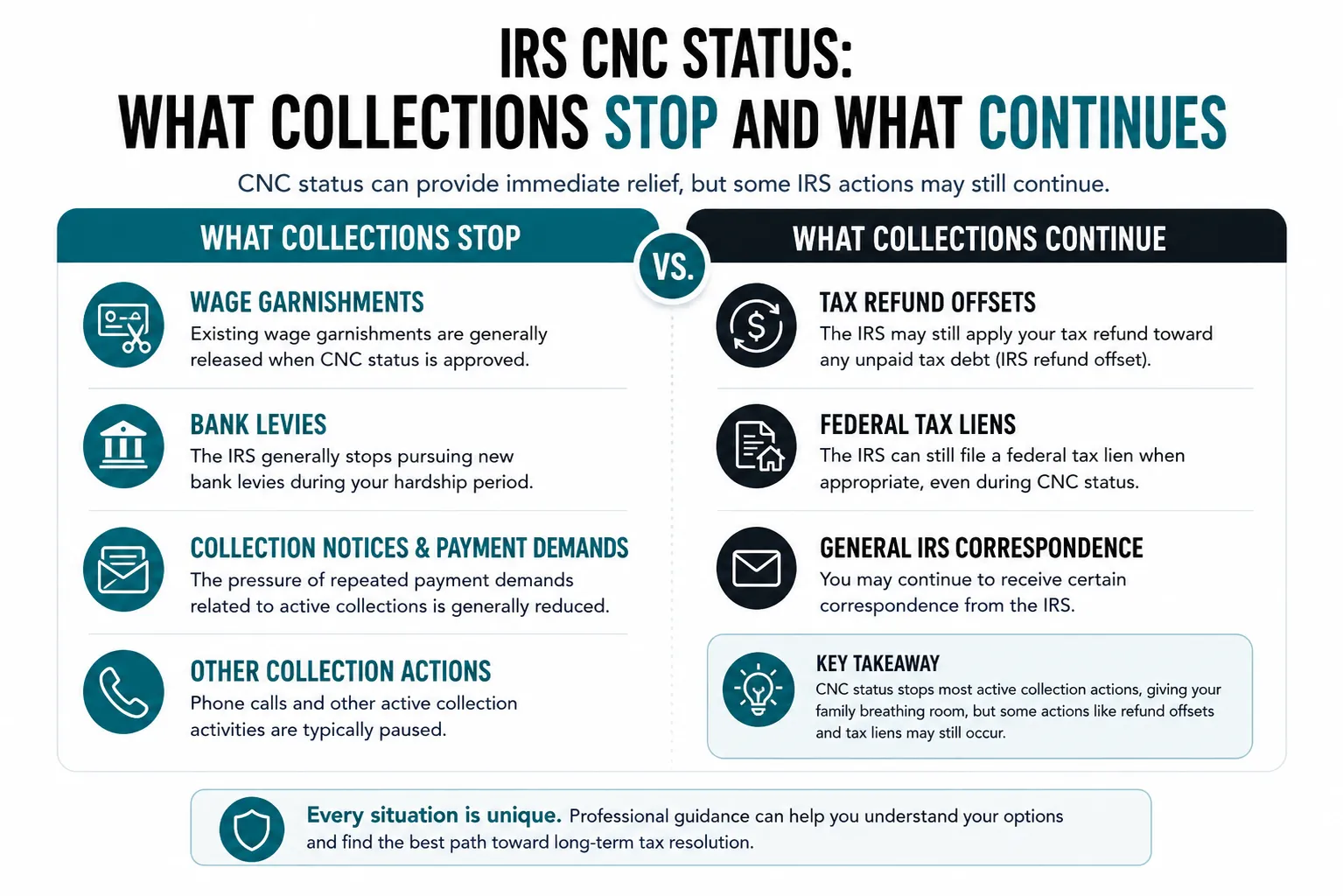
What IRS Actions Continue During CNC Status?
Receiving IRS CNC status family hardship approval can provide welcome relief, but it does not stop every IRS action. Understanding what continues during CNC status helps families avoid surprises and plan for the future.
Many taxpayers believe their tax debt disappears once the IRS approves CNC status. That is not the case. Your tax debt remains, and the IRS can still take certain actions while your account is classified as Currently Not Collectible.
Interest and Penalties Continue
One of the biggest misconceptions about CNC status is that it freezes your tax balance. Unfortunately, that is not true.
Even after your account is placed in Currently Not Collectible status, the IRS generally continues to charge:
- Interest on the unpaid balance
- Failure-to-pay penalties, when applicable
As a result, your total tax debt may continue to grow over time.
| What Happens? | During CNC Status |
| Interest Accrues | Yes |
| Failure-to-Pay Penalties | Usually Yes |
| Tax Debt Is Forgiven | No |
Tax Refund Offsets
The IRS may seize your tax refund to pay your outstanding tax debt. This is known as an IRS refund offset. If you rely on your refund for school expenses or emergency savings, it’s important to plan since CNC status does not stop refund offsets.
Federal Tax Liens
An IRS tax lien is the government’s legal claim against your property because of unpaid taxes. While CNC status may stop many collection actions, it does not automatically prevent the IRS from filing a lien.
A tax lien can affect your ability to sell or refinance property and obtain financing. If you receive notice of a lien, seek professional guidance as soon as possible.
IRS Reminder

CNC status is temporary relief, not a permanent solution. Continue filing all future tax returns and paying current taxes on time to remain compliant with the IRS.
How Families Can Protect Their Budget While on CNC Status
Being approved for CNC status gives your family time to regain financial stability. Making smart financial decisions during this period can help you avoid future tax problems and prepare for long-term financial success.
At Salinger Tax Consultants, we encourage families to use this time to strengthen their finances instead of simply waiting for the IRS to contact them again.
Prioritize Essential Living Expenses
When money is limited, focus first on the expenses your family cannot live without.
These usually include:
- Housing
- Utilities
- Groceries
- Healthcare
- Transportation to work
- Childcare
Avoid spending money on non-essential purchases until your financial situation improves.
Creating a simple monthly budget can help you see where your income is going and identify areas where you can reduce spending.
Build an Emergency Fund
Even a small emergency fund can prevent future financial setbacks.
You do not need thousands of dollars to get started. Setting aside a small amount from each paycheck can help cover unexpected expenses like:
- Car repairs
- Medical bills
- Home repairs
- School emergencies
Many families begin with a goal of saving one month’s essential living expenses before gradually building a larger emergency fund.
Avoid Additional Tax Debt
One of the most important steps while on CNC status is avoiding new tax debt.
You should:
- File every tax return on time.
- Adjust paycheck withholding if necessary.
- Make estimated tax payments if you are self-employed.
- Keep records of income and deductible expenses.
A common issue we see is taxpayers solving one tax problem while creating another by missing future tax payments.
Staying compliant gives you more options if you later decide to pursue any another form of IRS tax relief services.
Documents Needed to Apply for CNC Status
The IRS makes its decision based on the financial information you provide. Missing or incomplete documents can delay your request or lead to additional questions.
Preparing complete records before applying helps the IRS understand your financial situation more quickly.
Income Documentation
The IRS may ask for proof of all household income.
Examples include:
- Recent pay stubs
- Self-employment income records
- Social Security benefit statements
- Pension income
- Unemployment benefits
- Other regular income sources
Providing accurate proof of income helps demonstrate whether you have enough disposable income to pay your tax debt.
Monthly Expense Records
You should also gather documents showing your necessary monthly living expenses.
These may include:
- Rent or mortgage statements
- Utility bills
- Grocery expenses
- Insurance payments
- Childcare invoices
- Medical bills
- Transportation expenses
Organizing these records before submitting your request can make the IRS review process much smoother.
Asset Information
The IRS also reviews your assets as part of its financial disclosure process.
You may need information about:
- Bank accounts
- Retirement accounts
- Vehicles
- Real estate
- Investments
- Other valuable property
Providing complete and accurate information helps avoid delays and demonstrates good faith during the review.
CNC Application Document Checklist
| Document | Purpose |
| Pay stubs | Verify income |
| Bank statements | Show available funds |
| Monthly bills | Verify living expenses |
| Childcare receipts | Support necessary expenses |
| Medical invoices | Document healthcare costs |
| Tax returns | Confirm filing history |
| Asset records | Complete financial disclosure |
Step-by-Step Process to Request IRS CNC Status
Applying for IRS CNC status due to family hardship is more than filling out a form. The IRS needs enough financial information to determine whether paying your tax debt would prevent you from covering necessary living expenses.
Submitting complete and accurate information from the beginning can help reduce delays and improve the review process.
Complete an IRS Financial Statement
The first step is completing an IRS Collection Information Statement. Depending on your situation, the IRS may ask you to complete one of the following forms:
| IRS Form | Who Typically Uses It |
| Form 433-F | Individuals with simpler financial situations |
| Form 433-A | Individuals and self-employed taxpayers |
| Form 433-B | Businesses |
These forms ask for information about your:
- Monthly income
- Household expenses
- Bank accounts
- Vehicles and other assets
- Debts and financial obligations
The IRS uses this information to determine whether you qualify for IRS financial hardship.
Submit Supporting Documents
The financial statement should be supported with documents that verify your information.
These may include:
- Recent pay stubs
- Bank statements
- Mortgage or lease agreements
- Utility bills
- Childcare invoices
- Medical bills
- Insurance statements
One issue we frequently encounter is taxpayers submitting only part of the required documentation. Missing records often result in additional IRS requests and can slow down the review.
IRS Financial Review Process
Once the IRS receives your request, it reviews your financial information to determine whether your account qualifies for Currently Not Collectible status.
The IRS may:
- Request additional documentation.
- Ask questions about certain expenses.
- Verify income and assets.
- Review your tax filing history.
If the IRS approves your request, your account is generally placed in CNC status until your financial situation changes or the IRS conducts another review.
Common Mistakes Families Make When Applying
Many hardship requests are delayed because of incomplete information. Avoiding these mistakes can improve your chances of a smoother IRS review.
Missing Financial Documents
Incomplete IRS documentation can delay your application. Before submitting your request, make sure you include proof of income, bank statements, expense records, medical bills, and childcare costs.
Underestimating Household Expenses
Many families report only major bills and overlook recurring allowable expenses like transportation, health insurance, prescriptions, and childcare. This can make it appear that you have more disposable income than you actually do.
Ignoring IRS Notices
Ignoring IRS collections notices can delay your hardship review and allow collection activity to continue. If the IRS requests additional information, respond promptly or seek professional guidance.
Common Mistake

Waiting until the IRS begins enforced collection before asking for hardship relief. Seeking assistance earlier often provides more options and reduces unnecessary stress.

CNC Status vs. Offer in Compromise: Which Is Better for Families?
Both CNC status and an Offer in Compromise help taxpayers dealing with IRS debt, but they serve different purposes. The right option depends on your financial situation, future income, and long-term ability to pay.
When CNC Status Is the Better Option
CNC status may be the better choice if:
- Your financial hardship is temporary.
- You have little or no disposable income.
- You need immediate relief from IRS collection actions.
- You expect your financial situation to improve later.
For many families dealing with temporary setbacks, CNC status provides valuable breathing room while they regain financial stability.
When an Offer in Compromise Makes More Sense
An IRS Offer in Compromise allows eligible taxpayers to settle their tax debt for less than the full amount owed.
This option may be appropriate if:
- You cannot reasonably pay the full balance.
- Your financial hardship is expected to continue.
- Your assets and future income support a settlement.
Unlike CNC status, an Offer in Compromise is designed to permanently resolve eligible tax debt rather than temporarily pause collections.
| CNC Status | Offer in Compromise |
| Temporary relief | Potential permanent settlement |
| Tax debt remains | Tax debt may be reduced |
| Stops many collection actions | Resolves qualifying tax debt |
| Financial hardship required | Strict financial qualification required |
Read More: Information to IRS Currently Not Collectible Status in 2025
How Salinger Tax Consultants Can Help Families
Understanding IRS hardship rules is only one part of the process. At Salinger Tax Consultants, we help taxpayers understand their options and guide them through every stage of the hardship process.
Reviewing Financial Hardship Eligibility
Every family’s financial situation is different. Our team carefully reviews your income, monthly expenses, assets, tax balance, and IRS notices to determine whether IRS CNC status, family hardship, an IRS Offer in Compromise, or another IRS resolution option is the best fit.
Preparing IRS Forms and Documentation
Accurate paperwork plays a critical role in a successful IRS hardship review. When applying for CNC status for parents, we assist clients by completing necessary IRS financial statements, organizing all required supporting documentation, and presenting financial information clearly to the IRS. We also handle communication with the IRS, responding directly to any requests for additional information. Our goal is to ensure you submit a comprehensive and accurate application from the start, giving you the best chance at relief.
Representing You Before the IRS
Our experienced team works directly with the IRS on your behalf, explains your financial hardship, and helps you pursue the most appropriate solution. Whether you need help with CNC status or other IRS tax relief services, we’re here to help.
Conclusion
Back-to-school expenses and IRS tax debt can quickly strain a family’s finances. If you’re facing IRS CNC status family hardship, CNC status may provide temporary relief by pausing many IRS collection actions while you focus on essential living expenses.
At Salinger Tax Consultants, we help families evaluate their options, prepare strong hardship applications, and find the right solution. Whether you need help with CNC status or want to explore an IRS Offer in Compromise, our team is here to help you move forward with confidence.
FAQs
IRS Currently Not Collectible (CNC) status is a temporary hardship designation the IRS may grant when paying your tax debt would prevent you from covering necessary living expenses. While your tax debt is not forgiven, the IRS may temporarily pause many collection actions until your financial situation improves.
Yes. CNC status for parents is based on the IRS's review of your entire financial situation. Necessary expenses such as housing, food, transportation, childcare, and certain medical costs may be considered when determining whether you qualify for financial hardship.
In many cases, yes. If the IRS approves your request because of financial hardship, IRS wage garnishment may be released to help protect family income from IRS collection efforts. However, every case is reviewed individually.
Yes. Even if your account is placed in Currently Not Collectible status, interest and applicable penalties generally continue to accrue until your tax debt is fully resolved.
Yes. Receiving CNC status does not automatically prevent the IRS from filing a federal tax lien if it believes doing so is appropriate. A lien protects the government's interest in your property while the tax debt remains unpaid.
There is no fixed time limit. Currently Not Collectible status remains in effect until the IRS reviews your financial situation again or determines that your ability to pay has improved. The IRS may request updated financial information during future reviews.
It depends on your financial situation. CNC status provides temporary relief from many collection actions, while an Offer in Compromise may allow eligible taxpayers to settle their tax debt for less than the full amount owed. A tax professional can help determine which option best fits your circumstances.

