

An IRS CP508C notice means the IRS notified the State Department that you owe a seriously delinquent tax debt, which can put your passport at risk.
However, this certification can be reversed. The IRS will issue a CP508R notice to clear your status once you pay in full, set up an approved payment plan, or prove the notice was sent in error.
This guide covers what triggers a CP508C, the 2026 debt threshold, and your options to fix it.
|
Key Takeaways
|
What Is an IRS CP508C Notice?
A CP508C is the notice the IRS mails when it certifies your unpaid federal tax debt to the U.S. Department of State. The notice arrives after certification has already happened, so treat it as a problem that needs a response now.
The IRS sends it by regular mail to your last known address and does not copy your power of attorney.
How You Got Here: The Path to Certification
The IRS sends this notice after earlier steps went unanswered. Certification happens when:
- Your balance passes the seriously delinquent threshold ($66,000 in 2026)
- The IRS filed a Notice of Federal Tax Lien after your appeal rights lapsed, or issued a levy
- Those conditions met, the IRS certified the debt
|
Example: You owe $70,000 in tax, penalties, and interest and did not respond to collection letters. Certification can follow. |
What CP508C Means for Your Passport
After certification, the State Department generally will not issue you a passport. It may:
- Deny an application or renewal
- Revoke your current passport
You can still use your current passport until the State Department notifies you in writing that it has been revoked.
|
Important: Before the IRS asks the State Department to revoke your passport, it sends Letter 6152 asking you to call. If you are overseas, the State Department may issue a limited-validity passport for a direct return to the United States. |
If a pending application worries you, you can get help with a CP508C notice before the 90-day window closes.
Who Can Receive a CP508C Notice?
Not everyone with an IRS balance receives a CP508C. The law targets seriously delinquent tax debt, a specific legal category based on the debt amount, the type of tax, and the status of the collection case. Knowing where you fit tells you whether certification is a present risk.
The 2026 Seriously Delinquent Tax Debt Threshold
For 2026, seriously delinquent tax debt means legally enforceable, unpaid federal tax debt above $66,000, including assessed penalties and interest. Qualifying debts include individual income taxes, Trust Fund Recovery Penalties, business taxes you are personally liable for, and other civil penalties.
The IRS must also have filed a Notice of Federal Tax Lien after your administrative remedies lapsed or were exhausted, or issued a levy.
| Tax Year | Threshold |
| 2024 | $62,000 |
| 2025 | $64,000 |
| 2026 | $66,000 |
The threshold rises with inflation and counts interest and penalties, so a balance that started below it can cross the line over time. Business owners should also note that Trust Fund Recovery Penalties from unpaid payroll taxes count.
Debts and Situations Excluded From Certification
Several situations keep a debt out of certification, and many tie to an IRS tax relief program you may already qualify for. The IRS does not certify debt that is being paid on time under an approved installment agreement or an accepted offer in compromise.
It also excludes debt tied to a timely requested collection due process hearing about a levy and debt suspended by an innocent spouse relief request.
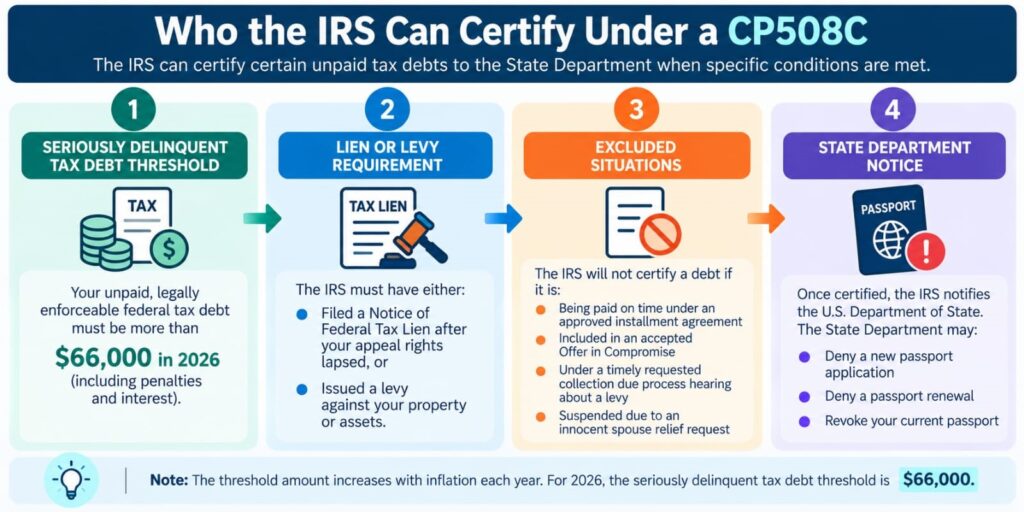
The IRS also will not certify accounts in IRS currently not collectible status due to hardship, accounts with a pending installment agreement or offer request, identity theft victims, taxpayers in bankruptcy, or taxpayers in a federally declared disaster area. If one of these fits you and you still received the notice, the certification may be erroneous.
How Do You Reverse a CP508C Certification?
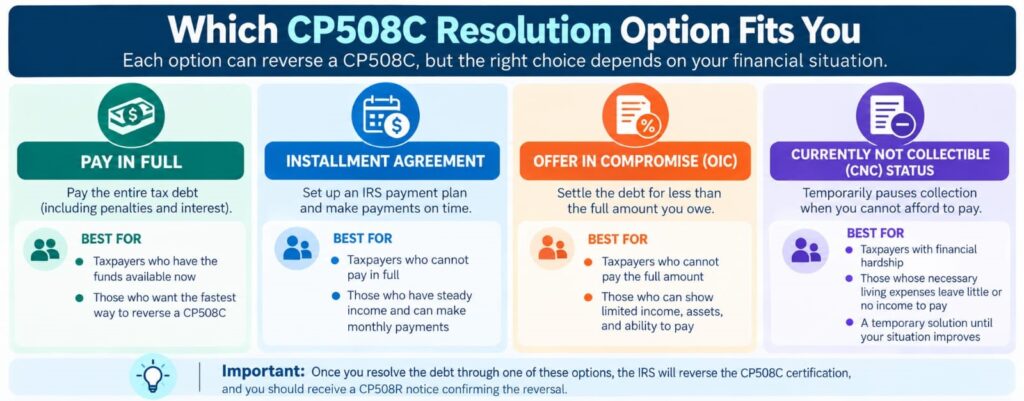
The IRS reverses a CP508C certification when the debt is fully paid or legally unenforceable, no longer seriously delinquent, or certified in error. Partial payments that only push the balance below the threshold do not reverse it. You must fully resolve all certified debt, and the IRS then mails a CP508R notice.
| Option | How It Helps |
| Pay in full | IRS reverses certification within 30 days of resolution |
| Installment agreement | Debt is not seriously delinquent while paid on time |
| Offer in compromise | Same effect once accepted and paid on time |
| Currently not collectible | Hardship accounts are excluded from certification |
Pay the Tax Debt in Full
Full payment is the most direct route. Once you resolve the debt, the IRS reverses the certification and notifies the State Department within 30 days. If you filed your current-year return and expect a refund, the IRS applies it to the balance. If the refund covers the debt, the IRS treats the account as paid in full once it processes the return and refund.
If you already paid, use the IRS Document Upload Tool to send proof of payment.
If paying in full is out of reach, you can get help resolving IRS tax debt through a structured plan.
Correct an Erroneous Certification
Sometimes the IRS certifies a debt that should have been excluded, such as a balance in a pending installment agreement request, an account in bankruptcy, or a debt you already paid. Call the number on the notice and send proof of payment or documents showing the error.
|
Pro Tip Keep copies of each payment confirmation, IRS letter, and State Department letter. They are your proof if anyone questions your case. |
You can also sue in U.S. Tax Court or a U.S. District Court to ask a judge whether the certification is erroneous, and you do not need to contact the IRS first. The court cannot release a lien or levy or award money damages. A tax relief attorney can tell you whether a court filing makes sense.
Can an IRS Payment Plan Reverse a CP508C?
For many taxpayers, an IRS payment plan is the most realistic way to resolve a CP508C. It fits people who can afford monthly payments but not a lump sum.
Pay Over Time and Lift the Passport Block
An installment agreement lets you pay your balance over time. Key facts:
- A certified debt stops being seriously delinquent while you pay on time under an approved agreement
- A pending request has the same effect. It can halt certification before approval
- This route suits taxpayers who cannot pay a large balance at once
|
Important Note: |
Our IRS payment plan assistance covers choosing the plan type, preparing financial forms, and filing the request.
Read More: IRS Installment Agreement Types: Which Payment Plan Fits You
Stay Current or Risk Losing Protection
An IRS payment plan protects your passport only as long as it stays in good standing.
Do this:
- Make timely payments every month
- Meet all terms of your agreement
- File future returns on time
- Pay new taxes when due
- Use automatic payments or calendar reminders
If you fall behind: Missing several payments could default your agreement, reopen the collection case, and reactivate the passport block.
Can Currently Not Collectible Status Help With a CP508C?
If you cannot afford monthly payments, IRS currently not collectible status may fit better than a payment plan. The IRS does not certify accounts in this hardship status, and a certified debt stops being seriously delinquent once the account qualifies. The status pauses most collection activity, but the debt remains.
When the IRS May Grant CNC Status
The IRS may grant CNC status when it determines you cannot pay any of your tax debt because of financial hardship, meaning payment would keep you from covering basic living expenses. Before approving it, the IRS may ask for a Collection Information Statement, such as Form 433-F, 433-A, or 433-B, plus proof of income, expenses, and assets.
Quick Fact

During a temporary collection delay, the IRS will review your ability to pay again.
Because the review repeats, keep your records current and report income changes. Taxpayers with no room in the budget for payments are the usual candidates.
Read More: IRS Currently Not Collectible Status: How to Qualify
What CNC Status Does Not Do
CNC status does not cancel the debt. Interest and penalties continue to accrue until you pay the balance in full, and the IRS may still file a Notice of Federal Tax Lien while your account is in CNC status.
Collection may resume if your finances improve, so CNC works best as a bridge to a longer-term plan such as an installment agreement or an offer in compromise. If your account is in CNC status and you still received the notice, call the number listed on it.
Can an IRS Tax Relief Program Remove Passport Certification?
Beyond payment plans and hardship status, another IRS tax relief program may reduce the balance or pause collection. An accepted offer, innocent spouse relief, and a collection due process hearing all prevent certification.
Settle for Less: Offer in Compromise
An offer in compromise is an IRS tax relief program that settles your tax debt for less than the full amount you owe.
Key points:
- A debt paid under an accepted offer is not seriously delinquent
- A pending offer request also prevents certification
- The offer must reflect what you can actually pay
- Payments must stay on schedule after approval
The IRS reviews your income, expenses, and assets before accepting an offer. Our tax debt resolution support includes reviewing whether you qualify before you file.
Challenge the Debt: Innocent Spouse Relief and Collection Due Process
Innocent spouse relief may apply when you believe you should not owe part of a joint tax debt.
Key protections:
- The IRS excludes debt suspended because of your relief request from certification
- A timely collection due process hearing about a levy gets the same protection
- The request must cover the certified debt (not uncertified years)
A tax relief attorney can help you match the relief to the certified tax years and file on time.
What Is a CP508R Notice and How Long Does Reversal Take?
A CP508R notice is the IRS confirmation that it reversed your certification and told the State Department. You do not need to respond, but keep it with your records.
CP508R vs. CP508C: What Is the Difference?
A CP508R and a CP508C tell you opposite things, as the table shows.
| Notice | What It Means | What You Do |
| CP508C | IRS certified your debt | Resolve the debt |
| CP508R | IRS reversed the certification | Keep it and stay current |
A CP508R does not mean the debt is gone. You may still owe a balance depending on why the reversal happened:
- You paid in full
- An exclusion applies
- The certification was erroneous
Keep the CP508R with your permanent records.
After reversal, the State Department is no longer required to deny your application or revoke your passport for tax status.
The 30-Day Reversal Timeline and Urgent Travel
The IRS reverses certification and notifies the State Department within 30 days of resolving the debt.
If you have international travel within 45 days, you can request expedited reversal. The IRS can generally shorten processing to 9 to 16 days.
You will need:
- An open passport application or renewal
- Proof of travel (such as a flight itinerary)
- A State Department letter dated within the last 90 days
Contact the IRS promptly; the application stays open for only 90 days after the State Department letter.
How Salinger Tax Consultants Can Help
A CP508C combines a tax problem with a deadline, so the right first step depends on your balance, budget, and travel plans.
IRS Tax Debt Analysis
We review your account transcripts to see what the IRS certified and whether you have a way out. Our review covers:
- Which tax years the IRS certified
- Whether the balance is above the threshold
- Whether an exclusion applies
- Which IRS tax relief program fits your finances
If the certification looks wrong, we gather proof of payment or account records to support the correction.
Payment Plan and Resolution Assistance
We help you choose between an IRS payment plan, IRS currently not collectible status, or an offer in compromise. Then we:
- Prepare the financial forms and submit the request
- Compare the monthly cost of each option against your income
- Track the terms after approval so you stay in good standing
IRS Notice and Tax Relief Support
Our team handles IRS notices, appeals, and the documents an expedited reversal requires, such as travel proof and the State Department letter. Peter Salinger, EA, a former IRS Revenue Officer and Appeals Settlement Officer, founded the firm.
Consider a tax relief attorney or tax professional if you:
- Cannot pay in full
- Owe for several tax years or through a business
- Have urgent travel
- Believe the certification is wrong
You can speak with a tax relief professional to review your options.
Conclusion
A CP508C notice is serious, but you have clear ways to reverse it. Full payment, an approved IRS payment plan, IRS currently not collectible status, an accepted offer, or proof of an error can each lead to a reversal once the IRS confirms it. The sooner you act, the sooner the IRS can send the reversal to the State Department.
Salinger Tax Consultants helps taxpayers facing passport certification review the certified debt, choose the right resolution path, and work with the IRS on their behalf. We serve clients nationwide from our Florida office.
Schedule a consultation with Salinger Tax Consultants to review your options.
FAQs
A CP508C is an IRS notice confirming that the IRS certified your seriously delinquent federal tax debt to the State Department. You received one because your balance passed the 2026 threshold of $66,000 and the IRS filed a lien after your remedies lapsed or issued a levy.
The State Department may deny a new application or renewal and may revoke your current passport. The IRS decides on revocation referrals case by case and sends Letter 6152 first. You can use your passport until the State Department tells you in writing.
A debt paid on time under an approved installment agreement is not seriously delinquent, and a pending request can also prevent certification. Keep payments current, because falling behind may put the debt back in certification.
Either IRS tax relief program can help. An accepted offer paid on time keeps a debt from being seriously delinquent, and so does IRS currently not collectible status due to hardship. Each requires IRS approval, and CNC does not stop interest and penalties.
A CP508R confirms that the IRS reversed your certification. The IRS generally reverses within 30 days of resolving the debt, and expedited requests for travel within 45 days can shorten that to 9 to 16 days.
A tax relief attorney or tax professional can help if you cannot pay in full, owe for several years, have business tax debt, or face urgent travel. They can also handle IRS contacts and paperwork for you.

