

If you owe the IRS and are looking for a fresh financial start, summer may be the perfect time to review your tax situation. Many taxpayers use the middle of the year to reassess their finances, catch up on tax obligations, and explore relief options before year-end pressures begin. One question we hear frequently is whether the best time to file OIC 2026 is during the summer months.
An OIC allows you to settle tax debt for less than you owe, but approval depends on factors like your financial health, document accuracy, and tax compliance. If you are considering this, mid-year is a strategic time to organize your records and assess your options before year-end.
This guide explains the steps, requirements, and considerations for filing an Offer in Compromise, providing you with the insights needed to determine if now is the right time to submit your application.
|
Key Takeaways
|
Why Timing Matters When Filing an Offer in Compromise
Timing plays an important role when filing an offer in compromise. While the IRS accepts applications year-round, your financial situation often determines the best time to file an OIC 2026. Applying before resolving filing issues or gathering complete financial records can lead to delays or rejection.
Quick Fact

The IRS carefully reviews your income, assets, allowable living expenses, and future ability to pay before deciding whether to accept an offer in compromise.
How IRS Collection Activity Changes Throughout the Year
An IRS tax settlement request does not depend on a specific filing season, but collection activity continues throughout the year. The IRS may issue notices, file tax liens, levy bank accounts, or garnish wages when tax debt remains unresolved.
Filing an offer in compromise can temporarily suspend certain collection actions while your application is under review, provided the application is complete and meets IRS requirements.
| IRS Collection Stage | Typical IRS Action |
| Initial balance due | Payment reminder notices |
| Continued nonpayment | Collection notices |
| Serious delinquency | Federal tax lien or levy consideration |
| Active collections | Wage garnishment or bank levy |
| OIC under review | Certain collection activity generally pauses while the application is being evaluated |
Why Mid-Year Is an Important Financial Checkpoint
A mid-year tax settlement review gives you time to assess income, update financial records, and prepare for year-end tax obligations. By summer, your financial picture is often clearer, making it easier to determine whether you’re ready to apply. In our experience, waiting until your finances have stabilized helps create a stronger offer in compromise application.
What Is an Offer in Compromise?
An offer in compromise is an IRS relief program that allows eligible taxpayers to settle outstanding tax debt for less than the full amount owed when paying the entire balance would create financial hardship.
The IRS does not approve Offer in Compromise simply because a taxpayer requests one. Every application undergoes a detailed financial review to determine whether accepting a reduced payment is in the government’s best interest.
How an OIC Works
An IRS tax debt settlement begins with submitting the required application forms, financial statements, supporting documents, and any applicable fees.
The IRS reviews your reasonable collection potential, which estimates how much it believes it could collect through normal enforcement actions.
| Step | What Happens |
| Step 1 | Complete the offer in compromise application. |
| Step 2 | Submit financial statements and supporting documentation. |
| Step 3 | IRS reviews your financial condition. |
| Step 4 | IRS requests additional information if necessary. |
| Step 5 | IRS accepts or rejects the offer. |
The Three Types of Offer in Compromise
The IRS recognizes three primary categories of OIC eligibility.
| Type | Description |
| Doubt as to Collectibility | You cannot reasonably pay the full tax debt. |
| Doubt as to Liability | You believe the assessed tax is incorrect. |
| Effective Tax Administration | Paying the debt would create exceptional financial hardship despite having the ability to pay. |
Among these, Doubt as to Collectibility is the most common basis for an offer in compromise application.
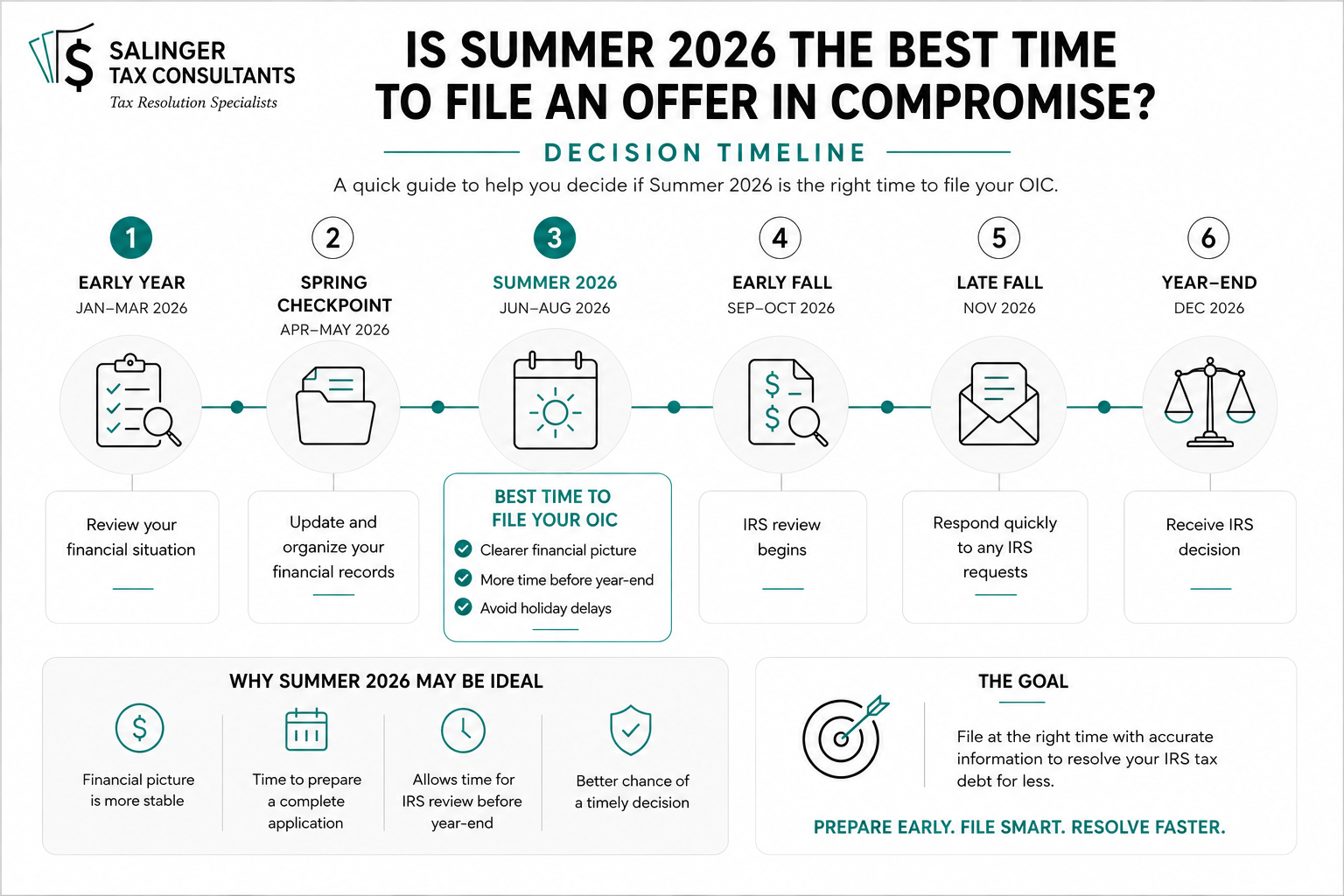
Is Summer 2026 the Best Time to Submit an OIC?
For many taxpayers, summer OIC filing can be an excellent opportunity to prepare a strong application. By the middle of the year, income patterns are often easier to evaluate, tax returns have generally been filed, and financial records are more complete.
However, the answer depends entirely on your personal circumstances. The best time to file OIC 2026 is when you have satisfied IRS filing requirements, gathered accurate financial documentation, and can present a realistic settlement proposal.
Advantages of Filing During Summer
Several factors make summer OIC filing attractive.
|
Advantage |
Benefit |
|
Recent tax returns available |
Improves financial accuracy |
|
Stable income information |
Helps calculate repayment ability |
| More time before year-end |
Allows quicker response to IRS requests |
| Opportunity to organize records |
Reduces documentation errors |
Many clients who begin preparing during summer find they have sufficient time to respond promptly if the IRS requests additional information.
Situations Where Waiting May Be Better
Although summer works well for many taxpayers, there are situations where submitting an offer in compromise should be delayed.
You may benefit from waiting if:
- Your income has recently changed significantly.
- You have not yet filed all required tax returns.
- Major financial documents are unavailable.
- You’re expecting medical expenses or other financial hardships that could materially change your financial picture.
- Your employment situation is still uncertain.
Signs You’re Financially Ready to File an OIC
The best time to file OIC 2026 is when your financial information accurately reflects your current situation, and you can demonstrate that paying your full tax debt would create a genuine hardship.
Stable Income and Expenses
The IRS reviews your income and expenses to determine your ability to pay. When evaluating financial hardship IRS standards, it compares your income, allowable living expenses, and available assets. If your finances have changed recently, it may be worth waiting until your records reflect your current situation.
Current Tax Filing Compliance
Tax compliance is one of the most important eligibility requirements for an offer in compromise. In most cases, the IRS requires all required tax returns to be filed before it will consider your application.
If you are self-employed or own a business with employees, you must also be current with required estimated tax payments or federal tax deposits.
Many taxpayers are surprised to learn that outstanding tax returns can prevent the IRS from processing an otherwise strong offer in compromise application.
IRS Reminder

Before submitting an offer in compromise, confirm that all required federal tax returns have been filed and any required current-year tax obligations are being met.
Complete Financial Documentation
Your IRS financial statement forms the foundation of your offer in compromise application. Every figure you report should be supported by documentation.
Typical supporting records include:
- Recent pay stubs
- Bank statements
- Mortgage or lease agreements
- Utility bills
- Vehicle loan statements
- Investment account records
- Retirement account balances
A common issue we frequently encounter is taxpayers estimating financial information instead of using actual documentation. Even small inconsistencies can result in additional IRS requests for information.
IRS Eligibility Requirements in 2026
Not everyone qualifies for an offer in compromise. The IRS reviews each application based on your financial situation.
Doubt as to Collectibility
Most accepted offers in compromise are based on tax settlement through Doubt as to Collectibility. This means the IRS believes it is unlikely to collect the full amount of tax owed within the legal collection period.
Factors considered include:
- Current income
- Monthly expenses
- Equity in assets
- Future earning potential
- Available cash and investments
If your reasonable collection potential is less than the amount you owe, an offer in compromise may be appropriate.
Effective Tax Administration
Some taxpayers can pay their tax debt, but doing so would cause significant IRS hardship. Situations involving serious medical issues, disabilities, or exceptional financial hardship may qualify if supported by appropriate documentation.
Doubt as to Liability
A tax dispute under Doubt as to Liability applies when you believe the IRS incorrectly assessed your tax. You’ll need evidence showing the assessment was inaccurate.
|
OIC Basis |
When It Applies |
|
Doubt as to Collectibility |
You cannot reasonably pay the full amount owed. |
| Effective Tax Administration |
Full payment would create exceptional hardship despite the ability to pay. |
| Doubt as to Liability |
You believe the assessed tax is incorrect. |
Documents You Should Prepare Before Filing
A complete OIC application includes more than just IRS forms. Supporting documentation allows the IRS to verify the financial information provided in your application.
Preparing these records before filing can help reduce processing delays and improve the overall quality of your submission.
Financial Statements
The IRS typically requires detailed financial information through Form 433-A (for individuals) or other applicable financial disclosure forms.
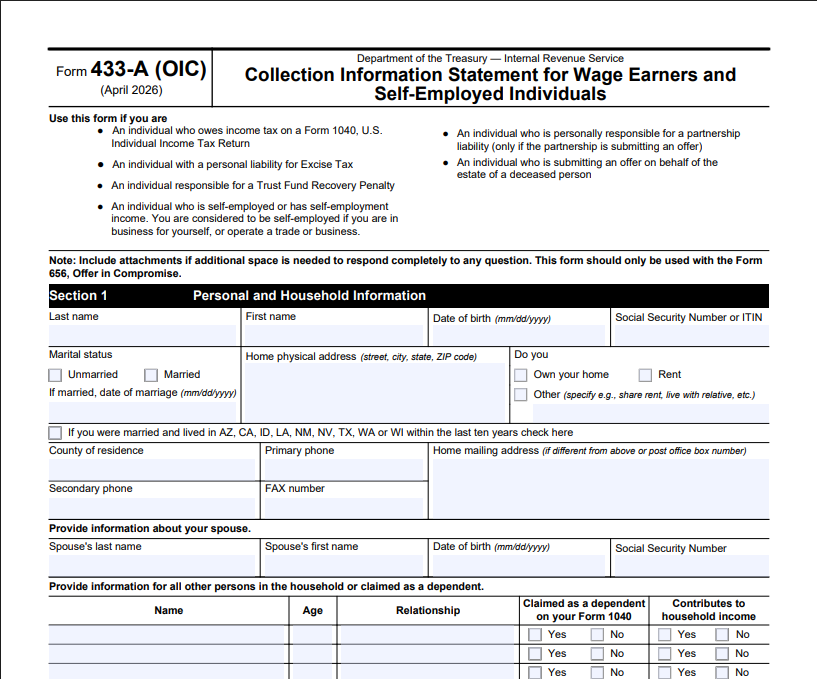
These statements generally include:
- Income sources
- Monthly living expenses
- Real estate
- Vehicles
- Bank accounts
- Retirement accounts
- Investments
- Business interests
Providing complete and accurate information is essential.
Tax Returns
Maintaining IRS compliance begins with filing all required tax returns.
Before applying, verify that:
- All required federal returns have been filed.
- Any missing returns have been submitted.
- Current-year filing obligations are being met.
- Required estimated tax payments have been made, if applicable.
Bank Statements and Asset Records
The IRS relies on IRS documentation to verify the financial information included in your application.
Common records include:
- Three to six months of bank statements
- Investment account statements
- Vehicle titles
- Mortgage information
- Property valuations
- Loan balances
- Retirement account statements
Document Checklist
- Recent bank statements
- Pay stubs or proof of income
- Mortgage or rent information
- Vehicle information
- Investment records
- Retirement account balances
- Federal tax returns
- Monthly expense documentation
- Asset ownership records
Common Mistakes That Delay OIC Approval
Many offer in compromise delays result from incomplete applications or missing information rather than ineligibility. Avoiding these common mistakes can help keep your application moving through the IRS review process.
Incomplete Forms
An incomplete OIC application can delay processing. Missing signatures, unanswered questions, or inconsistent financial information often result in IRS requests for clarification.
Missing Documentation
During the IRS review, missing records such as bank statements, proof of income, or unfiled tax returns can significantly extend processing times. Submitting complete documentation upfront helps avoid unnecessary delays.
Unrealistic Settlement Offers
Your offer should reflect your reasonable collection potential. Proposing an amount that isn’t supported by your financial information may increase the risk of rejection.
Read More: Offer in Compromise Denied: 7 Reasons and How to Appeal
How Long Does an OIC Take in 2026?
The offer in compromise timeline varies based on the completeness of your application, your financial situation, and whether the IRS requests additional information. Submitting a complete application can help avoid unnecessary delays.
|
Stage |
What Happens | Typical Timeline* |
|
Application Received |
IRS confirms receipt and performs an initial review. | Several weeks |
|
Financial Review |
IRS evaluates income, assets, expenses, and supporting documentation. |
Varies by case |
| Additional Information | IRS may request clarification or more documents. |
Depends on response time |
| Final Decision | IRS accepts, rejects, or returns the application. |
Several months |
*Processing times vary based on IRS workload and the complexity of the application.
Initial IRS Review
The first stage of the IRS processing time focuses on whether your application is complete. The IRS verifies your forms, required payments, tax filing compliance, and basic eligibility before beginning a full review.
Requests for Additional Information
The IRS may send IRS correspondence requesting updated financial records or clarification. Responding promptly helps keep your application moving. Keep digital copies of every document submitted with your offer in compromise. If the IRS requests additional information, you’ll already have most of what you need readily available.
Final Approval or Rejection
After reviewing your financial information, the IRS will issue an OIC decision. Possible outcomes include:
- Your offer in compromise is accepted.
- Your offer in compromise is rejected.
- Your application is returned because it does not meet processing requirements.
- The IRS requests further clarification before making a final determination.
Receiving a rejection does not necessarily mean your tax relief options have ended.
What Happens While the IRS Reviews Your OIC?
After your application is accepted for processing, many taxpayers wonder what happens next. Although every situation is different, understanding IRS collection suspension rules can help you know what to expect while the IRS evaluates your application.
If your goal is to resolve your IRS tax debt, staying informed about the review process can help you avoid unnecessary surprises.
Collection Activity During Review
In many situations, the IRS limits certain IRS collections while a properly submitted offer in compromise is under review.
This temporary pause may provide valuable breathing room while your financial information is being evaluated.
However, interest and applicable penalties generally continue to accrue until your tax debt is fully resolved.
|
During OIC Review |
What to Expect |
|
Collection activity |
Certain enforcement actions are generally suspended while the application is pending. |
|
Interest |
Continues to accrue on unpaid balances. |
| Penalties |
May continue unless separately addressed. |
| IRS communication |
Additional documentation may be requested. |
Required Tax Compliance
Maintaining tax compliance remains essential throughout the review process.
The IRS generally expects you to:
- File future tax returns on time.
- Pay any new taxes when due.
- Make required estimated tax payments if applicable.
- Remain current with federal tax deposit requirements for businesses.
Failure to remain compliant can jeopardize your pending application.
A common issue we see is taxpayers focusing solely on resolving past tax debt while falling behind on new tax obligations. Staying current is just as important as resolving existing balances.
What If Your Offer Is Rejected?
An OIC rejection can be disappointing, but it does not necessarily mean you have run out of options. The IRS provides several ways to continue addressing your tax debt, including appeals and alternative resolution programs.
Appeal Rights
If you disagree with the IRS decision, you may have the right to file an IRS appeal.
The appeals process allows an independent review of your case and may be appropriate if you believe:
- The IRS misunderstood your financial information.
- Important documentation was overlooked.
- The financial analysis was inaccurate.
- Additional supporting evidence is available.
Reviewing the rejection carefully before filing an appeal can help determine whether an appeal is appropriate.
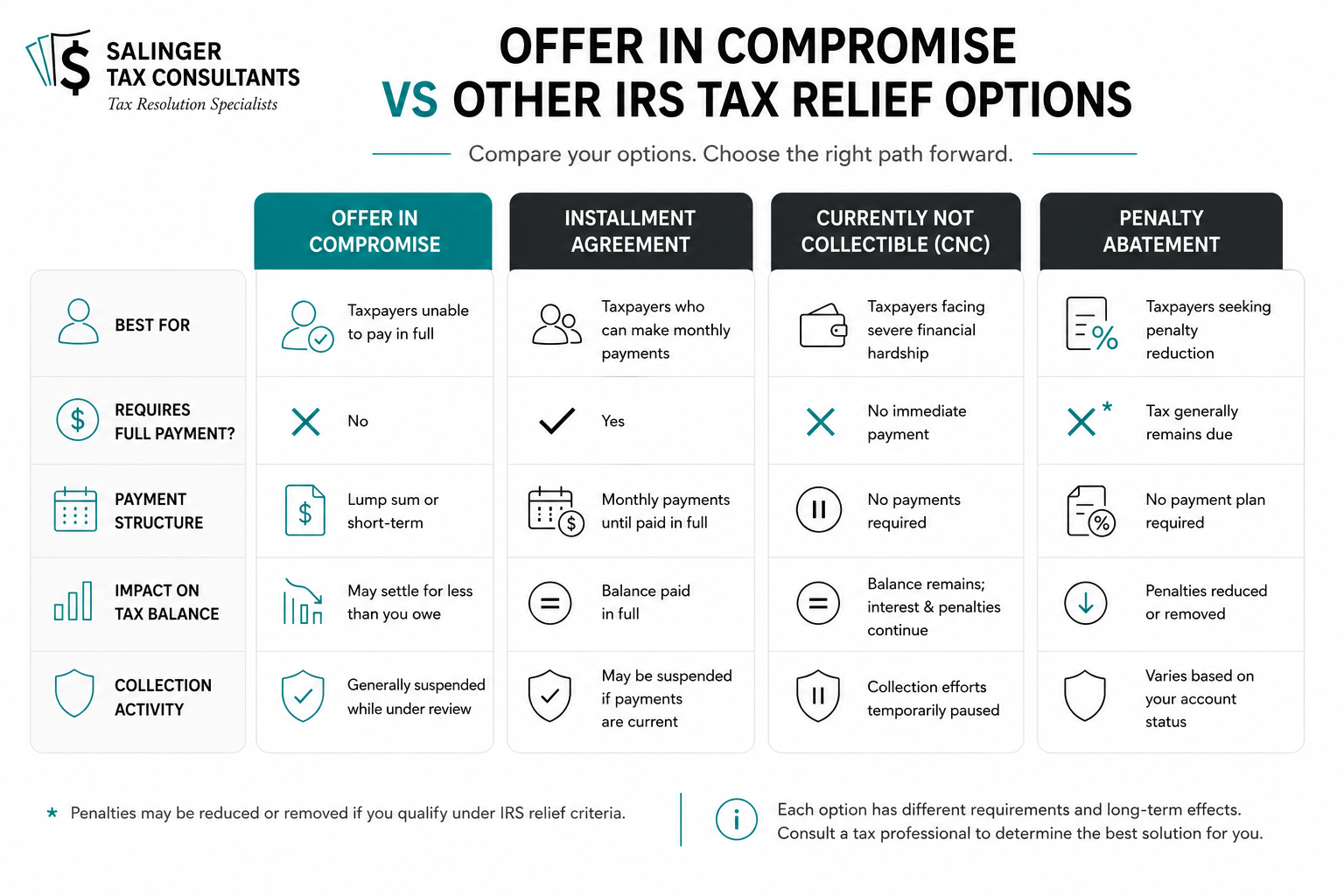
Alternative Tax Relief Options
If an offer in compromise is not the best solution, other IRS payment plan options may still help resolve your tax debt.
Depending on your financial situation, alternatives may include:
- Installment Agreements
- Currently Not Collectible status
- Penalty abatement
- Other IRS collection alternatives
|
Resolution Option |
Best For | Requires Full Payment? |
|
Offer in Compromise |
Taxpayers unable to pay the full balance | No |
|
Installment Agreement |
Taxpayers who can make monthly payments |
Yes |
| Currently Not Collectible | Taxpayers experiencing severe financial hardship |
No immediate payment |
| Penalty Abatement | Taxpayers seeking penalty reduction |
Tax generally remains due |
Read More: What Happens If You Miss an IRS Installment Payment?
How Salinger Tax Consultants Can Help
Applying for an offer in compromise requires careful preparation. Salinger Tax Consultants provides offer in compromise services to help taxpayers determine eligibility and prepare complete applications.
Eligibility Review
Our OIC consultation evaluates your Income, Expenses, Assets and the balance due to determine whether one or another IRS resolution option may better fit your situation.
Preparing Your Application
We assist with every stage of your offer in compromise filing, including:
- Preparing IRS forms
- Organizing documentation
- Calculating a realistic offer
- Reviewing the application before submission
- Responding to IRS requests
IRS Negotiation Support
Our team helps you navigate the IRS tax settlement process by assisting with IRS correspondence, Documentation requests, Appeals, when appropriate and Ongoing case support.
Conclusion
Summer can be an excellent time to evaluate your finances and determine whether it’s the best time to file OIC 2026. The strongest applications are submitted when your tax filings are current, your financial records are complete, and your eligibility has been carefully reviewed.
If you’re considering an Offer in Compromise or another IRS relief option, Salinger Tax Consultants can help you understand your options and prepare a strategy tailored to your financial situation.
Contact our tax resolution team to discuss your situation and explore the IRS tax relief options that may be available to you.
FAQs
Summer can be a good time to file if your financial information is complete, your tax returns are current, and you meet the IRS eligibility requirements. The best timing ultimately depends on your individual financial situation.
The offer in compromise timeline varies depending on the complexity of the case, the completeness of the application, and IRS workload. Responding promptly to IRS requests can help avoid unnecessary delays.
The best time is when you've filed all required tax returns, gathered complete financial documentation, and can accurately demonstrate your ability to pay.
A typical OIC application includes financial disclosure forms, tax returns, bank statements, proof of income, documentation of monthly expenses, and records of assets and liabilities.
A properly submitted application may result in IRS collection suspension for certain collection activities while the IRS reviews your offer in compromise. Interest and applicable penalties generally continue to accrue.
An OIC rejection does not necessarily end your tax relief options. Depending on your circumstances, you may be able to appeal the decision or pursue another IRS resolution program.
Yes. If you believe the IRS made an error in evaluating your application, you may have the right to file an IRS appeal within the applicable time frame.
Common offer in compromise delays include incomplete forms, missing financial documentation, unfiled tax returns, and inconsistent financial information.
The right choice depends on your financial condition. An offer in compromise vs installment agreement comparison should consider your income, assets, expenses, and long-term ability to pay.
Professional offer in compromise services can help ensure your application is complete, supported by proper documentation, and based on an accurate evaluation of IRS eligibility requirements.

