
The “One Big Beautiful Bill” (OBBBA) of 2025/2026 changed tax rules for current and future years, but it does not automatically cancel or erase existing IRS back taxes.
If you owe the IRS, it is important to distinguish between new tax benefits (which might affect your current return) and IRS collection relief (which addresses your past debt). The new law does not replace established relief options like payment plans or Offers in Compromise. This guide explains what changed, what stayed the same, and which steps Florida taxpayers can take before collection activity becomes more serious.
|
Key Takeaways
|
Understanding Back Taxes One Big Beautiful Bill 2026 Rules
The back taxes One Big Beautiful Bill 2026 discussion starts with an important date. The IRS identifies OBBBA as Public Law 119-21, enacted in 2025. The law changed many individual and business tax provisions, with different effective dates.
These changes may affect a taxpayer’s return, withholding, estimated payments, or business deductions. They did not replace established IRS collection procedures. If a prior balance is already being collected, IRS installment agreement assistance may still be relevant even when a new deduction applies to a later year.
Why the New Tax Law Was Introduced
The law extended or changed several provisions that were scheduled to expire and added temporary benefits for some workers, families, seniors, and businesses. From a tax reform 2026 perspective, the practical aim was to define the rules that individuals and businesses would use for upcoming returns and planning.
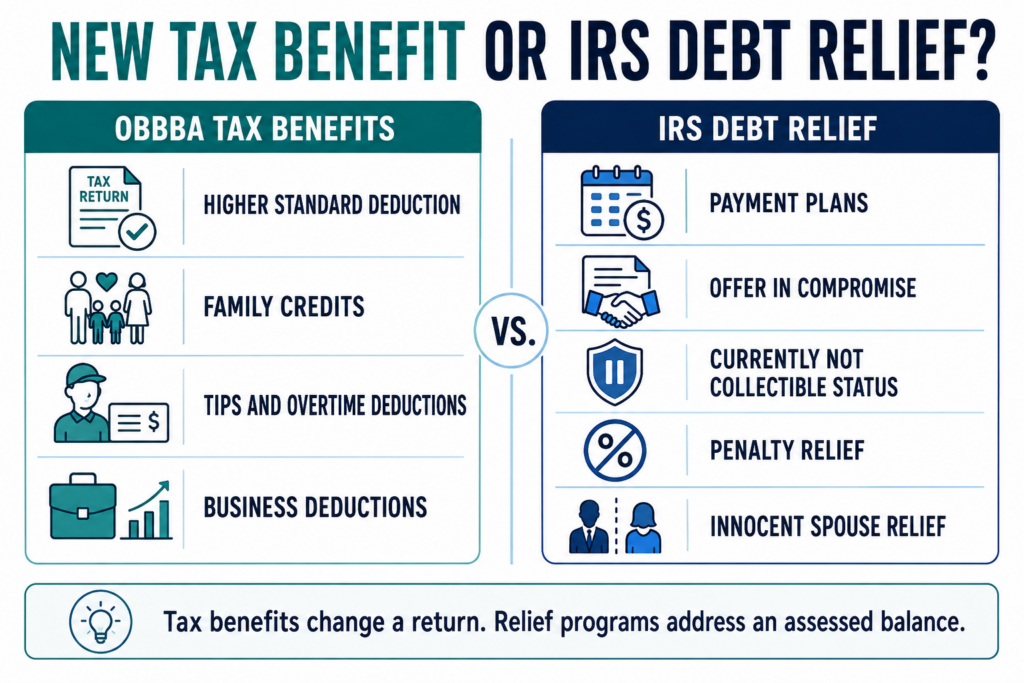
These provisions calculate tax liability. Collection rules answer a different question: how the IRS handles an assessed balance that remains unpaid. Confusing those two systems can lead someone to expect debt relief that the law does not provide.
Major Tax Changes Affecting Individuals and Businesses
For individuals, the 2026 tax law includes a higher standard deduction, changes to family-related credits, and temporary deductions for qualifying tips and overtime.
The IRS lists the 2026 standard deduction as $16,100 for single filers and married people filing separately, $32,200 for married couples filing jointly, and $24,150 for heads of household.
Businesses may need to review depreciation and other provisions. For example, IRS guidance describes permanent 100% additional first-year depreciation for eligible property acquired after January 19, 2025, when the requirements are met.
What the Law Does and Doesn’t Change
The OBBBA tax provisions may change taxable income, deductions, credits, and planning decisions. They do not direct the IRS to cancel old assessments, stop notices, release levies, or approve settlement applications. This is the central distinction in the back taxes One Big Beautiful Bill 2026 rules.
The distinction is simple. A deduction may lower the tax calculated for a covered year. A back taxes resolution program addresses a balance that has already been assessed and remains unpaid. Taxpayers need to determine which issue they actually face before deciding what to do.
|
OBBBA May Affect |
OBBBA Does Not Automatically |
|
Taxable income for an eligible year |
Forgive an existing IRS balance |
|
Available deductions and credits |
Stop IRS collection notices |
| Current withholding or estimated payments |
Release an existing tax lien or levy |
| The amount of a current or amended return |
Approve an Offer in Compromise |
| Cash available to address tax debt |
Remove penalties without a qualifying request |
Read More: Payroll Tax Consultants: When Businesses Should Bring In Help
Does OBBBA Eliminate or Reduce Existing IRS Back Taxes?
OBBBA does not provide general forgiveness for existing IRS back taxes. It may reduce tax for a specific year through an eligible deduction, credit, corrected return, or amended return.
The Truth About IRS Debt Forgiveness
IRS debt forgiveness is often confused with three separate options:
- Tax deductions reduce taxable income for an eligible year.
- Penalty relief may remove qualifying penalties.
- Offer in Compromise may let eligible taxpayers settle for less after a financial review.
Taxpayers considering the third option can seek IRS Offer in Compromise help.
Why Existing Tax Debt Remains Collectible
IRS collection can continue until the balance is paid, corrected, challenged, or placed under an approved resolution. New deductions for later years do not pause collections, and interest and penalties may continue on unpaid balances.
Who Benefits Most From the New Law
Eligible workers, families, and businesses may receive tax savings or refunds that can help them address existing IRS debt. Eligibility depends on the provision and tax year.
Keep in Mind

A new deduction may help you keep more of your current income or generate a refund. It does not automatically change the amount assessed for an older tax year. The tax year, eligibility requirements, filing status, and amendment deadline must all be reviewed.
New Tax Benefits That May Help Taxpayers Manage Back Taxes
The term new IRS back tax options 2026 can be misleading. OBBBA’s tax benefits are not collection programs, though eligible deductions or credits may free up money to address an IRS balance.
Higher Standard Deduction
The higher standard deduction may reduce taxable income for eligible taxpayers who do not itemize. It does not reduce an older assessment unless an amended return is permitted and the provision applies to that year.
Expanded Family Tax Benefits
Changes to family benefits include the Child Tax Credit, Adoption Credit, and certain education provisions. An eligible credit may reduce current tax or increase a refund, which the IRS may apply to past-due federal taxes.
New Worker-Related Deductions
From 2025 through 2028, eligible taxpayers may deduct qualified tips or overtime compensation. The overtime deduction generally covers only the qualifying premium above the regular rate required by the Fair Labor Standards Act.
These deductions have limits and income-based phaseouts. They reduce federal taxable income, while the related pay may remain subject to payroll taxes.
Small Business Tax Opportunities
Business tax changes may affect depreciation, interest deductions, and other calculations. Owners should confirm each provision’s eligibility and effective date before claiming it.
Quick Tip for Business Owners

Keep business income tax debt separate from payroll tax liabilities when reviewing your options. Payroll tax cases may involve different collection procedures and potential personal responsibility, so they should be evaluated promptly.
Tax savings may improve cash flow for back tax resolution. Business owners with payroll tax debt should seek help promptly.
IRS Back Tax Relief Programs Still Available in 2026
The established IRS relief programs remain the main routes for resolving assessed debt. Which program fits depends on the balance, filing compliance, income, assets, expenses, remaining collection time, and whether the taxpayer agrees with the assessment. The back taxes One Big Beautiful Bill 2026 provisions did not replace these programs.
- Installment Agreements
An installment agreement allows eligible taxpayers to pay over time. The IRS offers short-term and long-term IRS payment plans, with different qualifications and application methods.
According to the IRS payment-plan guidance, levy action is generally restricted while a qualifying request is pending, subject to exceptions. Interest and penalties may continue. IRS installment agreement assistance can help taxpayers evaluate an affordable proposal and the information the IRS may request.
-
Offer in Compromise
An Offer in Compromise allows the IRS to settle qualifying debt for less than the full amount. The IRS considers income, expenses, asset equity, and ability to pay, along with the taxpayer’s facts and circumstances.
It is not automatic debt forgiveness. Applicants generally need to meet filing and payment compliance rules and provide accurate financial information.
-
Currently Not Collectible Status
CNC status may pause IRS collection when payment would prevent a taxpayer from covering basic living expenses. It does not erase the debt, and interest and penalties may continue. The IRS may also file a tax lien and review the taxpayer’s finances later.
-
Penalty Abatement
IRS penalty relief may remove qualifying penalties through first-time abatement, reasonable cause, or another applicable provision. The underlying tax and interest may remain due. IRS penalty relief support can help prepare the request and supporting documents.
-
Innocent Spouse Relief
Innocent Spouse Relief may protect a qualifying taxpayer from liability connected to a joint return. Because eligibility depends on specific circumstances and deadlines, taxpayers should request relief promptly after discovering the debt.
Which IRS Relief Option Fits Your Situation?
The right IRS debt solution depends on the balance, filing history, finances, notices, and accuracy of the assessment. Review the following before choosing among the new IRS back tax options 2026:
- Tax years and total balance
- Filed and missing returns
- Income, expenses, and assets
- Penalties included
- IRS notices and deadlines
- Accuracy of the assessment
Owe Less Than You Can Pay
An installment agreement may help if you can pay the balance over time. Choose a monthly payment you can maintain while meeting IRS requirements.
Financial Hardship
Currently Not Collectible status may apply if payments would prevent you from covering necessary living expenses. The IRS may request proof of your income, assets, and expenses.
Unable to Pay the Full Balance
An Offer in Compromise may apply when full collection is unlikely or would cause qualifying hardship. Eligibility should be assessed before filing.
IRS Penalties Added to Your Balance
Penalty abatement may reduce qualifying penalties. IRS penalty relief requests should clearly explain the circumstances and include supporting records.
Common Misconceptions About OBBBA and IRS Back Taxes
Many back taxes One Big Beautiful Bill 2026 misunderstandings come from treating a tax benefit as a collection remedy. The following claims can lead taxpayers to delay action.
Do Not Assume

A tax-law headline does not suspend an IRS deadline. Continue reading and responding to notices unless the IRS confirms that collection activity has been paused or another legal restriction applies.
“The New Law Forgives IRS Debt”
The law did not establish general OBBBA back tax relief for old assessments. An eligible taxpayer may lower tax for a covered year through a deduction or credit, while existing balances require a separate review.
“Collections Will Stop Automatically”
IRS collections do not stop merely because tax law changed. Collection protection may arise from a timely appeal, bankruptcy stay, pending or accepted resolution request, or another legal restriction, depending on the facts.
“I Don’t Need to Respond to IRS Notices”
An IRS notice may contain a response deadline, appeal rights, proposed collection action, or a request for information. Read the full notice and compare it with the account records. Ignoring it may narrow available options.
Read More: Received An IRS Notice? A Tax Consultant’s Step-By-Step Response Plan
What Florida Taxpayers Should Do Before IRS Collections Increase
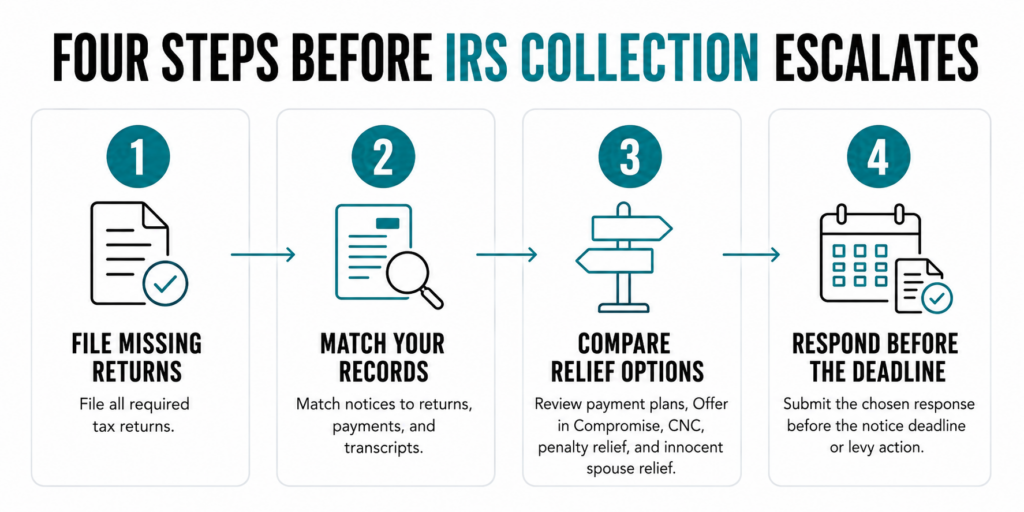
OBBBA is federal law and does not give Florida taxpayers a separate IRS debt-forgiveness program. Taxpayers should take the following steps before collections escalate.
File Any Missing Tax Returns
Most IRS relief programs require all necessary returns to be filed. Filing also stops the failure-to-file penalty from continuing to increase, even when full payment is not possible.
Review IRS Notices Carefully
Check each notice for:
- Tax period and balance
- Reason for the adjustment
- Response or payment deadline
- Appeal rights
- Proposed collection action
- Requested documents
Compare the notice with your returns, payments, correspondence, and IRS transcripts.
Evaluate Available Relief Options
Choose an IRS tax relief program based on your balance, finances, and ability to pay. Taxpayers seeking IRS back taxes help should avoid relying on headlines or advertisements.
Act Before Liens or Levies Begin
A levy may reach wages, bank funds, or other property, while a federal tax lien creates a legal claim against property. Acting early provides more time to gather records and propose a resolution.
If a Levy Deadline Is Approaching

Do not wait until every financial record is perfectly organized. Identify the deadline, determine the required immediate response, and begin gathering the remaining documents. Missing the response date may reduce the time available to challenge or resolve the collection action.
Mistakes That Can Make Back Tax Problems Worse
Timely IRS back taxes help prevent avoidable problems. The following mistakes often increase cost, urgency, or documentation gaps.
Common mistakes include:
- Leaving IRS notices unopened or unanswered
- Waiting for a future law to erase the balance
- Missing installment-agreement payments
- Failing to remain current with new tax obligations
- Submitting a relief application without complete financial records
- Choosing a program before confirming that the assessment is correct
The following sections can then explain the most important mistakes in greater detail.
Ignoring IRS Letters
IRS collection notices do not resolve themselves. A missed deadline may affect appeal rights or allow the agency to move to the next collection step.
Waiting for New Tax Laws
Tax law myths encourage some taxpayers to wait for broad forgiveness. New laws may change deductions or credits without changing an existing assessment. Delay can allow interest and penalties to continue.
Missing Payment Plan Deadlines
An installment agreement can default when required payments or current tax obligations are missed. Read the agreement terms, keep future returns current, and contact the IRS quickly if finances change.
Not Seeking Professional Help
IRS representation may be useful when the balance involves several years, disputed assessments, business taxes, liens, levies, or hardship. A professional review can identify missing information and compare realistic options without promising a result.
How Salinger Tax Consultants Help Resolve Back Taxes
Salinger Tax Consultants provides back taxes resolution support for IRS notices, unpaid balances, and collection concerns. The process starts with reviewing the account before recommending a solution.
IRS Account Analysis
The team reviews balances, penalties, return status, notices, and collection activity to identify possible corrections or relief options.
Offer in Compromise Assistance
OIC help includes reviewing income, expenses, assets, compliance, and records to determine whether an offer is appropriate.
Installment Agreement Negotiation
The team can assess affordable monthly payments, prepare the request, and communicate with the IRS within the authorized scope.
Penalty Relief Representation
Salinger Tax Consultants can evaluate first-time abatement or reasonable-cause eligibility and prepare supporting facts. Explore back tax resolution services or contact Salinger Tax Consultants for a case-specific review.
|
If Your Situation Is… |
Start by Reviewing… |
|
You can pay, but need more time |
An installment agreement |
|
Any payment would cause financial hardship |
Currently Not Collectible status |
|
You may be unable to pay the full balance |
Offer in Compromise eligibility |
| Penalties form a large part of the balance |
Penalty-abatement criteria |
| The debt came from a joint return |
Innocent spouse relief |
| You believe the balance is incorrect |
Returns, transcripts, notices, and appeal rights |
| You have missing tax returns |
Filing compliance before requesting relief |
Conclusion
The back taxes One Big Beautiful Bill 2026 provisions may reduce tax for an eligible year or free up cash, but they do not erase existing IRS debt or stop collections. Taxpayers may still qualify for an installment agreement, Offer in Compromise, CNC status, penalty abatement, or innocent spouse relief.
Review your returns, IRS notices, and financial situation before choosing an option. For case-specific IRS back taxes help, contact Salinger Tax Consultants to discuss your balance and next steps.
FAQs
No. The back taxes One Big Beautiful Bill 2026 provisions do not provide general debt forgiveness. Existing balances still require payment, correction, appeal, or an approved IRS resolution option.
No. OBBBA changed certain tax benefits, while the main new IRS back tax options 2026 remain existing programs such as payment plans, Offers in Compromise, CNC status, penalty relief, and innocent spouse relief.
Yes. Eligible taxpayers can apply after meeting filing and payment requirements. The IRS reviews income, expenses, assets, and ability to pay before deciding.
No. OBBBA does not automatically stop IRS collections. Read each notice carefully and respond by the stated deadline.
Options include payment plans, Offers in Compromise, CNC status, penalty abatement, and innocent spouse relief. OBBBA back tax relief is not a separate universal program.
Yes. IRS penalty relief may be available through first-time abatement, reasonable cause, or another applicable provision. Eligibility depends on the penalty, facts, and supporting records.
No. Waiting for another law usually does not improve an existing balance. The 2026 tax law IRS debt provisions do not automatically pause notices, penalties, or collections.
Florida taxpayers can seek IRS back taxes help by checking the balance, filing missing returns, correcting errors, requesting penalty relief, or using an established resolution program.
Tax deductions 2026 generally apply only to the eligible tax year. However, the IRS may apply a refund from a current or amended return to an older federal tax balance.
Seek IRS representation when you have missing returns, multiple tax years, business liabilities, hardship, a disputed balance, or an approaching lien, levy, or appeal deadline.

