

Having a few years of unfiled tax returns is common. But the IRS is always aware of the status of your returns. Whether you moved, had a tough year, or simply delayed, IRS notices eventually arrive.
Filing online is simple for a single recent year with a basic W-2. However, multiple missing years, lost records, or unpaid balances quickly make the process complex.
This guide covers how to file back taxes online, common DIY pitfalls, and when hiring a professional saves money. If you prefer expert help, our team can file your back tax returns for any missed year.
|
Key Takeaways
|
Can You File Back Taxes Online?
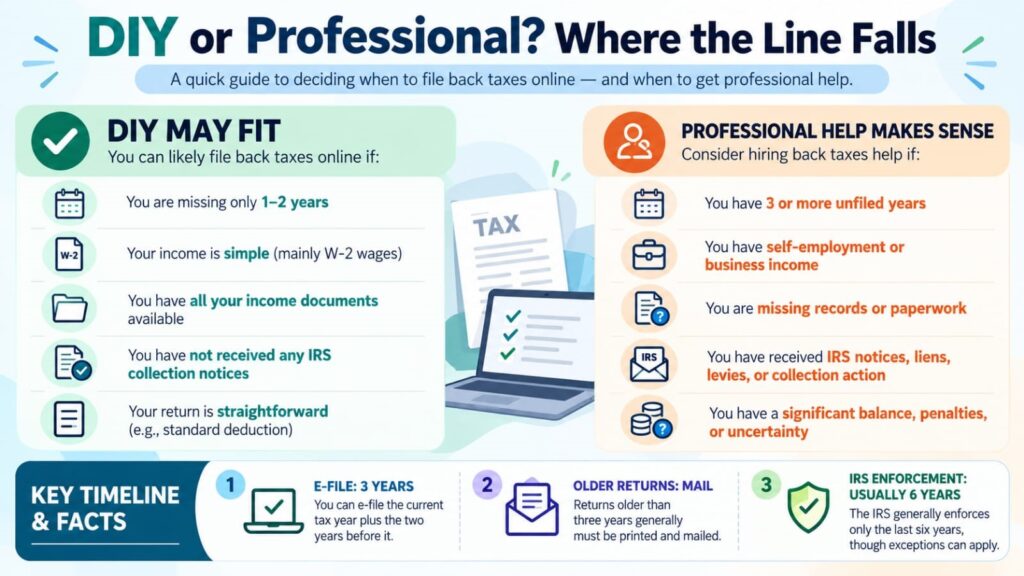
Yes, in most cases, and for recent years, it is the fastest way to get compliant. The IRS lets you e-file the current tax year plus the two years before it, so heading into 2026 you can file back taxes online for 2025, 2024, and 2023. Anything older must be printed and mailed.
What Counts as Back Taxes, and How Do You Know If You Owe Them?
Back taxes owed are simply federal taxes from a prior year that were never filed, never fully paid, or both, whether income tax, self-employment tax, or payroll tax. To answer how do I know if I owe back taxes, look for:
- A balance due or missing-year flag in your IRS online account
- A wage and income transcript pulled with Form 4506-T
- A CP59 notice saying the IRS has no record of a return
- A CP3219N showing a balance the IRS calculated for you
How Far Back Can You File a Tax Return?
No law stops you from filing a return from years ago, but two limits matter. The IRS generally enforces only the last six years under Policy Statement 5-133, longer if it suspects fraud, and you lose any refund once you file more than three years after the original due date.
Quick Fact

If you never file a required return, the IRS technically has no statute of limitations for assessing tax on that year, even though in practice it usually asks only for the last six years.
How to File Back Taxes Online, Step by Step
Whether you file electronically or mail an older return, the process follows the same basic order, and one wrong number can end up in IRS records that no longer match what you reported. The table below walks through the five stages.
|
Step |
What to Do |
|
1. Gather documents |
Collect W-2s, 1099s, and business records for each missing year |
| 2. Pull transcripts |
Request a wage and income transcript for any year with missing paperwork |
|
3. Use the right forms |
Download that specific year’s Form 1040 and instructions from IRS.gov |
| 4. Complete and review |
Match every entry against your transcript before submitting |
| 5. Submit each return |
E-file eligible years and mail the rest with proof of mailing |
- Gather every W-2, 1099, and deduction record for each missing year, keeping years in separate folders
- Pull an IRS wage and income transcript if paperwork is gone, since it often reveals more back taxes owed than expected
- Use that specific year’s Form 1040, since this year’s software will not calculate an old year correctly
- Match every line to your transcript before submitting, then e-file eligible years and mail the rest with a certified mail receipt
The Advantages and Limits of Filing Back Taxes Online
For plenty of taxpayers, doing it yourself is the right call. A software that makes one simple year easy can work against you once things get complicated, so it helps to get help with back taxes before that happens.
Where DIY Filing Works Well
DIY tends to go smoothly when:
- You are missing only one or two years
- You have all your income documents in hand
- You have not received any IRS collection notices
- Your income is simple, mostly W-2 wages with a standard deduction
Software then connects directly to your IRS online account, calculates back taxes owed automatically, and costs far less than hiring a preparer, often all the back taxes help you need.
Where DIY Filing Breaks Down
The picture changes once any of these apply:
- Three or more unfiled years, since each uses different rules and a mistake compounds
- Self-employment income, which consumer software often handles poorly across back years
- A CP504 notice or other correspondence tied to IRS back taxes
A common issue we see is self-employed taxpayers who try to file several back years alone using the current year's software, only to underreport self-employment tax because the program was never built to handle that year's rules.
DIY vs. Hiring a Tax Professional: Cost, Time, and Risk
The real comparison includes how much time each option takes and how much a mistake could cost you, both of which the table below lays out side by side.
| Factor | Filing Online Yourself | Hiring a Tax Professional |
| Upfront cost | Free to a few hundred dollars | Varies by years and complexity |
| Multiple unfiled years | Time-consuming and error-prone | Handled together as one plan |
| IRS communication | You handle notices yourself | Professional communicates for you |
| Payment plan or settlement | Not included | Often built in alongside filing |
What a Tax Professional Does That Software Can’t
IRS back tax assistance begins with a complete pull of your IRS transcripts to review all unfiled years at once and identify any gaps. Professional help can rebuild missing income records from bank statements, calculate accruing penalties, check eligibility for penalty relief, and handle all direct communication with the IRS on your behalf.
When the Math Favors Professional Help
A rushed attempt to file back taxes online across several years at once raises the odds of a missed deduction or a return that does not match what the IRS already has on record.
Tax relief services can pay for themselves by catching deductions software misses, avoiding a rejected filing, and building a payment strategy while preparing your returns.
What Happens After You File, and Your Options If You Can’t Pay in Full
Filing is only the first step. Paper-filed prior-year returns take longer to process, often several weeks to a few months, and once done, the IRS combines tax, penalties, and interest into one balance.
Back taxes owed rarely shrink on their own, since interest compounds daily and the failure-to-file penalty runs 5% per month, up to 25%, with a minimum of the lesser of $525 or 100% of the tax owed for returns due in 2026. Once confirmed, an unresolved IRS back taxes balance can lead to:
- Increasingly serious IRS notices
- A federal tax lien
- A levy on wages or bank accounts
The good news is filing does not require paying in full. If your back taxes owed exceed what you can cover, the programs below can help.
Did You Know?

The failure-to-file penalty is ten times steeper than the failure-to-pay penalty, which is one reason the IRS would rather you file on time and pay late than not file at all.
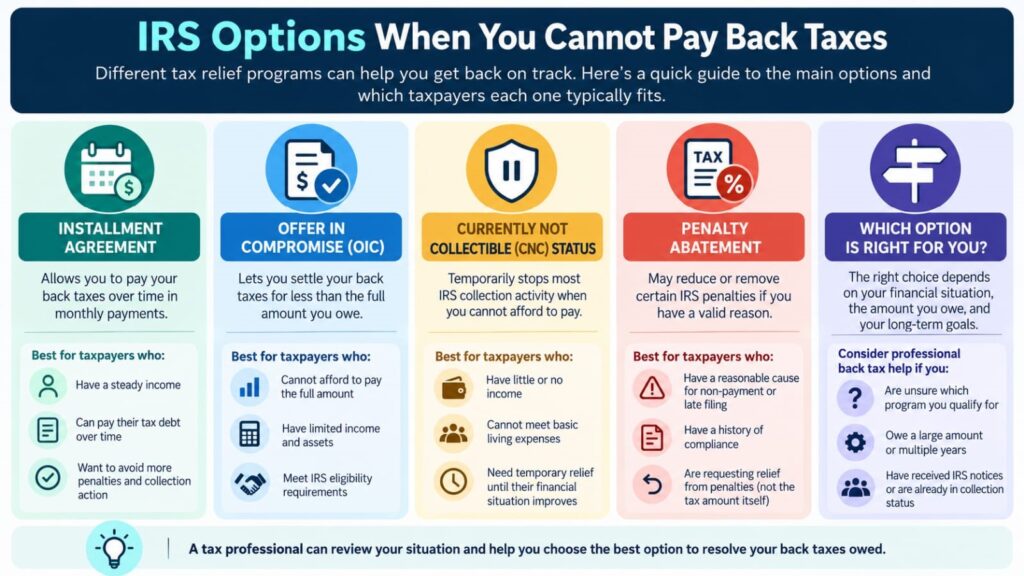
| Option | Best For | Requires Full Payment? |
| Installment Agreement | Taxpayers who can pay monthly | Yes, over time |
| Offer in Compromise | Taxpayers unable to pay in full | No |
| Currently Not Collectible | Severe financial hardship | No immediate payment |
| Penalty Abatement | Clean compliance history | Tax generally still due |
Payment Plans and Offer in Compromise
Among the most common tax relief services, an IRS installment agreement lets you pay a balance under $50,000 in monthly payments over up to 72 months, often without a full financial statement. A larger or unpayable balance may qualify for an Offer in Compromise, settling for less than you owe based on your reasonable collection potential. Both require current filing first.
Currently Not Collectible Status and Penalty Abatement
If paying anything would leave you unable to cover basic living expenses, Currently Not Collectible status pauses active collection, though interest and penalties keep accruing. First-time penalty abatement can separately remove a failure-to-file or failure-to-pay penalty with a clean three-year compliance history, even while the tax itself remains due.
When DIY Filing Costs You More, and How to Choose Help
A few clear patterns tend to mean DIY will end up costing more than it saves. If several apply to you, pause before filing anything else on your own.
Signs You Need Professional Back Taxes Help
The math favors a professional once you are juggling four or more unfiled years, since mismatched numbers become more likely and early mistakes cost more to fix later. The same holds once your back taxes owed reach a significant amount, since even a small error compounds with penalties and interest.
An IRS notice mentioning a lien or levy means you are managing an active collection case, and if you already know you cannot pay in full, tax relief services can build your resolution plan and filings together.
What to Look for in a Back Taxes Professional
Not every tax preparer has experience with multi-year IRS issues. Look for a professional with a proven track record in handling back-tax cases who can address all your unfiled years systematically rather than one at a time.
Ensure they are skilled in tax relief options like payment plans, Offers in Compromise, and Currently Not Collectible status. Always request their fees and proposed strategy in writing before getting started.
Read More: Can You File Bankruptcy on Back Taxes
How Salinger Tax Consultants Can Help With Back Taxes
We work with taxpayers whose unfiled returns range from a single missed year to more than a decade of back taxes, and we build a plan that covers both filing and what comes after. Because Peter Salinger spent over three decades inside the IRS, our team understands both sides of a back tax case, from what triggers a notice to what the IRS actually needs to resolve one.
Back Tax Return Filing Assistance
Our team helps you file back taxes online or by mail for every missing year at once, pulling transcripts directly from the IRS when your records are incomplete so nothing gets left out.
IRS Back Tax Resolution and Tax Relief Options
We handle IRS back tax cases from filing through collections, so you don’t have to start over with a new professional once your returns are done. Where appropriate, we discuss tax relief services such as installment agreements, an Offer in Compromise, or Currently Not Collectible status once your full balance is known.
IRS Notice and Collection Support
If you are already facing a lien, levy, or wage garnishment, our team can resolve back tax debt by communicating with the IRS directly while your back filings are being completed, so you are not managing both at once.
Conclusion
Deciding whether to file back taxes yourself or get professional help depends on three main factors: the number of unfiled years, the completeness of your records, and whether the IRS has started collection actions. Handling a single, simple tax year on your own is usually manageable.
If you face multiple unfiled years, missing documents, or complex IRS notices, Salinger Tax Consultants can assist. Our experienced team can guide your case from filing to complete resolution.
If you are unsure of the best approach, speak with our tax resolution professional to review your options before submitting your returns.
FAQs
Yes, for recent years you can file back taxes online through most tax software, since the IRS accepts e-file for the current year and the two years before it. For anything older, you must print and mail it, along with any supporting documents the IRS requests.
Check your IRS online account for a balance due, request a wage and income transcript, or look for a CP59 or CP3219N notice in the mail confirming a missing return or balance.
There is no legal cutoff for filing an old return, but the IRS generally enforces only the last six years to consider you back in compliance. If you are due a refund, though, you generally lose it after three years from the original due date.
The IRS calculates penalties and interest separately for each unfiled year, so your total back taxes owed can grow quickly across multiple returns. This is exactly why many taxpayers bring in help once more than a couple of years are involved.
For one simple year, yes, since software costs far less than a professional's fee. Across several years or a more complex return, the risk of a costly error can make filing back taxes online alone more expensive in the long run.
Consider back taxes help once you have multiple unfiled years, missing documents, self-employment income, or any IRS notice mentioning a lien or a levy. Each of these adds complexity and raises the stakes if you get it wrong.
Yes, a professional experienced with IRS back taxes can file your missing returns, pull missing records, and build a plan to resolve any resulting balance.
You still need to file even if you cannot pay in full, since the failure-to-file penalty is far steeper than the failure-to-pay penalty. Payment plans, an Offer in Compromise, and other tax relief services can then reduce or spread out what you owe.
In many cases, yes. Tax relief services like installment agreements, penalty abatement, or Currently Not Collectible status can ease the pressure of a back tax balance once you file your returns.
No. Filing satisfies your legal requirement to submit a return, but back taxes help usually continues afterward to negotiate how the resulting balance actually gets paid down or reduced.
Yes, tax relief services typically include direct negotiation with the IRS over payment terms, penalty relief, or settlement options once your back tax returns are officially on file.

