

A payroll deposit that arrives even a few days late can create an unexpected tax problem. The IRS requires employment taxes to be deposited on the correct schedule, for the correct amount, and through an approved electronic payment method. Errors can result in a Failure-to-Deposit, or FTD, penalty.
The IRS failure-to-deposit penalty Florida employers face ranges from 2% to 15% of the unpaid amount, plus potential interest. Employers with good compliance histories may qualify for penalty relief.
This guide covers common Q3 payroll mistakes, how FTD penalties are calculated, and what Florida employers can do next.
|
Key Takeaways
|
What Is the IRS Failure-to-Deposit (FTD) Penalty?
The IRS failure-to-deposit penalty Florida employers receive applies when required employment tax deposits are made late, for the wrong amount, or in the wrong manner. The FTD penalty 2026 rules apply federally, so Florida employers follow the same federal deposit requirements as employers elsewhere in the country.
If a deposit issue has already resulted in an assessment, help with IRS payroll penalties can include reviewing what was deposited, when it was deposited, and whether a relief request is appropriate.
Why the IRS Imposes Deposit Penalties
Employers withhold federal taxes from employee wages and owe employer portions. Federal compliance rules determine when these funds must be deposited.
The IRS imposes FTD penalties on late, short, or misdirected deposits. The penalty amount depends on the unpaid tax and the length of the delay.
Because deposit deadlines are strict, filing quarterly Form 941 does not satisfy your obligation to make timely tax deposits.
Payroll Taxes Subject to Deposit Rules
For most Form 941 employers, federal payroll taxes subject to deposit requirements include:
- Federal income tax withheld from employee wages
- Employee Social Security tax
- Employer Social Security tax
- Employee Medicare tax
- Employer Medicare tax
- Additional Medicare Tax withheld when applicable
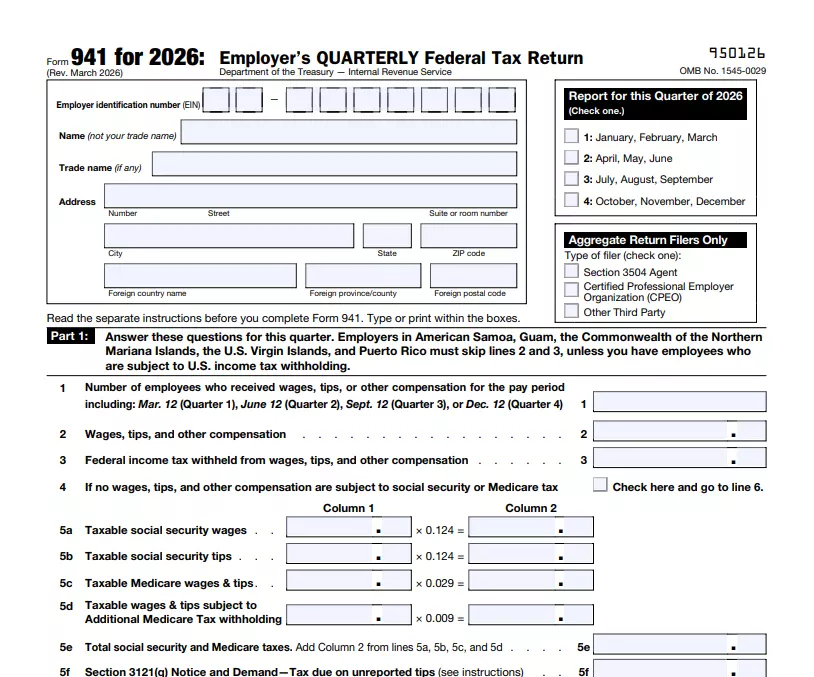
Federal tax deposits generally must be made electronically. The IRS currently permits electronic deposits through options including EFTPS, a business tax account, Direct Pay for businesses, and certain financial institution or third-party methods.
FUTA follows separate deposit rules and is reported on Form 940.
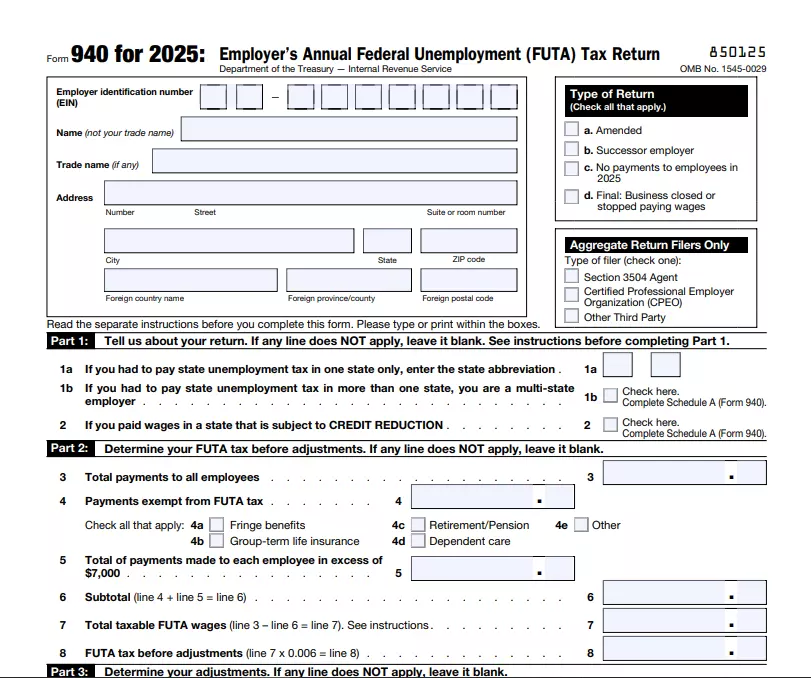
Important Note: Federal employment tax requirements can depend on your payroll amounts, deposit history, and filing circumstances. Review the current IRS rules or obtain professional guidance when determining your obligations.
Which Florida Employers Are Most at Risk?
A payroll deposit penalty Florida businesses face can often result from missed deadlines or payroll errors. Employers with changing payrolls, rapid growth, or seasonal staffing may face a higher risk.
Small Business Owners
Small business owners often manage payroll alongside other responsibilities. Common mistakes include:
- Missing a deposit deadline
- Using the wrong deposit schedule
- Entering an incorrect payment amount
- Assuming a payroll provider completed the payment
Using a payroll company does not remove the employer’s responsibility for federal tax deposits.
Growing Companies with Employees
Rapid hiring can increase payroll tax liabilities and change deposit requirements. Employers should monitor their deposit schedule and avoid assuming that last year’s process still applies.
Seasonal and Hospitality Businesses
Seasonal staffing can cause large changes in payroll and tax liabilities. Florida employers should closely follow their required deposit schedule and pay attention to the $100,000 next-day deposit rule when applicable.
Read More: IRS Form 941: Everything Business Owners Must Know in 2026
Common Q3 Payroll Mistakes That Trigger IRS Penalties
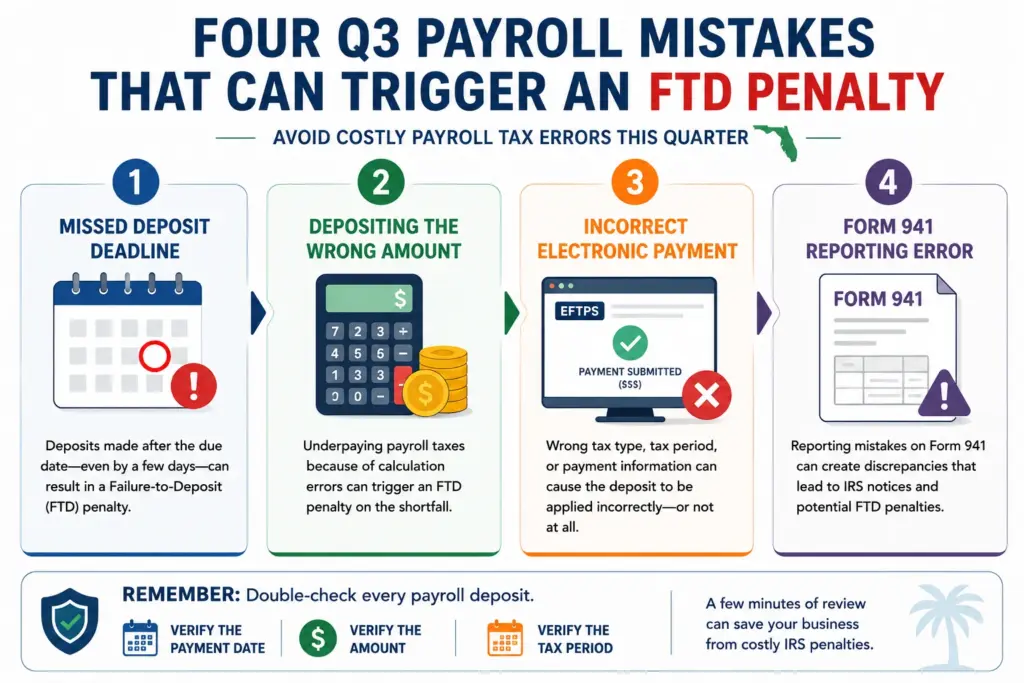
The IRS 941 deposit penalty Q3 employers face can result from missed deadlines, incorrect amounts, payment errors, or reporting mistakes.
Missing Payroll Deposit Deadlines
Monthly depositors generally must deposit employment taxes by the 15th of the following month, while semiweekly depositors follow deadlines based on their payday. Deposits that are just one to five calendar days late can trigger a 2% FTD penalty.
Depositing the Wrong Amount
Payroll calculation errors can result in an underdeposit. Employers must correctly account for federal income tax withholding and applicable Social Security and Medicare taxes when calculating deposits.
Incorrect EFTPS Payments
EFTPS payroll deposits must include the correct tax type, tax period, payment amount, and date. Employers should also retain the payment confirmation with their payroll records.
Form 941 Filing Errors
Form 941 mistakes can create differences between reported payroll tax liabilities and deposits credited by the IRS. Employers should reconcile Form 941 with payroll and deposit records before filing.
If your records do not match an IRS notice, payroll tax compliance assistance can help you review the discrepancy before responding.
How the IRS Calculates the Failure-to-Deposit Penalty
The IRS failure-to-deposit penalty Florida employers owe is calculated as a percentage of the deposit that was not made correctly or on time. The percentage increases according to the number of calendar days the deposit remains late.
Importantly, the percentages generally replace one another as lateness increases. They are not added together at each stage.
2% Penalty
The first of the FTD penalty rates is 2%. It generally applies when the deposit is 1 to 5 calendar days late.
| Simple Example: If an employer fails to deposit $ 10,000 on time and makes the deposit three calendar days late, a 2% FTD rate would equal $200, before considering any applicable interest or other issues. |
5% Penalty
IRS deposit penalties increase to 5% when a deposit is 6 to 15 calendar days late. Using the same $10,000 unpaid deposit as a simple illustration, a 5% rate would equal $500.
10% Penalty
Payroll tax penalties generally reach 10% when the deposit is more than 15 calendar days late. A 10% rate can also apply to required deposits that were paid directly to the IRS instead of being properly deposited, subject to applicable exceptions.
On a $10,000 unpaid deposit, 10% equals $1,000.
15% Penalty
The FTD rate can reach 15% when unpaid payroll taxes remain outstanding beyond the applicable period after the IRS issues its first notice requesting payment, or when the employer receives a notice demanding immediate payment.
For a $10,000 unpaid deposit, a 15% penalty equals $1,500.
| Deposit Status | FTD Rate |
| 1 to 5 calendar days late | 2% |
| 6 to 15 calendar days late | 5% |
| More than 15 calendar days late | 10% |
| Remains unpaid after the applicable IRS notice period | 15% |
These rates are central to the FTD penalty 2026 rules.
Failure-to-Deposit Penalty vs Failure-to-File vs Failure-to-Pay
Several IRS payroll penalties can relate to the same tax period, but they address different compliance failures.
Key Differences Explained
An FTD penalty concerns the required deposit of employment taxes. A failure-to-file penalty concerns filing a required return after its deadline. A failure-to-pay penalty concerns tax that remains unpaid after the applicable payment deadline.
| Penalty | What Triggers It |
| Failure-to-Deposit | Required tax deposit is late, insufficient, or made incorrectly |
| Failure-to-File | Required return is filed after its deadline |
| Failure-to-Pay | Tax remains unpaid after its payment deadline |
This IRS penalty comparison matters because filing Form 941 and making payroll deposits are separate responsibilities.
Can Multiple Penalties Apply?
Yes. Different IRS tax penalties can apply when an employer has more than one type of compliance failure.
For example, an employer could have a deposit problem and separately fail to file a required return on time. The IRS calculates penalties according to the rules applicable to each failure.
If you receive a notice containing several assessments, review each penalty separately rather than assuming they all arose from the same mistake. IRS penalty abatement may be worth requesting when the applicable relief requirements are satisfied.
How Form 941 Deposits Work for Q3
Following the correct deposit schedule can help employers avoid an IRS 941 deposit penalty Q3 issue. Your schedule is generally based on the tax liability reported during the IRS lookback period.
Monthly Deposit Schedule
Employers with a lookback-period tax liability of $50,000 or less are generally monthly depositors. Taxes on wages paid during a month are typically due by the 15th of the following month.
Semiweekly Deposit Schedule
Employers with a lookback-period liability above $50,000 are generally semiweekly depositors:
- Wages paid Saturday through Tuesday: deposit by the following Friday.
- Wages paid Wednesday through Friday: deposit by the following Wednesday.
Your deposit schedule is based on IRS rules, rather than how often employees are paid.
EFTPS Requirements
EFTPS is one option for making required electronic federal tax deposits. Employers using EFTPS payroll deposits should verify payment details and keep confirmations with their payroll records.
| Quick Tip: Do not treat payroll processing and tax deposit confirmation as the same task. Verify that the electronic deposit was actually completed and credited correctly. |
Read More: IRS Form 941: Everything Business Owners Must Know in 2026
Can the IRS Remove an FTD Penalty?
Yes, some employers may qualify for IRS penalty relief, including administrative relief or reasonable cause relief, depending on the circumstances. Relief is not guaranteed simply because the error was unintentional.
First-Time Penalty Abatement (FTA)
IRS first-time abatement has historically provided administrative relief for eligible taxpayers with a strong compliance history.
The IRS updated its administrative penalty relief framework for 2026. Its current guidance explains that Failure-to-Deposit penalties are among the penalties eligible for administrative relief, subject to compliance history and other requirements. For business taxpayers, additional conditions apply.
Employers seeking First Time Penalty Abatement should therefore review the current IRS administrative relief rules for the relevant quarter rather than relying on older guidance.
Reasonable Cause Relief
Reasonable cause penalty relief is based on the facts and circumstances of the case. The IRS generally considers whether the taxpayer exercised ordinary business care and prudence but was still unable to comply. Relevant circumstances can include events such as natural disasters, inability to obtain records, serious illness, unavoidable absence, or certain system problems.
A reasonable cause request should explain:
- What happened
- When it happened
- How it prevented timely compliance
- What steps the employer took to comply
- How quickly the problem was corrected
Supporting documentation can strengthen the request.
When Penalty Relief Is Denied
An IRS penalty appeal or relief request may be unsuccessful when the facts do not satisfy the applicable standard.
The IRS states that lack of knowledge, ordinary mistakes or oversights, reliance on a tax professional by itself, and lack of funds by itself generally do not establish reasonable cause. Other facts may change the analysis.
If a relief request is denied, the IRS provides procedures for appealing certain penalty-relief decisions.
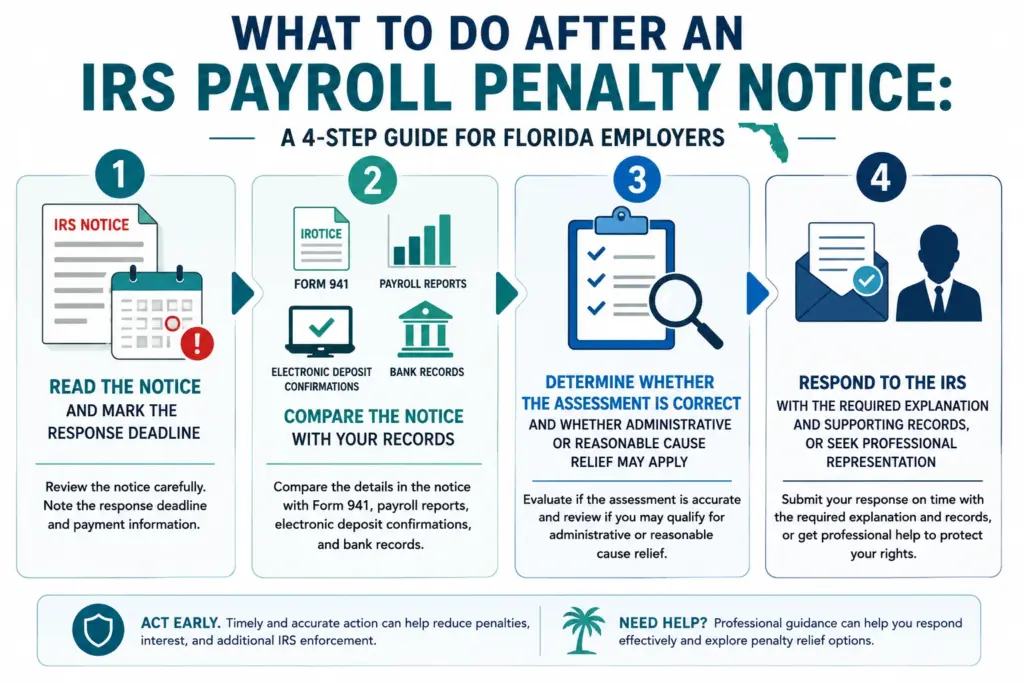
What To Do If You Receive an IRS Payroll Penalty Notice
Receiving a payroll deposit penalty Florida notice requires a careful review. The notice should identify the penalty, tax period, amount due, and response instructions.
Review the IRS Notice Carefully
Start by reading the IRS payroll notice from beginning to end. Check:
- Tax period
- Penalty type
- Amount assessed
- Deposit dates shown
- Payment information
- Response deadline
- IRS instructions
The IRS sends a notice or letter when it assesses a Failure-to-Deposit penalty.
Verify Payroll Deposit Records
Compare the notice against your payroll documentation. Useful records can include:
- Payroll reports
- Electronic payment confirmations
- Bank records
- Form 941
- Tax liability records
- Correspondence with your payroll provider
The goal is to determine whether the IRS assessment matches the business’s actual deposit history.
Respond Within the Deadline
Follow the IRS response instructions and deadline shown on the notice. If you are requesting reasonable cause relief, explain the circumstances clearly and include relevant documentation. Some penalty relief requests can be handled by phone, while other situations may require a written request, including Form 843 where appropriate.
Request Professional Representation
Complex payroll tax matters can involve deposit records, filing history, penalty calculations, and IRS correspondence at the same time. Professional IRS representation can help organize the facts, identify the appropriate relief route, and communicate with the IRS when authorization is in place.
Salinger Tax Consultants provides help with IRS payroll penalties and works with businesses dealing with payroll tax liabilities and IRS notices.
Best Practices to Avoid Future Payroll Deposit Penalties
The IRS failure to deposit penalty Florida employers face is easier to manage when payroll compliance includes regular checks throughout the quarter.
Automate Payroll Tax Deposits
Payroll automation can reduce manual scheduling errors, particularly when a company has multiple payroll dates.
Automation still needs oversight. Employers should confirm that their correct deposit schedule has been entered and that deposits have actually been processed.
Monitor EFTPS Confirmations
Payroll compliance should include retaining electronic deposit confirmations and reconciling them against payroll liabilities. Do not wait for the end of the quarter to discover that a scheduled transaction failed or contained incorrect information.
Conduct Quarterly Payroll Reviews
A payroll audit before filing Form 941 can identify differences among:
- Payroll reports
- Tax liabilities
- Deposits
- Electronic payment confirmations
- Form 941 amounts
For businesses that have previously experienced an IRS 941 deposit penalty Q3 issue, this review can also help identify the process that allowed the mistake to occur.
How Salinger Tax Consultants Help Florida Employers
When IRS payroll penalties have already been assessed, the next step is to understand what caused them and whether the amount or relief options should be reviewed.
Salinger Tax Consultants provides tax resolution services for individuals and businesses, including assistance with payroll tax liabilities and IRS penalties.
Payroll Tax Compliance Reviews
Payroll tax services can begin with a review of the records connected to the assessment. This may include examining deposit history, Form 941 information, electronic payment records, IRS correspondence, and the employer’s compliance history.
IRS Penalty Abatement Requests
An IRS penalty relief request needs to match the applicable IRS standard. Salinger Tax Consultants can assist with IRS penalty abatement by reviewing the circumstances behind the penalty and helping determine whether an administrative relief or reasonable cause request may be appropriate.
Representation During IRS Payroll Disputes
IRS representation can be useful when an employer needs assistance communicating with the IRS about a payroll tax assessment or relief request.
Conclusion
Unresolved Q3 payroll errors can be costly. The IRS Failure-to-Deposit penalty for Florida employers starts at 2% for deposits 1 to 5 days late and can reach 15% if unpaid after an IRS notice.
Good payroll controls can reduce the risk. If a penalty has already been assessed, do not assume that paying the notice immediately is your only possible response. Current IRS rules provide IRS penalty relief in qualifying situations, including administrative relief and reasonable cause relief.
If assessed, Salinger Tax Consultants can review your notice and payroll records to determine if IRS penalty relief services apply. Contact Salinger Tax Consultants with your records ready for assistance.
FAQs
The IRS failure-to-deposit penalty Florida employers may receive is a federal penalty for failing to make required employment tax deposits on time, in the correct amount, or in the required manner. The rate depends mainly on how late the deposit is and can range from 2% to 15% of the unpaid deposit.
Under the FTD penalty 2026 rules, the IRS generally charges 2% for deposits one to five calendar days late, 5% for six to 15 days, and 10% after 15 days. The rate can reach 15% when the amount remains unpaid beyond the applicable period after an IRS notice.
A payroll deposit penalty a Florida employer may encounter generally involves federal income tax withheld from wages and applicable Social Security and Medicare taxes. Additional Medicare Tax withholding may also be included where applicable. FUTA has separate deposit rules.
Yes. IRS payroll penalties address different failures. The FTD penalty concerns employment tax deposits, while a failure-to-file penalty concerns filing a required tax return late. Depending on the facts, more than one type of penalty may apply.
Potentially. Failure-to-Deposit penalties can qualify for certain forms of administrative relief or reasonable cause relief when the applicable requirements are met. Current IRS guidance should be checked because the administrative penalty-relief framework changed for 2026 quarterly returns.
IRS first-time penalty abatement is a form of administrative penalty relief tied to a taxpayer's compliance history and other requirements. For 2026 quarterly returns, employers should review the IRS's current administrative relief rules, which include the new Automatic Exemption from Penalty framework alongside FTA.
To reduce the risk of an IRS 941 deposit penalty Q3 assessment, determine your correct deposit schedule, make deposits electronically by the required deadlines, verify payment confirmations, reconcile payroll liabilities, and file an accurate Form 941. Remember that making deposits and filing Form 941 are separate obligations.
Read the IRS payroll notice carefully and compare it with your Form 941, payroll reports, electronic deposit confirmations, and bank records. Identify the tax period, penalty, amount, and response deadline. If you believe relief applies, follow the notice instructions and provide the facts and supporting records relevant to your request.
No. EFTPS payroll deposits provide an electronic method for making federal tax deposits, but using EFTPS does not by itself prevent penalties. The deposit still needs to be made by the applicable deadline, for the correct amount, and with accurate payment information.

