
A side hustle can create a tax problem long after the payment reaches your bank account. Delivery income, freelance fees, marketplace sales, and creator payments may arrive without federal income tax withholding. If that income is missing from a return, or if estimated payments fall short, the balance can lead to an IRS notice after the agency processes third-party reporting.
This guide explains taxable gig income, 1099 forms, IRS matching, collection risks, resolution options, and prevention. It covers general federal tax information. State tax duties may require separate review.
|
Key Takeaways
|
Why More Gig Workers Are Receiving IRS Collection Notices in 2026
Cases involving gig worker back taxes in 2026 often start with a simple mismatch: income was earned, a payer or platform reported it, and the tax return did not fully account for it. Other cases begin when a worker reported the income correctly but did not set aside enough for tax. IRS penalty relief may be relevant when penalties are part of the balance, though relief depends on IRS rules and the taxpayer’s facts.
Growth of the Gig Economy
Gig economy workers can earn from one platform or combine several streams during the same year. A person may drive on weekends, design websites for clients, sell handmade items, and receive referral income. Each activity can create separate records, expenses, and tax forms.
Small payments can add up, and switching platforms does not remove the duty to report taxable income. A clear income list helps when reviewing freelancer IRS debt 2026 across several payers.
Increased IRS Reporting Requirements
IRS reporting rules determine when businesses and payment platforms must issue information returns. For payments made during 2026, the federal reporting threshold for certain Form 1099-NEC and Form 1099-MISC payments increased to $2,000. The federal Form 1099-K threshold generally applies when payments for goods or services exceed $20,000, and the transaction count exceeds 200, although a form may still be issued below that level.
These are form-issuance thresholds, not tax-free amounts. Gig income may remain reportable when it is part-time, paid in cash or property, or absent from an information return.
Why Side Hustle Income Is Easier for the IRS to Track
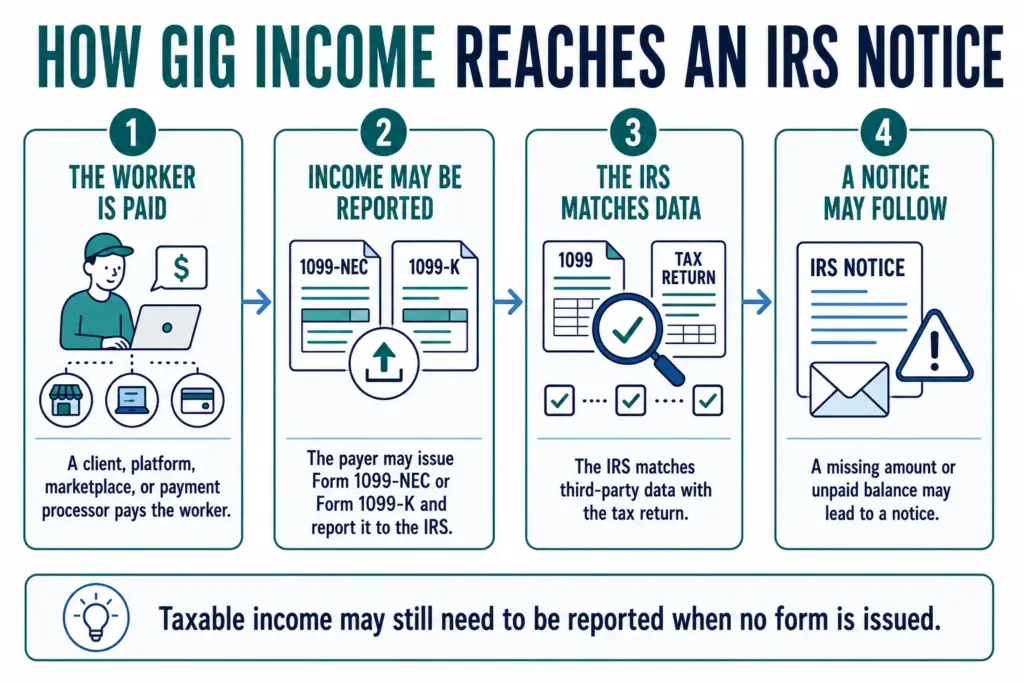
Clients, card processors, and online platforms send information returns to both the worker and the IRS. The agency can compare those records with the income shown on a tax return. If the numbers do not align, the IRS may ask for an explanation, propose a change, or bill an assessed balance.
A gig economy tax notice does not prove that every reported dollar is taxable profit. Compare the notice with platform statements, invoices, deposits, refunds, and expense records.
What Counts as Gig Economy Income?
Gig economy income generally includes money, property, goods, or virtual currency earned through on-demand work, temporary work, or independent services. For gig worker back taxes 2026, the app’s label does not decide whether income is taxable. The payment facts matter.
| Type of gig work | Examples of taxable income | Records to retain |
| Freelancing | Project fees, retainers, consulting payments | Invoices, contracts, payment confirmations |
| Ride-share and delivery | Trip payments, tips, bonuses, incentives | Platform summaries, mileage logs, deposit records |
| Online selling | Business sales through Etsy, eBay, or Amazon | Sales reports, fees, refunds, shipping costs, inventory records |
| Content creation | Sponsorships, affiliate commissions, subscriptions, advertising income | Contracts, platform statements, payment records |
| Noncash work | Products, services, property, or virtual currency received for work | Date received, fair market value, payer details |
Freelancing and Independent Contracting
Freelancer taxes can apply to writing, design, consulting, tutoring, repairs, photography, coding, and many other services. Independent contractors commonly report business income and expenses on Schedule C and calculate self-employment tax on Schedule SE when required.
Keep invoices and payment records even if a client does not issue a 1099. Investigate a duplicate or incorrect form before responding to the IRS.
Ride-Share and Delivery Platforms
Uber taxes and DoorDash taxes can involve pay, tips, incentives, and adjustments. Reconcile platform summaries with Forms 1099 and trip records.
Online Selling and Marketplace Income
Etsy, eBay, and Amazon sellers must distinguish business receipts from personal-item sales. Form 1099-K can include gross payments before fees, refunds, shipping, or the original cost of goods.
Content Creators and Digital Income
Influencer taxes may cover sponsorships, subscriptions, advertising, affiliate commissions, digital products, and noncash compensation. Record each source, date, amount or value, and related expense.
Understanding 1099 Forms and IRS Matching Programs
Many disputes involving 1099 back taxes owed begin because the taxpayer uses bank deposits alone or assumes every form reflects net profit. When reviewing gig worker back taxes for 2026, the return must show correct income and allowable expenses.
| Comparison | Form 1099-NEC | Form 1099-K |
| What it generally reports | Nonemployee compensation paid by a business | Payment card and third-party network transactions |
| Common gig-worker examples | Freelance writing, consulting, design, repairs, photography | Marketplace sales and payments processed through qualifying platforms |
| Federal threshold discussed for 2026 payments | Generally $2,000 for covered payments | Generally more than $20,000 and more than 200 transactions for third-party settlement organizations |
| What the amount may represent | Compensation paid for services | Gross processed payments before certain fees, refunds, or other adjustments |
| Important reminder | Income below the form threshold may still be taxable | A platform may issue the form below the federal threshold |
Important Notice

A reporting threshold controls when a payer must send a form. It does not exclude income from taxation. State reporting thresholds may also differ.
How the IRS Matches Third-Party Income
IRS information matching compares payer data with filed returns. A mismatch may involve omitted income, a wrong taxpayer number, duplicate reporting, or gross payments needing proper treatment.
If a notice appears incorrect, respond with records. If it reflects 1099 back taxes owed, back tax resolution services can help evaluate the years, filings, payments, penalties, and collection options.
Common Reasons Gig Workers End Up Owing Back Taxes
The pattern behind gig worker back taxes in 2026 is often predictable. Income arrives without withholding, the worker spends the full payment, and the tax obligation becomes clear only when the return is prepared, or the IRS makes an adjustment.
No Taxes Withheld From Payments
Employees usually have tax withheld from wages. For gig worker back taxes 2026, independent contractors generally receive gross payments and handle their own income and self-employment tax. A strong revenue month can therefore create a larger tax obligation without creating a separate tax payment.
Missing Estimated Tax Payments
Quarterly estimated taxes allow self-employed workers to pay income and self-employment taxes during the year. Missing or underpaying them can leave a filing-time balance and may lead to an estimated-tax penalty. Workers with W-2 jobs may also adjust wage withholding when appropriate.
Underreporting Side Hustle Income
Unreported income may come from cash, payment apps, foreign platforms, noncash compensation, or small clients. A worker can owe tax even without a form. When 1099 back taxes owed involve an incorrect form, the worker should request a correction and keep proof supporting the correct amount.
Mixing Personal and Business Expenses
Bookkeeping mistakes grow when one account handles personal spending, app deposits, equipment, and refunds. Mixed records can hide legitimate costs or unsupported claims.
What Happens When You Ignore IRS Collection Notices?
With gig worker back taxes 2026, IRS collection notices usually describe the tax period, balance, response date, and next steps. Ignoring them can reduce the time available to dispute an error or arrange payment. It can also allow penalties and interest to continue.
IRS Balance Due Notices
When an IRS CP notice arrives, check the following information before paying or responding:
Then add:
- Notice number and issue date
- Tax year covered by the notice
- Amount the IRS says is owed
- Reason for the proposed adjustment or balance
- Response or payment deadline
- Instructions for disputing the notice
- Filed return and any amended return
- Proof of estimated payments or other tax payments
If any information is incorrect or incomplete, gather supporting records and respond using the instructions provided in the notice.
Penalties and Interest Continue to Grow
IRS penalties and interest can increase the balance while it remains unpaid. Some taxpayers may qualify for IRS penalty relief through first-time abatement or reasonable-cause rules. Approval is fact-specific, and penalty relief generally does not remove the underlying tax.
Federal Tax Liens
An IRS tax lien is the government’s legal claim against property after a demand for unpaid tax. A Notice of Federal Tax Lien can affect property transactions and creditor priority.
Wage Garnishment and Bank Levies
An IRS levy can take wages, bank funds, or property after required collection steps. Some notices provide Collection Due Process rights, so prompt IRS back-tax help can preserve response time.
How to Resolve Gig Worker Back Taxes
Resolving freelancer IRS debt 2026 begins with accurate returns and a complete account picture. The best option depends on the balance, collection stage, household finances, assets, and ability to pay.
Comparing IRS Back Tax Resolution Options
| Resolution step or option | When it may apply | Important consideration |
| File missing returns | One or more required returns have not been filed | Filing compliance is generally required before many resolution options are approved |
| Installment agreement | The balance is accurate, but full payment is unaffordable | Penalties and interest generally continue while the balance remains unpaid |
| Offer in Compromise | The taxpayer may be unable to pay the full balance within the collection period | The IRS reviews income, expenses, assets, and ability to pay |
| Currently Not Collectible status | Payment would prevent the taxpayer from meeting basic living expenses | Collection may pause, but the debt is not forgiven |
| Penalty relief | Penalties resulted from a qualifying first-time situation or reasonable cause | Relief usually does not eliminate the underlying tax |
File All Missing Tax Returns
Unfiled returns can block many resolution options. Gather Forms 1099, platform summaries, income, and expenses. An accurate return may differ from an IRS substitute return that omitted allowable deductions.
Set Up an Installment Agreement
An IRS payment plan lets eligible taxpayers pay over time. IRS installment agreement help can assist with an affordable proposal and required information.
Offer in Compromise
An IRS Offer in Compromise may settle qualifying tax debt for less than the full balance. The IRS reviews ability to pay, income, expenses, and asset equity. Required returns and current estimated payments generally must be up to date before an offer is considered.
Currently Not Collectible Status
IRS hardship relief may pause most collection activity when payment would prevent basic living expenses. CNC status does not forgive tax; penalties and interest generally continue.

Quick Tip

Do not choose a program based only on the lowest monthly payment. Compare the total cost, required financial disclosure, collection protections, and how long the arrangement may last.
Tax Deductions Gig Workers Commonly Miss
Self-employed deductions can reduce net business profit when expenses are ordinary, necessary, properly allocated, and documented. Deductions do not erase gross receipts from a 1099, and personal expenses remain nondeductible.
Commonly overlooked records include:
- Mileage logs showing dates, destinations, distances, and business purpose
- Receipts for software, subscriptions, supplies, and equipment
- Platform statements showing commissions and service fees
- Records separating business use from personal use
- Home-office measurements and related expense records
- Health insurance and eligible retirement contribution documents
Vehicle Expenses
The mileage deduction may apply to qualifying business travel. Keep a log of dates, destinations, business purpose, and distance. Separate commuting and personal miles.
Home Office Deduction
Home office expenses may apply when space is used regularly and exclusively for qualifying business activity. The simplified and actual-expense methods have different record needs.
Business Equipment and Software
Business deductions may include the business portion of computers, phones, subscriptions, platform fees, and supplies. Keep receipts and document personal use.
Health Insurance and Retirement Contributions
Self-employed benefits may include qualifying health insurance and retirement deductions. These items have limits and coordination rules and require full-return review.
Read More: Self-Employed Tax Deductions: The Complete List for 2026
How to Prevent IRS Problems Going Forward
A completed tax resolution should include current-year compliance so a new balance does not threaten the arrangement.
Monthly gig-worker tax checklist
- Record income from each client, app, platform, and marketplace.
- Include cash, virtual currency, products, and other non cash compensation.
- Reconcile platform reports with deposits and invoices.
- Save receipts and connect each expense to a business purpose.
- Update mileage records while the trips are still easy to verify.
- Transfer money into a separate account for estimated taxes.
- Keep business purchases separate from personal spending.
Before making each estimated tax payment:
- Review year-to-date income and expenses.
- Adjust the calculation if income has increased or decreased.
- Save proof of the payment and confirm that it was applied correctly.
How Salinger Tax Consultants Help Gig Workers Resolve Back Taxes
Salinger Tax Consultants provides IRS back taxes help for taxpayers who need to understand a balance, complete missing filings, or respond to collection activity. This IRS back taxes help begins with the account and documents rather than a standard program.
Documents to gather before requesting IRS back taxes help:
- Every IRS notice received
- Filed and unfiled tax returns
- Forms 1099-NEC and 1099-K
- Platform annual summaries
- Bank and payment-processor records
- Business expense receipts
- Mileage and vehicle records
- Proof of estimated payments
- Information about household income, expenses, and assets
IRS Account Review
IRS transcript analysis can identify assessed balances, missing returns, payments, penalties, and collection activity across tax periods. The review can also show where client or platform records need to be compared with filed returns.
Back Tax Resolution
A tax resolution plan may involve filing compliance, correction, payment, hardship status, penalty relief, or an offer. IRS Offer in Compromise eligibility depends on complete finances.
Payment Plan Negotiation
An installment agreement should be based on accurate account information and a payment the taxpayer can maintain. IRS installment agreement help can support the application and communication process when the IRS requires additional financial details.
IRS Collection Defense
IRS representation can include reviewing notices, communicating with the IRS, protecting response deadlines, and addressing lien or levy concerns. Taxpayers facing an active gig economy tax notice should keep all letters and act before the stated deadline when possible.
Conclusion
Side-hustle income can turn into an IRS balance when withholding, estimated payments, recordkeeping, or return reporting falls behind. The right response to gig worker back taxes 2026 starts with verifying the income, tax periods, assessments, payments, penalties, and collection stage. From there, you can compare payment, correction, and relief options based on real financial information.
If you are dealing with freelancer IRS debt 2026, avoid waiting for another notice. A structured back tax resolution may involve missing returns, an installment agreement, hardship status, an offer, or penalty relief.
Salinger Tax Consultants can review the account and help you prepare a response. Contact to discuss the notice, the amount claimed, and the next deadline. You can also review back tax resolution services before your consultation.
FAQs
Cases involving gig worker back taxes 2026 can arise when payer or platform records do not match the return, when a worker files with a balance, or when estimated payments were missed. Increased digital recordkeeping makes third-party income easier to compare. A notice still needs to be checked carefully because a form can be wrong, duplicated, or based on gross payments that require proper expense treatment.
If payer-reported income is missing, IRS matching may propose additional tax, penalties, and interest. 1099 back taxes owed should be reviewed against the form, return, bank records, and business books. If the 1099 is incorrect, ask the issuer to correct it and respond to the IRS with supporting records. If the income was omitted, an amended or missing return may be appropriate.
Yes. The IRS receives information returns from many clients, platforms, and payment processors and can compare them with a filed return. A gig economy tax notice may result when the amounts do not match. The IRS also requires taxable gig income to be reported even when no 1099 is issued, including qualifying cash or noncash payments.
For freelancer IRS debt 2026, collect all notices, returns, Forms 1099, account transcripts, payment records, and expense documents. Confirm that every required return is filed and that the IRS balance is accurate. Then compare payment in full, an installment agreement, an offer, hardship status, and possible penalty relief. Contact Salinger Tax Consultants if collection deadlines are approaching.
Many taxpayers can request an IRS payment plan, though the available terms depend on the balance, filing compliance, and financial facts. Interest and applicable penalties generally continue until the balance is paid. A taxpayer should also plan for current estimated taxes so a new balance does not default the arrangement.
Yes, a freelancer may qualify if the IRS requirements are met. An offer is based on factors such as ability to pay, income, expenses, and asset equity. Required returns and current estimated payments generally need to be up to date. Acceptance is not guaranteed, and an offer may be less suitable than another collection option.
Self-employed deductions may include qualifying vehicle costs, home office expenses, equipment, software, platform fees, supplies, health insurance, and retirement contributions. Each item has rules and documentation requirements. Only the business portion is deductible, and personal costs cannot be converted into business expenses merely because they were paid from a business account.

