

Every business with employees runs into IRS Form 941 sooner or later, and getting it wrong costs more than most owners expect. The form reports wages, withheld income tax, and Social Security and Medicare taxes each quarter, and the IRS watches it closely because it involves money already taken from employee paychecks.
Getting familiar with the form now saves time each quarter and keeps a business out of penalty territory before a problem starts. This guide covers what IRS Form 941 includes, who must file it, the 2026 deadlines, how deposits work, and what happens when a return is late or incorrect.
| Key Takeaways |
|
• The form reports employee wages, federal income tax withholding, and Social Security and Medicare taxes quarterly. • Most employers that pay wages subject to withholding must file, though seasonal, agricultural, and household employers follow separate rules. • 2026 deadlines fall on April 30, July 31, October 31, and January 31, with a 10-day extension for employers who deposited all taxes on time. • Deposit schedules are either monthly or semiweekly, based on a lookback period, and all deposits go through EFTPS. • Late filing, late deposits, and reporting errors each carry separate penalties, and Form 941-X is used to fix mistakes afterward. |
What Is IRS Form 941?
This is the Employer’s Quarterly Federal Tax Return. It exists so the IRS can reconcile what an employer withheld from workers’ pay against what is actually deposited.
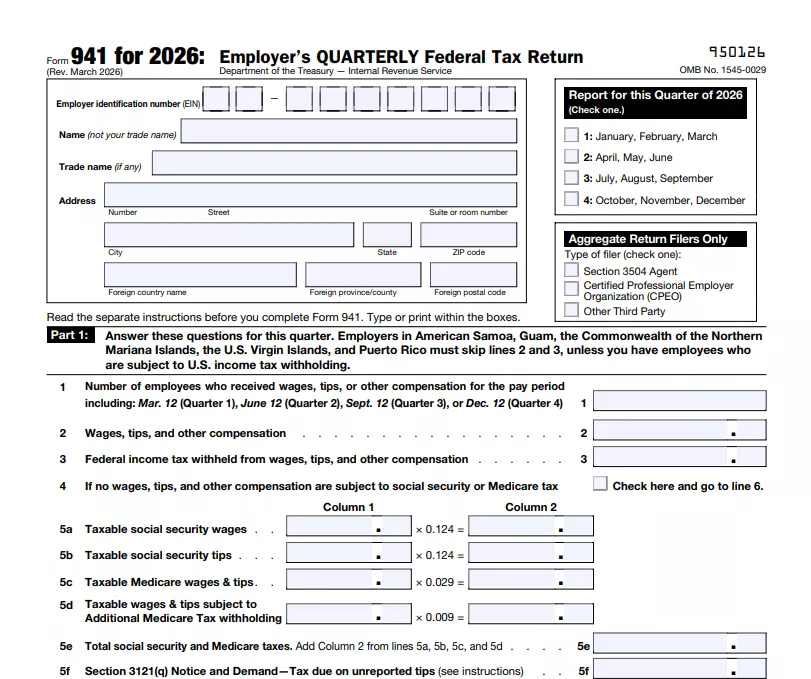
Purpose of Form 941
The form reports total wages paid, federal income tax withheld, and the Social Security and Medicare tax components for the quarter, tied to a specific employer identification number.
Why the IRS Requires Quarterly Payroll Reporting
Payroll withholding belongs to the government the moment it is taken from an employee’s paycheck. Quarterly payroll tax reporting lets the IRS confirm deposits are on schedule, rather than waiting until year-end to discover a shortfall.
Businesses That Commonly File Form 941
Retailers, restaurants, service firms, contractors, and any business running regular payroll typically file each quarter. Size matters less than whether wages subject to withholding were paid during the period.
For the full picture of your filing obligations, learn about payroll tax obligations in this related guide.
Who Must File IRS Form 941?
Filing requirements depend on whether a business paid wages subject to federal income tax withholding, Social Security, or Medicare taxes during the quarter.
Employers Required to File
Any employer paying wages to employees, other than household or agricultural workers, generally must file, even in a quarter with a single employee, once quarterly payroll tax obligations were triggered.
Businesses Exempt from Filing
Household employers report on Schedule H with their personal return, agricultural employers use Form 943, and very small employers with an annual liability of $1,000 or less may qualify for Form 944 instead. These Form 941 exemptions require written IRS approval.
Special Rules for Seasonal Employers
A seasonal employer Form 941 filer can check a box indicating no wages were paid in a given quarter, which stops the account from generating late-filing notices during the off-season.
What Information Is Reported on Form 941?
Form 941 compiles all payroll figures the IRS needs to confirm an employer’s tax position for the quarter.
Employee Wages and Federal Income Tax Withholding
The form reports total taxable wages, tips, and federal income tax withheld for the quarter. Accurate payroll tax reporting depends on records matching what was deposited.
Social Security and Medicare Taxes
Social Security tax is 12.4% of wages up to the annual wage base, split evenly between employer and employee. Medicare tax is 2.9%, split evenly, plus an additional 0.9% employee-only tax on wages above $200,000; both employment taxes are reported together on the form.
Tax Adjustments and Credits
The form includes lines for adjustments such as fractions of cents, sick pay, and tips, along with any applicable payroll tax credits still in effect, each backed by documentation in the employer’s payroll file.
IRS Form 941 Filing Deadlines for 2026
Every employer required to file works from the same four dates each year, regardless of business size or industry.
Quarterly Due Dates
The form is due by April 30 for the first quarter, July 31 for the second, October 31 for the third, and January 31 for the fourth. These 941 filing deadlines fall on the last day of the month after each quarter ends.
Late Filing Extensions and Exceptions
An employer that deposited all taxes for the quarter in full and on time gets an automatic 10 additional calendar days beyond the standard 941 filing deadlines. Outside of that, there is no standard extension, unlike income tax returns.
Calendar for Employers
Marking all four 941 filing deadlines at the start of the year, along with each deposit due date, keeps a business from missing a deadline during a busy stretch.
Understanding Employer Tax Deposits
Deposits and the quarterly payroll tax return itself are two separate obligations, and missing either one creates its own penalty.
Monthly Deposit Schedule
Employers with a total tax liability of $50,000 or less during the lookback period make employer tax deposits monthly, due by the 15th of the following month.
Semiweekly Deposit Schedule
Employers with a lookback liability above $50,000 deposit semiweekly: wages paid Wednesday through Friday are due the following Wednesday, and wages paid Saturday through Tuesday are due the following Friday.
Using EFTPS for Payments
All employer tax deposits go through the Electronic Federal Tax Payment System, and electronic payroll tax payments made through EFTPS post immediately to the account tied to the employer’s EIN.
How to Complete IRS Form 941 Step by Step
Working through the form in order keeps the numbers consistent from the top section to the final total.
Business Information Section
The top of the form asks for the business name, address, and employer identification number exactly as registered with the IRS, and a mismatch here is one of the more common reasons a return gets flagged.
Reporting Payroll and Taxes
Part 1 walks through employee count, wages paid, and each tax category in sequence, with quarterly payroll tax figures that tie back exactly to payroll register totals for the period.
Reviewing Before Submission
Before submitting, totals should be checked against deposit confirmations and prior-quarter figures, a payroll compliance step that catches transposed numbers before an IRS mismatch letter arrives.
How to File IRS Form 941
Employers can file electronically or by mail, though the IRS has pushed most filers toward e-filing in recent years.
Electronic Filing Options
Employers can e-file through an IRS-approved provider or a payroll service that transmits returns electronically, and filers who e-file Form 941 typically get confirmation of receipt right away.
Mailing Your Return
Paper filers use the IRS mailing address Form 941 instructions list for their state, which changes depending on whether a payment is included, and the wrong address can look like a late filing.
Recordkeeping Requirements
Payroll records supporting each return should be kept for at least four years from the date the tax became due or was paid, whichever is later, including registers, deposit confirmations, and copies of each filed return.
Common IRS Form 941 Filing Mistakes
Most filing errors come from mismatched numbers rather than anything complicated.
Incorrect Employee Wage Reporting
Wages that do not match what was actually paid, whether from a software export error or a manual entry mistake, are among the most common payroll mistakes on the form.
Missing Deposit Payments
A return reporting a tax liability without a matching deposit history raises questions immediately. Missing employer tax deposits, even by a few days, triggers the failure-to-deposit penalty regardless of whether the return itself was filed on time.
Filing with an Outdated Form
The IRS updates the form periodically, and submitting an old version can result in processing delays or rejection, so it pays to confirm the latest revision before each filing.
IRS Penalties for Late Filing and Incorrect Reporting
Form 941 penalties apply on more than one track at once, and they add up quickly when several quarters are involved.
Failure-to-File Penalties
The IRS charges 5% of unpaid tax per month for a late return, capped at 25%. These payroll tax penalties apply per return, so multiple late quarters compound fast.
Failure-to-Deposit Penalties
Late employer tax deposits carry a separate penalty that scales with how late the deposit was made, starting at 2% and reaching 15% once an IRS notice has been issued and the deposit still has not posted.
Interest Charges
Interest accrues daily on unpaid payroll tax and penalties at the federal short-term rate plus 3%, adjusted each quarter. This interest keeps compounding until the balance is paid in full, regardless of any penalty relief granted.
Read: IRS Failure-to-File vs. Failure-to-Pay Penalty: What’s the Real Cost?
How to Correct Errors Using Form 941-X
Mistakes discovered after filing get corrected through a dedicated amended return rather than a fresh filing.
When to File an Amended Return
Form 941-X should be filed as soon as an error is discovered, generally within three years of the original filing date or two years from when the tax was paid, whichever is later, since waiting only adds interest.
Common Corrections
Typical payroll tax correction entries include wage totals reported incorrectly, tax credits claimed in error, and deposits miscoded to the wrong quarter.
Supporting Documentation
Every correction on Form 941-X needs payroll compliance documentation behind it, including the original payroll records and an explanation of what changed and why.
Best Practices for Payroll Tax Compliance
A handful of habits keep most employers out of the quarterly payroll tax penalty categories covered above.
Keep Accurate Payroll Records
Payroll records that match deposits and filed returns line by line make each future filing easier to prepare and harder to dispute if the IRS asks questions.
Automate Payroll Tax Deposits
Routing employer tax deposits through payroll software or a dedicated account removes the manual step where deadlines get missed during a busy week.
Work with a Payroll Tax Professional
Businesses juggling multiple states, seasonal staff, or frequent payroll changes often benefit from professional payroll tax filing services rather than handling every quarter in-house. You can speak with a payroll tax expert before an issue turns into a penalty notice.
How Salinger Tax Consultants Can Help
Salinger Tax Consultants works with businesses at every stage of the payroll tax cycle, from routine quarterly filing to cleaning up past mistakes.
Payroll Tax Preparation & Filing
Our team prepares and files the return each quarter using actual payroll data, checked against deposit records before submission. Payroll tax filing services from Salinger scale from a single quarter to a full-year cleanup.
Payroll Tax Compliance Support
Ongoing support keeps deposit schedules, recordkeeping, and quarterly filings aligned throughout the year. Get help with payroll tax compliance if your current process feels like it is always catching up rather than staying ahead.
IRS Payroll Tax Resolution Services
When penalties or notices have already piled up, our IRS payroll tax resolution services address the balance directly with the IRS while getting current filings back on track.
Stay Compliant with IRS Form 941 in 2026
This form looks simple on its face, yet the 941 filing deadlines, deposit rules, and penalty structure leave little room for guesswork. Filing each quarter accurately, on the correct schedule, keeps a business out of the penalty and audit conversations covered here.
If your business needs help staying current on this filing or catching up after a missed quarter, Salinger Tax Consultants can manage the return, the deposits, and any IRS correspondence that follows. Schedule a payroll tax consultation to review your current filing status and identify what needs attention first.
FAQs
It reports wages paid, federal income tax withheld, and Social Security and Medicare taxes to the IRS on a quarterly basis.
Employers who pay wages subject to withholding, other than household and agricultural employers, generally must file each quarter unless approved for annual filing under Form 944.
The 2026 deadlines are April 30, July 31, October 31, and January 31, with a 10-day extension available for employers who made all deposits on time.
The return is filed quarterly, four times per year, reflecting quarterly payroll tax activity for that period.
The form reports federal income tax withholding along with Social Security and Medicare payroll taxes, including both the employer and employee share.
Deposits follow a monthly or semiweekly schedule based on the employer's lookback period, and all deposits are made electronically through EFTPS.
Yes, employers can e-file through an IRS-approved provider or a payroll service, which typically confirms receipt faster than a mailed return.
A missed deadline triggers a failure-to-file penalty of 5% of unpaid tax per month, capped at 25%, along with interest on any unpaid balance.
Errors are corrected using Form 941-X, generally filed within three years of the original filing date or two years from when the tax was paid.
Businesses with multiple states, seasonal staff, or a history of filing errors often benefit from professional payroll tax filing services to keep quarterly returns accurate and on time.

