

Most assume the IRS will accept whatever they can pay now. In reality, the IRS settlement amount is determined by what you can pay over 10 years, plus what it can seize from current assets. If you’re wondering how much the IRS settlement amount for OIC will be, the answer depends on your Reasonable Collection Potential (RCP). The RCP number is formula-driven based on your assets, income, and IRS-allowed living expenses.
This guide explains how Reasonable Collection Potential is calculated, what financial information the IRS requires on Form 433-A, how to estimate your own OIC settlement amount, and what factors the IRS uses to accept or reject offers.
Key Takeaways
|
What Is an IRS Offer in Compromise (OIC)?
An Offer in Compromise is a settlement program where the IRS accepts less than the full tax balance owed. Offer in compromise eligibility depends on your Reasonable Collection Potential, and understanding how the IRS calculates settlement amounts under IRC §7122 is essential.
How an Offer in Compromise Helps Reduce Tax Debt
An Offer in Compromise settles a tax debt for a percentage of what you owe, sometimes much less. Instead of paying the full balance over 10 years through installment agreements, an OIC can resolve the entire debt in one lump payment or a few years of installments.
The Three Types of OIC Programs
The IRS accepts offers based on three grounds: doubt as to collectibility (you cannot pay), doubt as to liability (you dispute the assessment), and Effective Tax Administration (full payment causes extreme hardship).
Doubt as to collectibility is most common, and the IRS settlement amount OIC is based entirely on your RCP.
Why Most OIC Applications Are Accepted or Rejected
The IRS approves or rejects offers based on whether your offer meets or exceeds RCP. If your Reasonable Collection Potential is $50,000 and you offer $45,000, you’re rejected. At $50,000 or more, it’s typically accepted.
How Does the IRS Determine a Settlement Amount?
The IRS settlement amount follows a strict mathematical formula with no discretion once the data is entered.
Understanding Reasonable Collection Potential (RCP)
Reasonable Collection Potential (RCP) is the total amount the IRS believes it can collect from you.
Formula- (Net Asset Equity) + (Monthly Disposable Income × 12 or 24).
Your offer must meet or exceed that number.
Why RCP Is the Most Important OIC Factor
Your RCP determines the IRS settlement amount that the agency will accept. Lower your RCP, lower your settlement requirement.
Every dollar legitimately removed from the calculation reduces what you must offer.
How the IRS Uses Financial Information to Evaluate Offers
The IRS uses Form 433-A data to calculate RCP: current asset values, outstanding liabilities, monthly income from all sources, and living expenses using published standards.
The resulting IRS settlement amount OIC is binding once calculated — unless you can prove an error.
Read more: How The IRS Calculates Your Ability To Pay
What Is Reasonable Collection Potential (RCP)?
RCP has two components: what you own (net asset equity) and what you’ll earn (projected disposable income). Together, these determine the floor for any OIC offer the IRS will accept.
Asset Equity Component
The IRS values assets at 80% of fair market value, not full retail. Real estate is 80% of the appraisal minus the mortgage.
Vehicles are 80% of the trade-in value minus the loan. Bank accounts are 100%, and retirement accounts are 80% of the balance. This Net Realizable Equity is the first part of your RCP.
Future Income Component
The IRS multiplies your monthly disposable income by 12 (for a lump-sum offer within 5 months) or 24 (for an installment offer).
Disposable income is gross income minus IRS-allowed living expenses — not your actual spending. This future income is the second part of RCP and often represents 60–80% of the total settlement the IRS will demand.
Allowable Living Expenses Under IRS Standards
The IRS publishes National Standards for food, clothing, housekeeping, and personal care ($816 per month for a single person as of 2026).
Local Standards vary by county for housing, utilities, and transportation. If your actual rent is $2,200 but the local standard is $1,800, the IRS uses $1,800. These caps determine your monthly disposable income and your future income component of RCP.
Understanding IRS Form 433-A and Its Role in OIC Calculations
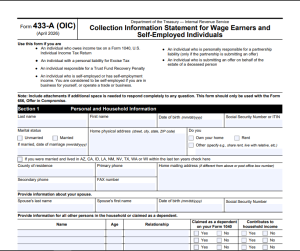
Form 433-A is the financial statement providing all the data the IRS needs to calculate your RCP. Every line item affects the settlement amount.
Information Required on Form 433-A
Form 433-A requires your name, age, family size, all income sources, a complete asset inventory with fair market values and loan balances, all monthly expenses, and outstanding liabilities.
Business ownership, investments, insurance with cash value, and pending judgments must be listed. Incomplete sections mean the IRS will return your application without review.
Supporting Documents for the IRS Reviews
The IRS requires proof for every Form 433-A number: bank statements, property appraisals, vehicle trade-in guides, pay stubs, lease agreements, and utility bills.
The IRS settlement amount calculation is only as accurate as the supporting documentation. Without proof, the IRS uses its own assumptions, which are usually higher than actual figures.
Common Mistakes Taxpayers Make on Form 433-A
Common mistakes: using round-number estimates instead of actual values, omitting liabilities, using full market value instead of 80%, or claiming expenses above IRS standards without justification.
Each mistake increases RCP and raises the IRS settlement amount the agency demands.
How to Calculate Your Potential OIC Settlement Amount
You can estimate your settlement amount using the IRS formula. Here are the three steps, with examples.
Step 1: Calculate Net Realizable Equity (NRE)
List each asset: real estate, vehicles, bank accounts, retirement accounts, and business interests. Multiply real estate and vehicles by 80%. Use 100% for bank accounts. Subtract outstanding loans. Add together.
The result is Net Realizable Equity, the first component of the OIC calculation.
Step 2: Determine Monthly Disposable Income
Start with gross monthly income from all sources. Subtract the IRS National Standards for food, clothing, housekeeping, and personal care. Subtract Local Standards for housing, utilities, and transportation.
Subtract documented necessary expenses like insurance, child support, or student loans. The result is monthly disposable income. Multiply by 12 (lump-sum) or 24 (installment).
Step 3: Apply the IRS OIC Formula
Add your Net Realizable Equity plus your projected future income (monthly disposable income × 12 or 24). That total is your calculated Reasonable Collection Potential — the minimum IRS settlement amount the agency will accept.
Your actual offer should meet or exceed this number to have a realistic chance of approval.
Example of an Offer in Compromise Calculation
Here’s an example showing how the IRS calculates settlement amounts.
Sample Asset Equity Calculation
You own a home appraised at $300,000 with a $200,000 mortgage: ($300,000 × 80%) − $200,000 = $40,000 home equity.
A car with $15,000 trade-in value and $8,000 loan: ($15,000 × 80%) − $8,000 = $4,000 equity.
You have $5,000 in savings (100%) and $30,000 in a retirement account (80% = $24,000).
Total Net Realizable Equity: $40,000 + $4,000 + $5,000 + $24,000 = $73,000.
| Asset | Fair Market Value (or Balance) | IRS Multiplier | Outstanding Loan | Net Equity |
| Home | $300,000 | 80% | $200,000 | $40,000 |
| Vehicle | $15,000 | 80% | $8,000 | $4,000 |
| Savings Account | $5,000 | 100% | $0 | $5,000 |
| Retirement Account | $30,000 | 80% | $0 | $24,000 |
| Total Net Realizable Equity | $73,000 |
Your Net Realizable Equity of $73,000 is the first component of your Reasonable Collection Potential.
Sample Future Income Calculation
You earn $4,000 monthly with a family of two. National Standards allowance: $816 (food, clothing, personal care).
Local Standard for housing and utilities: $1,200. Transportation: $425. Total allowed expenses: $2,441.
Monthly disposable income: $4,000 − $2,441 = $1,559.
For a lump-sum offer (5 months), multiply by 12: $1,559 × 12 = $18,708 future income potential.
| Category | Amount |
| Gross Monthly Income | $4,000 |
| IRS National Standards (food, clothing, personal care) | ($816) |
| Local Standard for Housing and Utilities | ($1,200) |
| Transportation (vehicle ownership and operation) | ($425) |
| Monthly Disposable Income | $1,559 |
| Multiplier for Lump-Sum Offer | × 12 |
| Future Income Component | $18,708 |
Your future income component represents what the IRS believes you can pay over 12 months.
Estimated Settlement Offer Example
Combining the components: Net Realizable Equity ($73,000) + Future Income Component ($18,708) = Total RCP of $91,708.
The IRS will accept an offer of $91,708 or higher to settle your tax debt. Anything less, and the application faces rejection unless you can justify an exception (such as Effective Tax Administration hardship).
Must Read: How to Settle Tax Debt for Less
Factors That Can Increase or Decrease Your Settlement Amount
Several factors can push your RCP up or down, directly affecting your settlement amount.
Home Equity and Real Estate Holdings
Home equity is usually the largest OIC component. Even at 80% discount, a $300,000 home creates significant settlement demand.
The IRS accounts for mortgages, property tax liens, and secured debts. Rental or commercial property equity is fully included. There are no exemptions for investment properties.
Retirement Accounts and Investments
Retirement account balances (IRAs, 401k plans, pensions) are included at 80% of the current balance. Stocks and bonds are at their current market value.
The IRS accounts for early withdrawal penalties, but usually applies only a small deduction rather than the full tax impact.
Retirement savings can significantly increase your settlement amount even if inaccessible without penalty.
Income Changes and Business Ownership
Self-employed or business owner income is based on recent tax returns and current-year performance. Rising income increases disposable income and raises your RCP. Declining income lowers the calculation.
Business interests are valued and included in the asset component.
Common Reasons OIC Applications Are Rejected
The IRS rejects most OICs due to documentation gaps and calculation errors. Understanding these helps you avoid them.
Incomplete Financial Disclosures
Incomplete Form 433-A submissions are the leading rejection reason. Missing asset values, incomplete income, or unlisted liabilities cause automatic return without calculation.
The IRS won’t ask for missing information. It rejects the offer and returns it. You lose your $205 fee and must reapply.
Overstated Expenses
Claiming expenses above IRS standards without justification inflates your claimed disposable income reduction and artificially lowers your RCP.
The IRS reviews against published standards and independent verification. Unsupported overstated expenses are grounds for immediate rejection.
Non-Compliance With Tax Filing Requirements
You cannot qualify for an OIC if you have unfiled tax returns, unpaid payroll taxes (if self-employed), or outstanding estimated taxes.
Full compliance with all filing obligations is required. Any open tax year blocks OIC consideration until filed.
Alternatives If Your Settlement Amount Is Too High
If your RCP makes the settlement amount unaffordable, other IRS tax settlement options exist.
Installment Agreements
An installment agreement is a key IRS tax settlement option letting you pay your full tax balance over time. Balances under $25,000 qualify for streamlined agreements. Larger balances require Form 433-B but still allow payment over multiple years.
Partial Payment Installment Agreements
A Partial Payment Installment Agreement (PPIA) lets you pay a monthly amount based on your actual disposable income, with any remaining balance potentially expiring when the 10-year collection statute ends.
This is different from a standard installment agreement and doesn’t require you to pay the full balance, just what you can realistically afford each month.
Currently Not Collectible Status
If your income barely covers living expenses, you may qualify for Currently Not Collectible (CNC) status, which suspends all collection activity without any payment requirement.
The debt remains, but the IRS stops levies, garnishments, and liens while you’re in hardship. When your financial situation improves, the IRS can restart collection.
If the statute of limitations expires while CNC is in place, the remaining balance legally expires.
How to Improve Your Chances of OIC Approval
Specific strategies increase the likelihood that your offer will be accepted.
Ensure Complete Financial Documentation
Every Form 433-A number must be backed by documentation: bank statements, appraisals, valuations, pay stubs, and receipts.
Documentation completeness separates approved from rejected offers. Complete documentation submitted for the first time dramatically increases approvals.
Accurately Calculate Collection Potential
Correctly apply the 80% asset valuation rule, IRS expense standards, and the proper multiplier (12 or 24). Mathematical errors in OIC calculation often result in offers the IRS rejects as too low.
Work With an Experienced Tax Resolution Professional
An enrolled agent, CPA, or tax attorney with OIC experience knows the required documentation, calculation errors to avoid, and strategies to reduce RCP.
Professional guidance reduces rejection risk and increases settlement opportunity versus self-filed offers.
How Salinger Tax Consultants Helps Clients Settle IRS Debt
We structure offers around the exact IRS formula, maximizing settlement opportunity within published standards.
Comprehensive Financial Analysis
We perform a detailed review of your assets, income, and expenses using the exact IRS methodology.
We identify areas where your Reasonable Collection Potential can be legitimately reduced through proper documentation and expense justification, directly lowering the IRS settlement amount you’re required to offer.
Form 433-A Preparation and Review
We prepare Form 433-A using actual financial data and supporting documentation. Every asset is valued using the correct IRS standards.
Every expense claim is justified with documentation. The result is a financial disclosure that withstands IRS scrutiny and produces an accurate RCP calculation.
OIC Negotiation and IRS Representation
After we calculate your RCP, we prepare and submit your offer with a comprehensive narrative explaining your situation and supporting documentation.
If the IRS proposes adjustments to your calculated RCP, we handle all communication and negotiation to defend your figures and protect your settlement amount.
Understanding What the IRS May Accept as a Settlement
The IRS settlement amount OIC you’ll be required to offer is determined by a formula, not negotiation or fairness. That formula, based on your Reasonable Collection Potential, is predictable. Understanding how it works lets you estimate what the IRS will demand.
If you’re considering an OIC, calculating your own RCP first gives you a realistic picture of whether the program makes financial sense for your situation. If your settlement amount is too high or you don’t qualify, alternatives like installment agreements or hardship relief may be better fits.
Get help calculating your IRS settlement amount or speak with an experienced tax resolution specialist to review your options.
FAQs
The IRS calculates your settlement amount using Reasonable Collection Potential (RCP): (Net Asset Equity at 80% of fair market value, minus liabilities) plus (Monthly Disposable Income × 12 or 24 months). Your offer must meet or exceed that number to be accepted.
RCP is the total amount the IRS believes it can collect from you through your assets and future income. It determines the minimum IRS settlement amount that the agency will accept for an Offer in Compromise.
Form 433-A requires your income sources, a complete asset inventory with fair market values and outstanding loans, all monthly living expenses, and every outstanding liability. All information must be documented with supporting evidence like bank statements, appraisals, and pay stubs.
The amount you can settle for depends on your RCP calculation. If your Reasonable Collection Potential is $100,000, the IRS will not accept an offer below that amount. Settling for significantly less than you owe requires a very low RCP based on limited assets and low future income.
The IRS includes all assets: real estate, vehicles, bank accounts, retirement accounts, business interests, rental properties, and any other valuable property. Real estate and vehicles are valued at 80% of fair market value; bank accounts are valued at 100%, and retirement accounts are typically valued at 80% of the balance.
Your monthly disposable income (after IRS-allowed living expenses) is multiplied by 12 or 24 to determine the future income component of your Reasonable Collection Potential. Higher income directly increases your settlement amount demand.
Common rejection reasons include incomplete financial disclosure, overstated expenses above IRS standards, missing supporting documentation, unfiled tax returns, or an offer amount below your calculated RCP.
Yes, but your home equity (at 80% of appraised value minus the mortgage balance) is included in your Reasonable Collection Potential calculation, which increases the IRS settlement amount you must offer.
You can appeal the rejection or reapply with corrected financial information. You lose your $205 application fee, and the IRS continues collection activity unless you request another resolution program like an installment agreement or Currently Not Collectible status.
Professional representation significantly reduces rejection risk by ensuring complete documentation, accurate RCP calculation, and proper support for all figures. An experienced tax professional can identify strategies to reduce your Reasonable Collection Potential within IRS rules.

