

If you’re trying to figure out how to file overdue payroll taxes, the clock is already working against you. Missing Form 941 deadlines adds penalties, accrues daily interest, and draws IRS attention. For owners, the IRS can also pursue unpaid payroll taxes against individuals personally, even after the business closes.
Learning how to file overdue payroll taxes properly significantly limits that exposure. Businesses that come forward voluntarily, before the IRS contacts them, face fewer follow-up questions and smaller penalties.
This guide covers why businesses fall behind, what IRS forms are required, how to restore payroll tax compliance, and what options exist when full payment isn’t possible.
Key Takeaways
|
Understanding Overdue Payroll Taxes and IRS Filing Requirements
Payroll tax compliance starts with knowing exactly which taxes you owe and when they’re due. Overdue filings carry more weight with the IRS than other late returns.
What Are Payroll Taxes and Why They Matter
Payroll taxes are amounts withheld from employee wages and deposited with the federal government: income tax withholding, 6.2% Social Security, and 1.45% Medicare from the employee, plus the employer’s matching share.
The IRS treats withheld funds as held in trust; they belong to the Treasury the moment wages are paid, and using them for anything else is the root of most enforcement actions and payroll tax liability claims.
Common Reasons Businesses Fall Behind on Payroll Tax Filings
Cash flow problems are the most common cause we see. Owners divert withheld funds to cover expenses, planning to repay before the deadline, and it tends to repeat once nothing happens right away.
Other causes include rapid growth without proper procedures, ownership transitions where payroll tax filing requirements were overlooked, and a bookkeeper’s departure with no documentation left behind.
IRS Forms Required for Payroll Tax Reporting
Form 941, Employer’s Quarterly Federal Tax Return, reports wages, withheld income taxes, and Social Security and Medicare taxes each quarter, due April 30, July 31, October 31, and January 31.
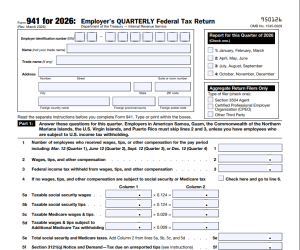
Form 940 covers unemployment taxes, due January 31. Deposits follow a lookback-based schedule: monthly depositors pay by the 15th of the next month, semiweekly depositors by Wednesday or Friday, depending on the pay period; missing a payroll tax deposit starts the failure-to-deposit penalty clock.
What Happens When Payroll Taxes Are Filed Late?
Late payroll tax filing triggers two separate penalty tracks at once: one for the missing return and one for the missing deposit. Both accrue independently and keep growing until resolved.
Failure-to-File Penalties
The IRS assesses a failure-to-file penalty of 5% of unpaid taxes per month on each late Form 941, capped at 25%.
A business catching up on four quarters at once faces four separate IRS 941 late filing penalty calculations, and the combined total adds up fast even after each cap is reached.
Failure-to-Pay Penalties
The failure-to-deposit penalty applies separately when payroll tax deposits are made late or deposited incorrectly. The rate escalates based on how late each deposit is:
| Days Past Deposit Deadline | Penalty Rate |
| 1 to 5 days late | 2% |
| 6 to 15 days late | 5% |
| 16 or more days late | 10% |
| More than 10 days after an IRS notice | 15% |
These penalties apply per deposit, not per quarter. A business running a weekly payroll can accumulate multiple deposit penalties within a single quarter.
Interest Charges and Additional Consequences
The IRS charges daily interest on unpaid payroll taxes and penalties at the federal short-term rate plus 3%. That rate peaked at 8% in 2024 and sits at 6% for the quarter beginning April 2026, resetting every quarter. Interest can’t be abated and keeps accruing until paid in full, and prolonged payroll tax debt can trigger a federal tax lien or bank account seizure.
Can Filing Overdue Payroll Taxes Trigger an IRS Audit?
Filing late, on its own, rarely triggers an audit. What actually raises risk is inaccurate or inconsistent data inside the returns, not the late arrival itself.
When the IRS May Review Late Filings More Closely
Filing multiple quarters of overdue Form 941 returns at once draws IRS attention, particularly when wage totals don’t align with prior-year W-2 filings, since the IRS cross-references Form 941 against Form 940 and each employee’s W-2.
Voluntary late filings typically move through normal processing. Proactive filing is far less likely to trigger an audit than waiting to be contacted by a Revenue Officer.
Common Red Flags That Increase Audit Exposure
Round-number or estimated figures are among the clearest payroll tax audit triggers, signaling returns weren’t pulled from actual payroll records.
Wages that don’t match W-2 totals create a discrepancy the IRS investigates, and missing deposit records, wage swings between quarters, and workers issued 1099s instead of W-2s round out the list.
Why Voluntary Compliance Often Helps Reduce Risk
The IRS distinguishes between taxpayers who come forward on their own and those who comply only after enforcement begins, and voluntary compliance supports IRS audit prevention even when years of returns are missing.
In our experience, the IRS typically processes multiple missing Form 941 quarters and issues a balance due notice without a formal examination, provided the returns are accurate and backed by real payroll tax documentation.
Step-by-Step Guide to Filing Overdue Payroll Taxes
Knowing how to file overdue payroll taxes correctly comes down to five steps: gather records, reconstruct what’s missing, file every return, catch up on Form 940, and fix past errors. Skipping a step usually invites IRS follow-up.
Gather Missing Payroll Records
Before preparing any missing Form 941, collect each quarter’s payroll registers: gross wages, withheld income tax, Social Security and Medicare taxes, and deposits made.
If formal payroll tax records no longer exist, bank statements, check registers, and payroll platform exports can often fill the gap.
Reconstruct Payroll Data if Necessary
When records are incomplete, reconstruct payroll data from bank deposits, pay stubs, 1099s, or general ledger entries; never use round-number estimates.
The IRS compares quarterly Form 941 totals against annual W-2 totals, so imprecise figures create mismatches that trigger inquiries.
Complete and File Missing Form 941 Returns
Each missing quarter requires its own Form 941, filed with the IRS processing center for your state. The IRS assesses penalties on each return independently, so filing order doesn’t change the total.
If circumstances prevented timely filing, attach a cover letter and documentation for a reasonable cause abatement request.
File Any Missing Form 940 Returns
Federal unemployment tax returns (Form 940) must be filed if missing.
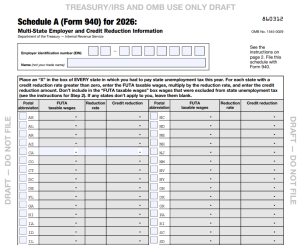
Form 940 reports FUTA tax on the first $7,000 of each employee’s wages annually, at an effective rate of 0.6% for most employers after the state unemployment tax credit applies.
Correct Errors Using Form 941-X
If previously filed Form 941 returns contained errors, wrong wage figures, missing employees, or miscalculated withholding, use Form 941-X to make payroll tax corrections for each affected quarter.
Corrections create either an additional balance due or a credit applied to the current account.
How to Reduce IRS Audit Risk During Late Filing
Accuracy is what keeps a late filing from turning into an audit. Every figure you report needs to trace back to an actual payroll record.
Report Accurate Wage and Tax Information
Every figure on Form 941 should match the underlying payroll data precisely for full payroll tax accuracy.
Confirm that wages reported each quarter, summed across all four, equal the annual W-2 total for the same employees. Any discrepancy generates an IRS notice, whether the return was filed on time or late.
Match Payroll Records With W-2 Filings
The IRS matches quarterly Form 941 wage totals against annual W-2 filings for the same employer ID. If the four quarters don’t sum to the W-2 total, the IRS sends an inquiry, so verify this reconciliation and keep payroll tax reporting consistent every quarter.
Avoid Estimated or Unsupported Figures
Precision matters on payroll tax returns. If records show $47,318 in wages, report $47,318 and not $47,000. Round numbers signal estimation rather than documentation and invite questions about whether actual records exist.
Options If You Cannot Pay Payroll Taxes in Full
Owing more than you can pay doesn’t disqualify you from resolution. The IRS offers an IRS payment plan, penalty relief, and, in limited cases, a reduced settlement.
IRS Installment Agreements
Businesses with unpaid payroll tax balances under $25,000 can apply for a streamlined in-business trust fund express installment agreement without full financial disclosure, with monthly payments over no more than 24 months.
Balances over $25,000 require Form 433-B documenting income, expenses, and assets.
Explore IRS payment solutions for businesses to review which installment agreement structure fits your balance and cash flow situation.
Penalty Abatement Opportunities
First-Time Penalty Abatement suits businesses with a clean three-year compliance history on the same form type. If returns and deposits were timely with no prior penalty history, FTA can eliminate late-filing penalties for the first affected period as a form of payroll tax penalty relief.
Reasonable cause abatement applies instead when non-compliance came from circumstances outside the business’s control, like a natural disaster or the loss of the employee who handled compliance.
Offer in Compromise Eligibility
In limited circumstances, a business or its owners may qualify for a payroll tax debt settlement, resolving the full balance for less than what’s owed through an Offer in Compromise.
OIC eligibility requires current compliance with all filings and deposits before the IRS accepts an application.
Learn how to handle unfiled tax returns first, since compliance is a prerequisite for every IRS resolution program.
Special Risks Associated With Payroll Tax Debt
IRS payroll tax debt carries consequences beyond the business itself. The trust fund portion can follow individual owners and officers personally, even after the company is gone.
Trust Fund Recovery Penalty (TFRP)
The Trust Fund Recovery Penalty is among the most serious consequences of payroll tax non-compliance.
Under IRC §6672, the IRS can assess the taxes directly against anyone responsible for collecting and paying them who willfully failed to do so.
The trust fund portion is the income tax withheld from employees’ pay plus the employee share of Social Security and Medicare taxes.
The TFRP is a personal liability separate from the business’s debt. It survives business closure, bankruptcy, and corporate dissolution, and the IRS can pursue a responsible person’s personal assets indefinitely after assessment.
Personal Liability for Business Owners
The IRS defines a “responsible person” broadly: owners, officers, partners, directors, check-signing employees, and anyone with control over payroll decisions can be personally assessed.
When multiple people qualify, each is jointly and severally liable, and the IRS pursues whichever responsible persons have assets through its IRS payroll tax collections process.
Collection Actions and Tax Levies
While a business stays non-compliant, the IRS can levy bank accounts, file a federal tax lien against business assets, and seize property through an administrative process requiring no court order.
A lien attaches to current and future assets, blocking credit access and interfering with contract work requiring lien-free status.
Best Practices for Maintaining Payroll Tax Compliance
Staying ahead of payroll tax compliance is far less expensive than catching up after the fact. A few structural habits prevent most of the problems we see.
Establish Reliable Payroll Procedures
A dedicated payroll tax account, kept separate from the operating account, prevents tax funds from mixing with general business cash.
Route withheld amounts into it after each payroll run and deposit on schedule directly from it. The single most reliable payroll tax management habit, and the safeguard against the fund misuse that starts most enforcement cases.
Monitor Federal Deposit Deadlines
Monthly depositors pay by the 15th of the following month; semiweekly depositors pay by Wednesday or Friday, depending on the pay period.
A missed deposit starts the escalating penalty clock at 2%, rising to 15% after an IRS notice.
Conduct Regular Payroll Reviews
A quarterly review comparing Form 941 liabilities against payroll records and deposit confirmations catches discrepancies before they compound. We recommend this review at least two weeks before each Form 941 due date.
When to Seek Professional Help for Overdue Payroll Taxes
Some situations call for professional help over a do-it-yourself approach. The line is usually drawn by how many quarters are missing and how large the balance has grown.
Multiple Years of Missing Payroll Returns
When a business has more than two years of missing Form 941 returns, filing without professional guidance raises the risk of errors between periods and unintentional TFRP exposure for individuals who may not realize they qualify as responsible persons.
Large Payroll Tax Balances Due
Balances exceeding $25,000 require full financial disclosure through Form 433-B for any installment agreement, and TFRP exposure across all responsible individuals needs careful analysis before any payment proposal goes to the IRS.
Receiving IRS Notices or Audit Letters
Once the IRS sends a notice, assigns a Revenue Officer, or issues a formal examination letter, the process moves on the IRS’s timeline.
This is where IRS audit help from a professional matters most, since missteps carry far more consequences than earlier on. Resolve overdue payroll tax issues today before enforcement begins.
How Salinger Tax Consultants Can Help Resolve Payroll Tax Issues
We provide payroll tax filing services and IRS payroll tax help built around getting businesses current without unnecessary exposure, starting with a full review of what’s missing and at risk.
Payroll Tax Filing Assistance
We prepare and file missing Form 941 and Form 940 returns using actual payroll data, reconstructing records where gaps exist.
Every return is cross-verified against available W-2 and deposit data before filing to prevent discrepancies that generate IRS follow-up.
IRS Notice Representation
When the IRS has already issued notices or assigned a Revenue Officer, we handle all communication directly.
This includes responding to information requests, presenting financial documentation, and negotiating on your behalf to protect the business and its owners from escalating enforcement.
Compliance and Penalty Resolution Strategies
After filing all missing returns, we evaluate penalty abatement eligibility, installment agreement structures, and TFRP exposure across every potentially responsible individual.
Get expert payroll tax filing assistance and speak with a payroll tax compliance specialist to review your complete compliance picture.
File Overdue Payroll Taxes Before Problems Escalate
Overdue payroll taxes carry mounting penalties, personal liability risk through the TFRP, and potential enforcement actions affecting both the business and its owners.
Knowing how to file overdue payroll taxes accurately before the IRS contacts you is the most important step a non-compliant business can take.
Voluntary compliance limits penalties, reduces audit exposure, and keeps every resolution option open.
If your business has missing filings or an outstanding balance, the right time to act is before the next IRS notice arrives. Schedule a confidential tax consultation with Salinger Tax Consultants to review your full situation.
FAQs
File a separate Form 941 for each missing quarter using actual payroll records, submit it to the IRS processing center for your state, and include documentation for any abatement request — that's how to file overdue payroll taxes correctly.
Voluntary late filings typically move through normal IRS processing without triggering a formal audit, but inconsistent wage figures or returns that do not match W-2 data will generate IRS follow-up inquiries.
The IRS charges 5% of unpaid taxes per month for each late Form 941, capped at 25% per return, with a separate failure-to-deposit penalty of 2–15% applied to each individual late deposit.
Yes — the IRS accepts multiple delinquent Form 941 returns together, and each is assessed penalties independently based on its own filing date and unpaid balance.
Businesses that cannot pay in full can apply for an installment agreement, streamlined for balances under $25,000, and must keep making required deposits on the current payroll throughout the resolution period.
First-Time Penalty Abatement can eliminate late-filing penalties for businesses with a clean prior-year history, and reasonable cause abatement applies when non-compliance came from circumstances beyond the business's control — both are forms of payroll tax penalty relief.
It is a personal liability assessment under IRC §6672 that holds responsible individuals accountable for the employee-side taxes withheld from wages but never remitted to the IRS.
The IRS has a 10-year statute of limitations to collect assessed payroll taxes; the TFRP carries its own 10-year collection period from the date it's assessed against each responsible individual.
For businesses with more than two missing quarters, balances over $25,000, or an active Revenue Officer already assigned, professional representation reduces the risk of filing errors and unintended TFRP exposure.
Maintain a separate bank account for payroll tax funds, follow your IRS-assigned deposit schedule without exception, and file Form 941 by each quarterly deadline regardless of whether full payment is available.

